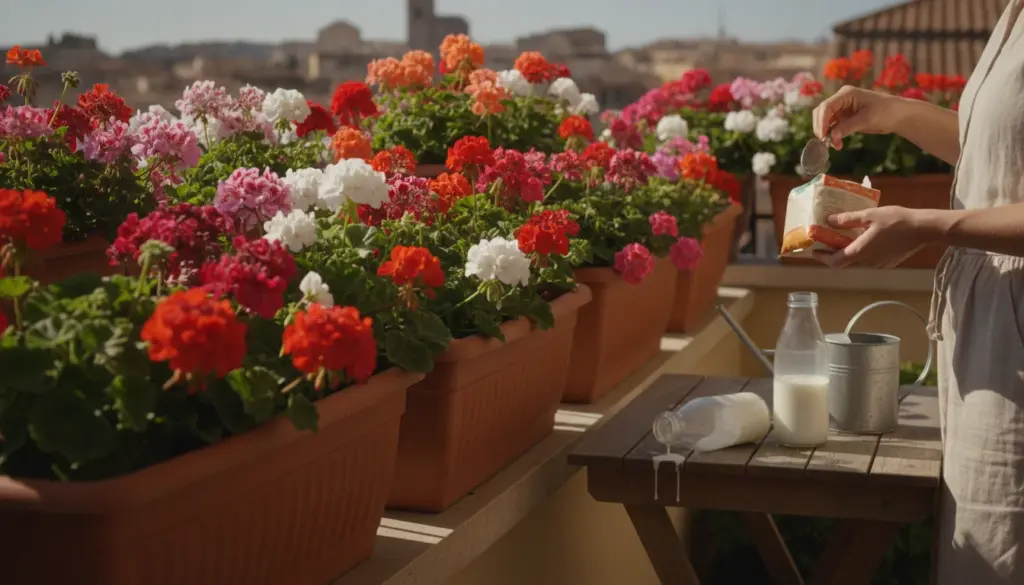
Forget well-meaning advice about pouring milk into your balcony planters. With a proper nutrient strategy, these blooming beauties will thrive beautifully without relying on kitchen scraps.
Even though they aren’t traditional bee magnets, these continuous bloomers are beloved for their incredibly easy-care nature. They delight even novice gardeners with their stunning variety of shapes and vibrant colors. Unlike many other delicate balcony favorites, these South African natives easily survive hot summers and blazing afternoon sun.
To help these plants reach their absolute peak potential, a targeted approach to nourishment is essential. Unfortunately, many gardening myths surround the fertilization process. Horticultural experts strongly warn against treating these flowers with supposed miracle solutions from the fridge.
Why Household Remedies Like Milk Often Fail
Online forums frequently suggest treating your potted flowers with everyday items like coffee grounds, crushed eggshells, or milk. Professionals heavily advise against this practice. Since these specific plants are heavy feeders, they demand a substantial and perfectly balanced concentration of nutrients that household remedies simply cannot provide.
Coffee grounds, for instance, do contain trace nutrients but will gradually acidify the potting soil. This creates a highly unfavorable environment for these sun-loving plants.
Using milk as a natural fertilizer introduces even more complications to your window boxes:
- While calcium is an essential plant nutrient, the excessive amount found in dairy shifts the soil’s pH level into a slightly alkaline state of 6.6. Ideally, the pH should remain in the slightly acidic range of 5.5 to 6.
- Dairy products add nutrients, but they also introduce fats and carbohydrates to the soil. These substances create a perfect breeding ground for destructive fungi and bacteria.
- Lactose and milk proteins actively encourage mold growth, fungus gnats, and harmful pathogens. As the saying goes, geraniums aren’t calves.
- Spoiling milk residues emit a strong, unpleasant odor and can easily trigger bacterial leaf spots.
- Preparing, measuring, and applying these DIY mixtures requires significantly more effort than using commercial products, yet yields far inferior results.
“Dairy products add nutrients, but they also introduce fats and carbohydrates into your window boxes. These substances create a perfect breeding ground for destructive fungi and bacteria.”
Proper Nourishment: Paying Attention to Nutrient Ratios
To ensure a magnificent, long-lasting floral display from spring right through autumn, sticking to traditional plant food is the best approach. A specialized blooming plant fertilizer delivers all the vital elements like nitrogen, phosphorus, potassium, and magnesium. This guarantees that your greenery receives exactly what it needs for vigorous growth and abundant budding.
The True Nutrient Profile of Milk
One liter of whole milk provides approximately 5.5 grams of nitrogen (N), 0.9 grams of phosphorus (P), 1.5 grams of potassium (K), and 0.1 grams of magnesium (Mg). Translated into standard fertilizer terminology, this equals a rounded NPKM ratio of roughly 6:2:2:0.2.
In stark contrast, the optimal ratio for these specific balcony flowers is 4:2:6:3. The mismatch is clear.
Liquid fertilizers are exceptionally convenient, as you simply mix them directly into your regular watering can. Applying this solution every one to two weeks during the peak growing season, between May and August, yields fantastic results.
If you prefer a lower-maintenance approach, mixing a slow-release granular fertilizer into the soil during planting is an excellent alternative. This method steadily releases nutrients over several months, ensuring a consistent baseline of nourishment throughout the entire season.
Dos and Don’ts for Maximum Blooming Power
Dos:
- Use traditional plant food: Always opt for a quality blooming plant fertilizer formulated for balcony flowers.
- Maintain a feeding schedule: Nourish your plants every one to two weeks with a liquid solution, or apply a slow-release option once at planting time.
- Seek out the sun: Ensure your planters are positioned in a brightly lit, sunny spot for maximum flower production.
Don’ts:
- Rely on kitchen scraps: Skip the unpredictable experiments involving coffee grounds, eggshells, or dairy.
- Allow waterlogging: Keep the soil consistently moist, but completely avoid stagnant water pooling in the saucers or decorative pots.
- Leave faded blooms: Routinely pinch off dead and dying flowers to stimulate the rapid production of fresh new buds.
The Bottom Line: While experimenting with household remedies might occasionally show mild results, it is highly unpredictable. More often than not, it fails to deliver the lush, vibrant blossoms that a well-balanced commercial product or fully matured compost would easily achieve.
For those who prefer to avoid synthetic options entirely, garden centers offer excellent organic and biological fertilizers that provide exactly the right balance without the messy side effects of kitchen waste.