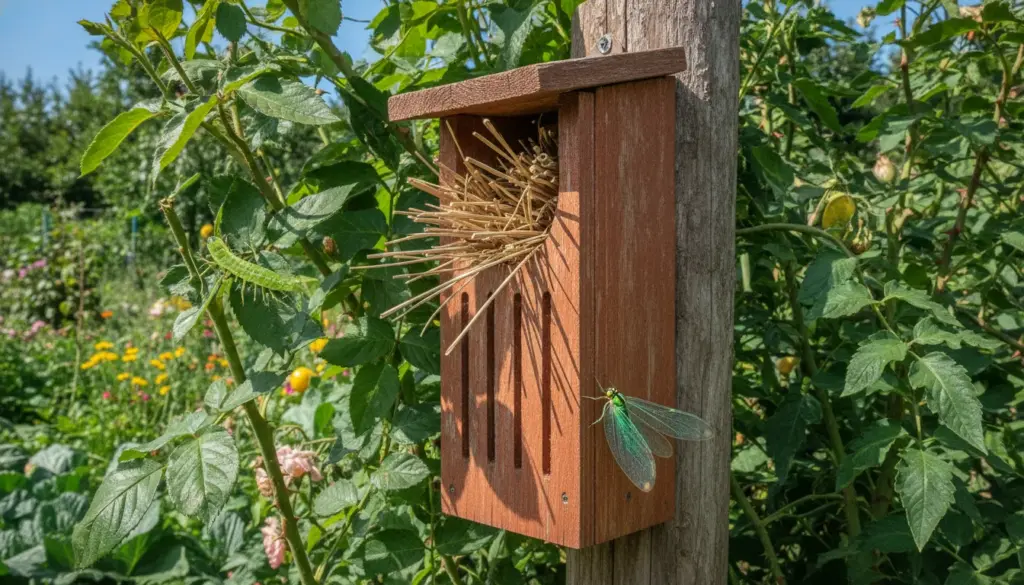
The Ultimate Natural Pest Controllers
Lacewings are undoubtedly some of the most valuable allies you can have in your backyard. During their early development phase, the larvae—frequently referred to as aphid lions—can devour up to 500 aphids. This massive appetite makes them a highly sought-after biological pest control solution for organic gardeners.
Eager to welcome these beneficial insects, many plant lovers rush to buy a dedicated lacewing house. Unfortunately, high hopes are often met with disappointment when the shelter remains completely empty. Understanding what actually makes a habitat functional is crucial if you want to successfully attract these delicate creatures.
Store-Bought Lacewing Boxes: Often Just Useless Toys
Starting in September, adult lacewings begin desperately searching for safe winter hideaways tucked inside tree crevices. Despite their best efforts, a massive portion of the population perishes during the freezing months. Providing a dedicated winter shelter drastically improves their survival rates.
However, those standard red-painted compartments found in commercial, multi-species insect hotels usually fail miserably. Entomologists often dismiss these miniature commercial slots as mere dollhouse furniture. The primary issue boils down to inadequate size. Scientific research indicates that lacewings require a shelter with a minimum edge length of 30 centimeters to actually move in. Standard bug hotels completely miss this mark, rendering their tiny compartments essentially useless.
Why Are Lacewing Houses Painted Red?
Insects perceive their environment uniquely, and vibrant shades of red or reddish-brown act as a powerful visual magnet for lacewings. Field observations consistently demonstrate that these beneficial bugs heavily favor red-painted boxes over unpainted wood or differently colored alternatives.
Common Design Failures in Standard Insect Hotels
Beyond the fatal size issue, most commercially available shelters suffer from a host of severe structural problems that actively deter beneficial garden bugs from settling down.
- Inferior materials: Manufacturers frequently cut corners by utilizing cheap, fibrous softwood. Rough, splintered drill holes pose a massive danger to fragile insect wings, making the habitat completely unlivable.
- Structural nightmares: Many popular designs feature drilled tubes that lead straight into a hollow void, leaving the insects entirely exposed. In other instances, the nesting holes are incredibly shallow, creating a fake sanctuary. Horizontally stuffed straws also render the quarters entirely useless.
- Food competition: All-in-one insect hotels create unnatural and competitive neighbor dynamics. Wild bees store valuable nectar and pollen inside their nesting tubes. Because hungry lacewings gladly consume these gathered resources, the bees ultimately lose out.
How to Properly House Your Garden Lacewings
If you genuinely want to provide a safe refuge, building a custom wooden box with the correct dimensions is by far the most effective approach. Once constructed, these winter shelters should be mounted outdoors right as September begins. Unlike traditional birdhouses, this specific type of insect sanctuary requires absolutely zero cleaning and can safely remain outside all year long.
Location is just as important as the architectural design itself. Install your handcrafted box at a height of 1.5 to 2 meters above the ground. Because lacewings are rather clumsy flyers, they desperately need a calm, wind-protected environment. Ensure the front entrance faces away from the prevailing wind direction and remains well-sheltered from heavy rain.
The Secret to a Naturally Balanced Garden
While artificial habitats provide a fantastic boost, cultivating a near-natural garden is the ultimate way to support a thriving insect ecosystem. The biological reality is remarkably straightforward: to attract predatory allies like lacewings and ladybugs, you first need an active aphid population.
Instead of panicking at the first sign of pests, try to tolerate a few aphids on your prized plants. By strictly avoiding chemical insecticides, you allow nature’s complex food web to function exactly as intended. The natural predators will soon arrive, settling in and resolving your infestation problems entirely on their own.