Do you feel like you are sitting on a display stage every time you step outside? Finding peace on a balcony can be quite challenging when neighbors and pedestrians have a direct line of sight. Instead of quietly sipping your morning coffee, you end up exchanging awkward nods with the person across the street. Fortunately, establishing a cozy outdoor oasis is completely achievable. By choosing the right privacy solutions, your balcony will finally transform into the peaceful retreat it was meant to be. The best approach depends largely on your specific space and setup.
Front Protection: Blocking Views from the Street and Below
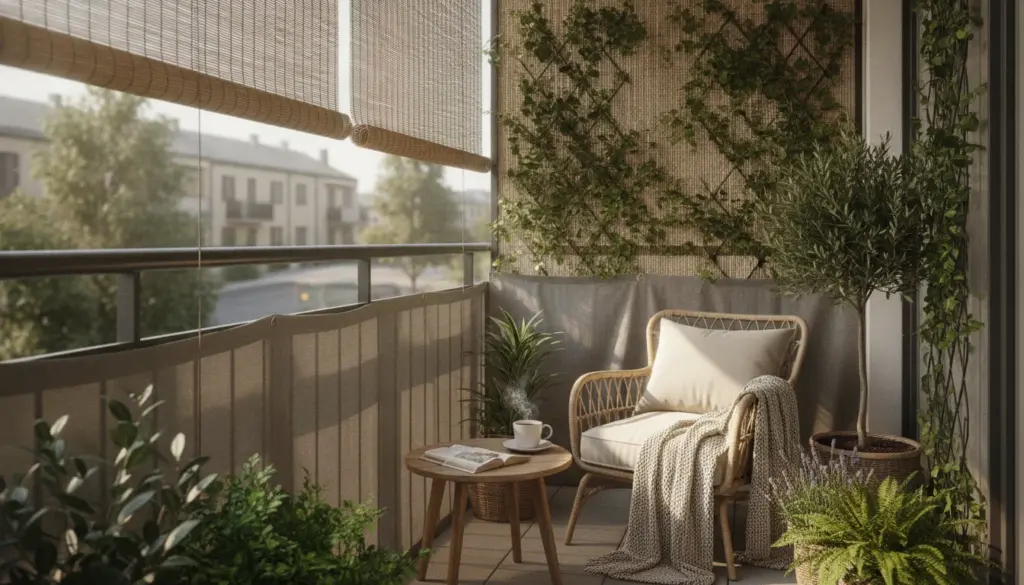
Whether dealing with a bustling street or curious ground-floor neighbors, feeling exposed from the front makes relaxation nearly impossible. The most straightforward defense mechanism is a weatherproof fabric balcony cover. These typically come equipped with metal eyelets, allowing you to quickly secure them to the railing using cords or zip ties. Choosing a UV-resistant and durable material is crucial here. Otherwise, the fabric will quickly fade and look unappealing after just a few sunny months.
If you prefer a more organic aesthetic, privacy mats made of bamboo, reed, or willow are excellent alternatives. They can also be effortlessly attached with sturdy ties. To ensure these natural screens last a long time, make sure they never touch the ground directly. Continuous moisture contact will inevitably cause the bottom edges to rot.
Both of these options are incredibly tenant-friendly since they require absolutely no drilling and leave zero residue behind upon moving out.
Side Protection: Shielding Against Neighboring Balconies
In many apartment complexes, balconies are constructed side-by-side, offering full visibility into your neighbor’s outdoor living room. Thankfully, there are numerous creative ways to block out these lateral views.
- Folding screens (Paravents): This is a rapid, renter-friendly fix that demands no drilling. However, they struggle in strong winds and require additional securing.
- Solid privacy walls (Wood, WPC, or Plastic): Extremely sturdy and completely opaque. Depending on the material, they are highly low-maintenance, though wooden panels need regular care. Keep in mind that permanent mounting usually requires landlord permission.
- Side awnings: Incredibly stylish and space-saving, making them perfect for compact areas. As with solid walls, installation typically mandates official consent.
- Trellises with climbing plants: Visually stunning and easily fastened to the railing using pipe clamps. They are perfect for renters but offer minimal coverage during the bare winter months.
Privacy Screens in Rented Apartments – What Is Permitted?
As a general rule of thumb, anything that can be removed without leaving traces is perfectly fine. Potted greenery and tied-on fabrics rarely require any official blessing. However, the moment you need to use dowels or screws—such as for awnings or rigid wooden partitions—you must obtain written consent from your landlord. If you ever find yourself doubting whether a specific installation is allowed, a quick conversation with property management can save you from massive headaches when your lease ends.
Overhead Protection: Blocking Views from Above
Living in a multi-story building often comes with a unique challenge: the balcony directly above has a clear view straight down onto yours. To counter this, you need a horizontal barrier that acts almost like a fabric roof.
The most adaptable and renter-friendly approach is investing in a parasol with a tilt joint. It angles easily, sets up in seconds, and completely avoids power tools. On the downside, the coverage area is quite localized, and heavy wind gusts will test the limits of even the strongest umbrella.
A shade sail with cable tensioning stays firmly in place while covering a much broader surface. It does require anchor points on walls, railings, or freestanding posts, which frequently means drilling is necessary. As an added bonus, this taut fabric acts as exceptional sun protection for your delicate potted foliage.
For ultimate comfort, retractable awnings remain unmatched. A simple push of a button glides them out, offering reliable shelter regardless of the weather. The major catch is their hefty price tag, coupled with the strict requirement for permanent facade mounting.
What is the Best Privacy Screen for a Small Balcony?
When dealing with highly restricted spaces, every single inch matters. The most effective solutions are those that consume absolutely zero floor area. Fabric covers and natural mats affixed directly to the railing block frontal sights without eating into your valuable square footage. Planters filled with tall grasses or vertical trellises encourage growth upwards rather than expanding outward. Retractable side awnings can be pulled out precisely when needed and tucked away neatly afterward. The ultimate golden rule here is to always build upward rather than outward.
Living Privacy Screens: The Most Beautiful Solution
Crafting a lush wall of foliage is arguably the most atmospheric way to reclaim your personal space. Not only does the vibrant greenery shield you from prying eyes, but it also casts cooling shade and brings a touch of vacation magic to any urban setting.
- Climbing plants trained up a trellis are absolute classics, and there is a perfect variety for every sun exposure. Ivy thrives beautifully on north-facing balconies. Clematis and jasmine prefer sunny to partially shaded spots, rewarding you with stunning blooms and intoxicating scents. Virginia creeper adores full sun, grows aggressively, and bursts into brilliant red hues come autumn. For an edible twist, try guiding tomatoes or pole beans up your grid. The only drawback is the patience required while the green wall establishes itself.
- Potted bamboo or tall ornamental grasses are brilliant container choices. Arranging several dense pots closely together instantly diminishes visibility from the outside.
- Raised garden beds serve as fantastic visual barriers on more spacious balconies, bringing both practicality and structural beauty to your outdoor sanctuary.
There is just one minor catch: when winter arrives, deciduous varieties drop their leaves, subsequently dropping their protective cover. To maintain a private retreat all year long, strategically pairing lush greenery with a permanent solid screen in the background is the ultimate winning combination.