Every passionate gardener fears the moment when a heavily laden tomato stem suddenly snaps under its own weight. After dedicating weeks of careful nurturing, losing a promising harvest to a broken shoot is incredibly frustrating. To prevent this familiar garden tragedy, your plants require a gentle yet robust support system. Fortunately, creating a highly effective and plant-friendly tie-up structure requires nothing more than a few common household items.
Choosing the Right Support Material
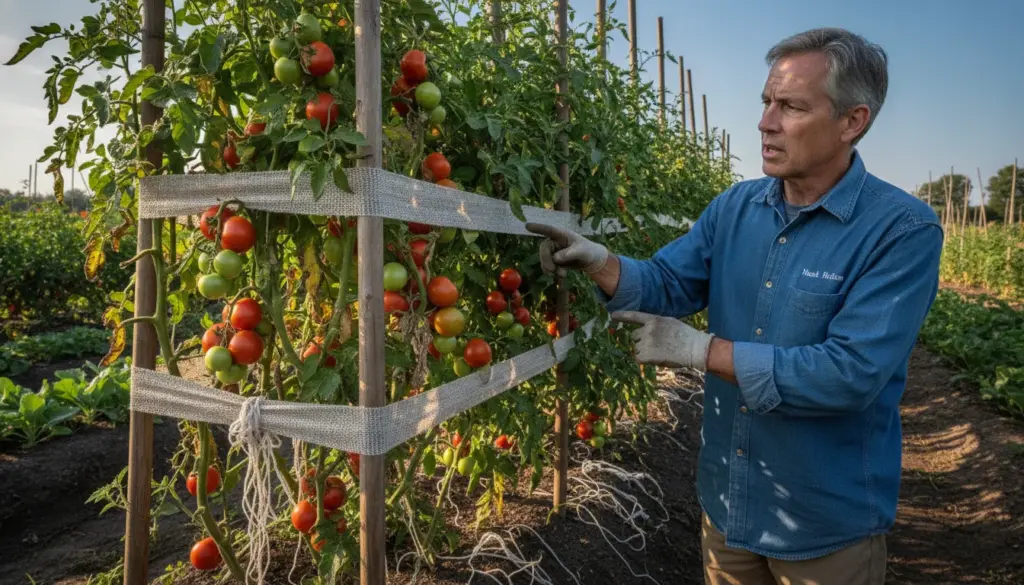
Selecting inappropriate tying supplies often causes more harm than good for growing crops. Mark Hutton, a vegetable cultivation specialist, strongly advises against reaching for standard hard twine. Any tough cord that could eventually slice into the delicate green tissue over time should be strictly avoided. Instead, the seasoned horticulturalist suggests opting for forgiving, elastic alternatives. Repurposed fabric strips sliced from worn-out shirts work wonderfully, as do discarded nylon stockings, which offer the added benefit of being rot-resistant.
The Figure-Eight Technique for Tying Tomatoes
A widely utilized and incredibly straightforward approach is the single-stake technique combined with a figure-eight knot. This specific arrangement prevents the fabric from slipping down the pole or causing damaging friction against the stalk. It also happens to be a fantastic way to prop up heavy ornamental perennials in the flower bed.
How to create the perfect plant support:
- Prepare your supplies: Drive a sturdy wooden or metal pole into the soil near the roots. Cut a piece of old clothing or hosiery into strips roughly one inch wide and long enough to wrap around the support.
- Wrap the stem: Gently guide the fabric piece around the back of the tomato’s main vertical shoot.
- Create the loop: Cross the two loose ends right in front of the green stalk. This forms a relaxed loop around the plant, crossing in the middle exactly like the number eight.
- Secure to the pole: Pull both ends backward toward the anchoring stake and knot them securely. The goal is a snug fit against the wood, without pulling the actual plant tissue too tightly.
As the season progresses and the central stalk expands in girth, it remains essential to inspect these bindings periodically. Simply loosen the fabric slightly if it begins to look overly tight.
Best Tomato Varieties for the Single-Stake Method
This individual pole strategy excels when applied to tall, indeterminate varieties, particularly heavy beefsteak types. Conversely, the tying process becomes overly tedious for sprawling wild or cherry varieties, and it proves entirely ineffective for compact bush tomatoes. While this approach is a fantastic choice for a small backyard plot, managing dozens of plants might require more scalable setups like the Florida weave or an overhead string trellis system.
About the Agricultural Expert
Mark Hutton serves as a dedicated vegetable cultivation professor at the University of Maine. His extensive academic research revolves around organic farming practices, evaluating companion planting strategies, and maximizing crop yields within high tunnels. His professional insights regularly benefit commercial growers and home gardening enthusiasts alike.
Essential Pruning and Foliage Care
Properly securing the stems is just one piece of the puzzle for a bountiful harvest. Channeling the plant’s energy directly into the primary shoot involves routinely pinching off the suckers. Allowing these small lateral offshoots to mature in the leaf axils typically results in a much lower quality yield.
Furthermore, maintaining an abundant canopy is vital for protecting the developing fruits. The dense foliage acts as a natural shield, preventing severe sunburn on the ripening tomatoes. Pruning should be limited to the very bottom leaves, and only after the lowest clusters of fruit have been fully harvested, which helps increase essential air circulation near the soil.
Gardeners Praise the Simplified Tying Trick
The sheer effectiveness of this technique has generated an overwhelmingly positive response from the online gardening community. Viewers of the instructional demonstration frequently describe it as the most helpful tutorial available for cultivating these popular fruits.
Many enthusiasts appreciate the concise, to-the-point explanation, noting it was exactly the practical solution they needed. Several backyard growers even declared this figure-eight strategy their absolute favorite, openly preferring it over traditional basket-weave methods.