
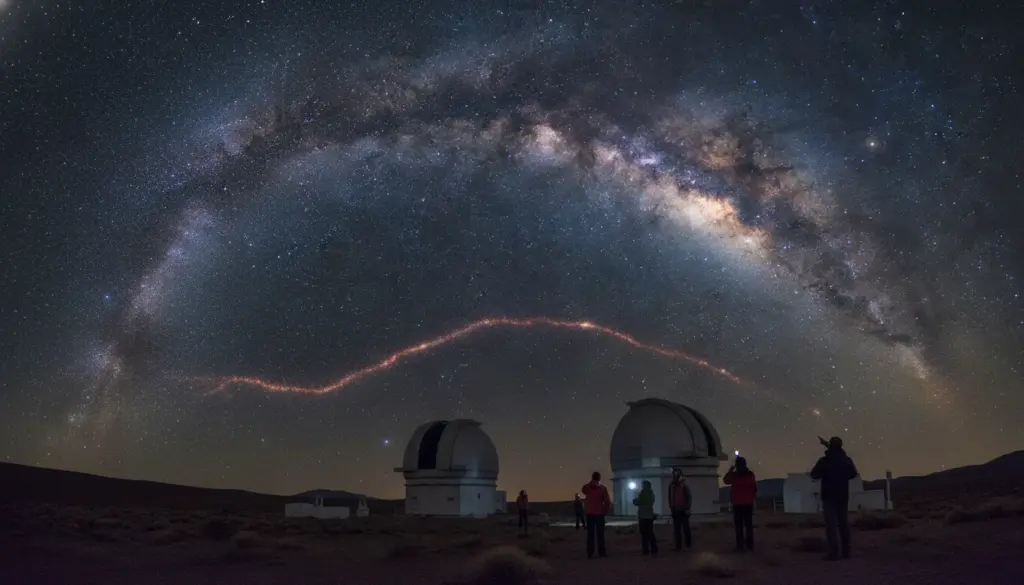
An Ancient Fossil From the Early Cosmos
Known to the astronomical community as C-19, this faint ribbon of stars represents the most metal-poor stellar stream ever detected within our Milky Way. Analyzing this celestial structure offers a remarkable window into the very first galactic building blocks, alongside subtle clues about the invisible forces of dark matter.
A vast halo of sparse stars, gas clouds, and dark matter envelopes our galaxy. Within this expansive region drift the torn remnants of ancient dwarf galaxies and star clusters, which we call stellar streams. While our galaxy hosts several of these structures, C-19 stands out as a truly extreme outlier.
Positioned approximately 58,700 light-years away from Earth, this cosmic ribbon stretches more than 650 light-years in length. If human eyes could see it completely, it would form a massive arc covering over 100 degrees across our sky. Instead, it remains hidden due to its incredibly faint and thinly scattered stellar population.
What truly sets C-19 apart is its staggering lack of “metals”—a term astrophysicists use to describe any element heavier than helium or hydrogen. The stars within this grouping possess a metallicity dropping below -3.0 dex. Put simply, they contain less than one-thousandth of the heavy elements found in our own Sun.
With a total mass hovering between 40,000 and 50,000 solar masses, this primitive population shares the physical weight of a medium-sized globular cluster. Yet, intriguingly, the internal dynamics behave much more like a miniature galaxy.
Mapping the Sky With Modern Spectroscopic Tech
This discovery was made possible by the Dark Energy Spectroscopic Instrument (DESI), an advanced observation system mounted on the 4-meter Mayall telescope at the Kitt Peak National Observatory in the United States. Capable of capturing thousands of stellar spectra simultaneously, this equipment represents a massive leap in observational capability.
By analyzing these precise light signatures, researchers can determine several crucial stellar characteristics:
- The exact radial velocity, showing how fast a star moves toward or away from us
- The specific chemical makeup and heavy element concentration
- The true intrinsic brightness and accurate distance from our solar system
After gathering data on over 10 million individual stars, researchers sifted through the massive catalog looking for distinct groups sharing similar chemical fingerprints and movement patterns. C-19 emerged from the background noise as a delicate string of ultra-primitive objects. Using sophisticated mixture models, specialists successfully isolated these specific stars from the general halo population based entirely on their unique trajectory and chemical composition.
Unexpected Chaos and a Strange Parallel Track
One particularly striking detail is the stream’s relatively wide velocity dispersion, clocking in at roughly 7.8 kilometers per second. This means the individual components inside C-19 are drifting quite chaotically relative to one another. Such disorganized movement strongly contrasts with the behavior of a standard globular cluster stream, which typically remains incredibly orderly and “cold” as it moves through space.
Adding to the mystery, observational data reveals a curious parallel offshoot alongside the primary structure. Running roughly 1,000 light-years parallel to the main body, this secondary track extends for about 3,000 light-years through the cosmic void.
While clearly belonging to the same stellar family, the stars in this fragmented branch follow an entirely different orbital path. This peculiar separation strongly suggests that the formation experienced a significant gravitational disruption in the distant past. Whether it was violently nudged by a massive gas cloud, a passing galaxy, or an invisible clump of dark matter remains a subject of intense academic study.
Debating the Origins: Cluster or Galaxy?
Astrophysicists are currently wrestling with a fundamental question regarding the stream’s true origin. The primary debate centers on whether this structure started as an ancient globular cluster or a tiny dwarf galaxy before being stretched across the heavens.
The incredibly pristine, metal-poor nature of the stars leans heavily toward the globular cluster hypothesis. Formations like this likely materialized shortly after the Big Bang, pulling together from primordial gas before massive explosions could seed the universe with heavier materials.
Conversely, the high velocity dispersion and that mysterious parallel branch point toward a different origin story. These structural complexities resemble the distinct signature of a disrupted dwarf galaxy, which would naturally harbor its own dark matter and exhibit more complicated internal dynamics. Future telescopic surveys aim to uncover even fainter, more distant family members to definitively settle this ongoing cosmic debate.
Probing the Invisible Halo of Dark Matter
Beyond their impressive age, stellar streams serve as highly sensitive instruments for measuring gravitational forces within the galactic outer limits. Because their delicate formations react dramatically to gravitational shifts, they operate as a natural probe for mapping unseen mass.
When a fragile ribbon of stars grazes a dense pocket of dark matter, the encounter leaves lasting scars, such as visible kinks, gaping holes, or separated parallel tracks. By meticulously plotting the exact geometry and kinematics of these stars, researchers can determine whether the surrounding invisible halo is smooth or filled with dense, unseen hurdles.
In many ways, C-19 acts as a cosmic seismograph. Its current shape preserves the impact of ancient gravitational shocks experienced during our galaxy’s turbulent youth. By combining historical trajectories mapped by the Gaia satellite with precise DESI measurements, experts hope to eventually rewind the clock and identify the exact collisions that distorted this ancient structure.
Reading the Chemical Records of the Early Universe
While a lack of heavy elements might sound rather ordinary, it represents an absolute goldmine for cosmologists. A metal-poor classification indicates these stellar bodies ignited back when the universe was nearly entirely untouched by previous life cycles of cosmic evolution.
The universe’s earliest massive stars ended their brief lives in spectacular supernova explosions, actively seeding the surrounding cosmos with newly forged elements like oxygen, silicon, iron, and carbon. Only after this widespread chemical enrichment could rocky planets eventually take shape.
Because the population within C-19 formed before this enrichment process gained momentum, they remain chemically pristine. Their specific elemental makeup effectively preserves the chemical fingerprint of perhaps just a single generation of the universe’s very first stellar detonations. By measuring these exact elemental ratios, scientists can piece together how massive those initial pioneer stars truly were.
Future Observations and Data-Driven Astronomy
The initial findings represent just the first steps in decoding this celestial enigma. Over the next several years, powerful observatories will inevitably focus their lenses directly on C-19 to capture high-resolution spectra of its individual members. This upcoming data will reveal whether the entire formation sprang from a single uniform gas cloud or if a more complex mixing process was involved.
This discovery perfectly illustrates the shifting landscape of modern astronomical methodology. Rather than relying on a single lucky photograph, this breakthrough required sophisticated statistical modeling and the meticulous parsing of millions of distinct data points. Modern astrophysics increasingly relies on recognizing subtle patterns hidden within massive digital archives.
While amateur stargazers won’t be able to spot this impossibly faint structure with backyard equipment, the analytical techniques pioneered here are already influencing other areas of research. As investigators continue studying this cosmic fossil, it provides a vital reference point for understanding how massive galaxies systematically assembled themselves from much smaller, fragile building blocks billions of years ago.