
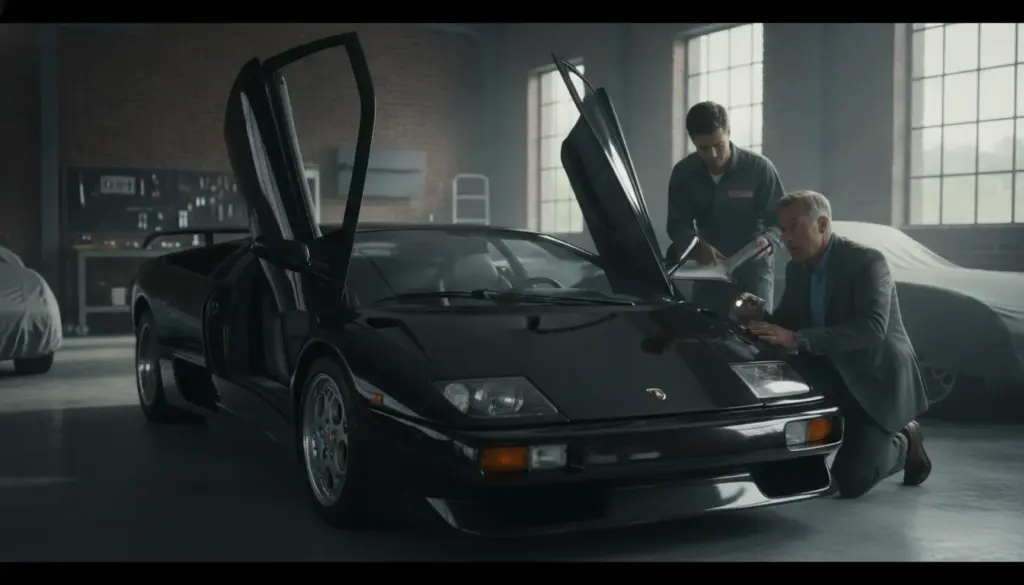
A Hidden Masterpiece in Plain Sight
What initially appeared to be a standard exotic vehicle transaction morphed into a fascinating journey of automotive archaeology, missed opportunities, and ultimate redemption. It wasn’t until the supercar was sitting in a different collector’s garage that its true historical magnitude became entirely apparent.
A Black V12 Hiding Motorsport Secrets
On the surface, this was merely a black Lamborghini Diablo VT featuring a subtle grey cabin. While highly desirable as a modern classic, nothing immediately screamed “motorsport legend.” However, a few peculiar physical traits quickly caught the attention of its caretakers.
- Non-standard ventilation ducts integrated into the hood
- A highly unusual roof scoop designed for aggressive air intake
- Residual mounting brackets scattered throughout the cabin
- Service documentation that failed to align with a factory-spec VT
These minor structural anomalies felt out of place, yet they didn’t immediately paint a cohesive picture. The Italian exotic handled beautifully, possessed incredible street presence, and served perfectly well as an extraordinary weekend driver.
Connecting the IndyCar Pace Car Dots
The true breakthrough occurred when vintage photographs from the 1990s American IndyCar championship surfaced. During that era, race organizers utilized highly modified, flamboyantly styled pace cars. Hidden within the archival footage was a black Lamborghini Diablo, heavily adorned with sponsor decals, structural roll cages, and noticeably altered bodywork.
By meticulously cross-referencing these historical images with their physical vehicle, the owners spotted undeniable matches. The precise curvature of the air intakes, distinct microscopic flaws in the fiberglass, and highly specific chassis holes aligned perfectly. A thrilling realization began to dawn: their quiet street car was once an official IndyCar pace vehicle.
It became evident that this wasn’t just a repurposed track car, but a highly specialized factory creation engineered specifically for high-speed exhibition duties.
Decoding the Roof Scoop and the Missing Yota Package
The most glaring clue remained the roof-mounted air intake, an element completely foreign to a standard Diablo VT. The mystery unraveled after consulting a former Lamborghini factory technician and reviewing period-correct video footage.
This specific chassis originally housed an exceptionally elusive factory upgrade known as the Yota package. Historically reserved for the limited-edition Diablo SE30 anniversary model, this extreme engine and aerodynamic kit was fitted to ensure the pace car had the essential horsepower, high-speed stability, and thermal management required for track duties.
Disaster struck during a high-profile event at Laguna Seca when the powertrain suffered a catastrophic failure. The exclusive Yota components were subsequently stripped, and the repaired vehicle was quietly exported to Europe as a standard road car. The whereabouts of this priceless kit remained a mystery for decades, until an independent collector unexpectedly revealed he had preserved the dismantled components.
Resurrecting a Motorsport Ghost
Recognizing the historical importance, the owners managed to acquire the surviving Yota parts from the collector. This acquisition presented a phenomenal opportunity to return the vehicle to its former IndyCar glory. A painstaking, period-correct restoration commenced:
- Reinstallation of the aggressive, track-focused aerodynamic enhancements
- Precision recalibration of the suspension geometry
- Full interior reconstruction, including heavy-duty harnesses and a structural roll cage
- Mechanical overhauls to push the V12 output back toward its original pacing specifications
Through this meticulous process, the Italian exotic transformed from a mere rare collectible into a rolling museum piece with a fiercely reclaimed identity.
Sant’Agata Confirms a 1-of-1 Masterpiece
Absolute validation arrived when Lamborghini Polo Storico, the manufacturer’s dedicated heritage division, audited the vehicle’s provenance. Deep within the corporate archives, specialists uncovered production records that firmly cemented the car’s legendary status.
Records indicated this exact chassis was destined for the United States as an all-wheel-drive VT, yet it was deliberately intercepted on the assembly line to receive the extreme Yota treatment. This bespoke configuration makes it the only Diablo in existence to blend a VT drivetrain with Yota performance engineering, custom-built for high-speed pacing and promotional displays.
Beyond the mechanical upgrades, the factory originally installed specialized bumpers, safety restraints, and roll protection tailored for demanding motorsport weekends. This documentation elevated the vehicle from a fascinating anomaly to an undisputed, fully authenticated one-off prototype.
The Sale and the Sinking Feeling of Regret
Despite having unearthed this incredible automotive treasure, the caretaking duo made the shocking decision to part ways with it. They transferred ownership to a dedicated Diablo aficionado, rationalizing that the priceless machine would be meticulously preserved by a true brand expert.
However, the sheer gravity of that transaction soon took a heavy emotional toll. They hadn’t merely liquidated a supercar; they had relinquished a singularly unique artifact of Lamborghini’s motorsport lineage. The factory certifications, the vintage photography, and the miraculously recovered Yota kit formed an automotive fairy tale that collectors dream of.
Initial doubt rapidly metastasized into profound seller’s remorse. The haunting thought of the vehicle being exported overseas or locked away forever in an impenetrable private vault became increasingly difficult to bear.
A Miraculous Second Chance
Out of nowhere, incredible news broke. The specialist collector was restructuring his portfolio and hinted at letting the legendary prototype go. For the original owners, there was zero hesitation—they simply had to bring it home.
They aggressively repurchased the one-off masterpiece, cementing a vow to never let it slip away again. Today, the legendary pace car doesn’t just sit statically in a climate-controlled garage. The owners actively campaign it at prestigious concours events, educate enthusiasts about its motorsport pedigree, and showcase the microscopic details that make it a unicorn.
Even Lamborghini’s top brass recognizes its monumental significance. The vehicle was formally invited to the brand’s lavish 60th-anniversary celebration in Italy, sharing the lawn with the manufacturer’s most sacred prototypes and victorious race cars.
How Provenance Skyrockets Supercar Valuations
This incredible saga highlights why rigorous historical documentation is paramount in the modern classic car market. Two visually identical vehicles can command vastly different valuations based entirely on their lineage. A verified motorsport pace car featuring a one-off factory racing package occupies a completely different financial stratosphere compared to a standard street iteration.
Serious investors look beyond displacement and top speed; they buy into the vehicle’s narrative. A machine boasting tangible track pedigree, backed by period photography and official factory homologation papers, commands absolute authority at global auctions and elite gatherings.
Crucial Lessons for Classic Car Enthusiasts
The journey of this black exotic serves as a masterclass in automotive forensics. Minor physical discrepancies—whether an unexplained chassis hole or an odd body panel—can occasionally point to a much richer, undiscovered lineage.
For those hunting for high-end modern classics, adopting a systematic approach can uncover hidden gems and prevent costly mistakes:
- Always run identifying chassis numbers through official heritage departments or established brand registries
- Scour vintage periodicals, digital archives, and historic racing forums for period imagery
- Carefully log any non-factory components and aggressively research their origin
- Track down previous caretakers and mechanics who historically serviced the exact chassis
Elite manufacturers offer premium heritage services that can officially authenticate a vehicle’s birth record. Securing these certificates not only drastically inflates market value but ensures a historically significant chassis isn’t unknowingly subjected to improper modifications.
Ultimately, the apex of car collecting is securing a vehicle with an unbelievable, verifiable story. A forgotten raceway pace car, resurrected from obscurity and fiercely protected by its devoted owners, perfectly encapsulates that ultimate automotive dream. And that is exactly why this particular vehicle will never be sold again.