He was the ultimate hard worker, always stepping up for others, and widely viewed as the perfect partner, colleague, and father. Yet, upon reaching the age of 74, a profound realization hit him. For decades, he had completely mistaken constant busyness and external validation for a fundamental human experience he barely understood: pure, unconditional joy.
Always useful, but rarely joyful
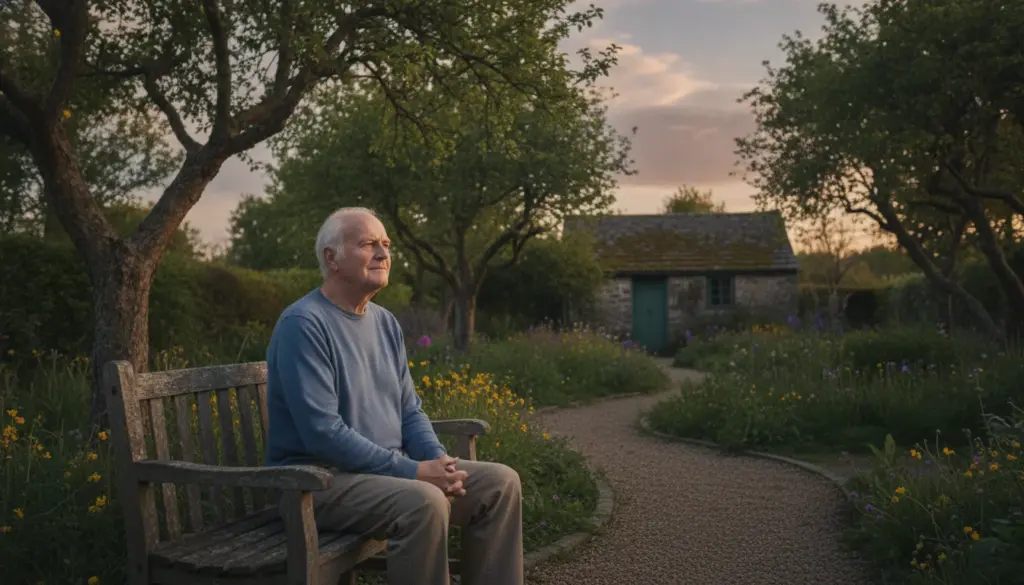
Nowadays, his daily routine is refreshingly quiet. Sitting on an aged wooden bench in his modest garden, surrounded by a few trees, he watches the evening sky turn a soft orange. It is in these still moments that the truth sinks in. He struggles to recall a single instance where he felt profound gladness without a specific reason, a looming task, or a heavy responsibility.
Looking back, his existence reads more like a polished resume than a lived experience. He was relentlessly active, frequently deemed indispensable, and highly respected by his peers. However, a hollow sensation emerges whenever he asks himself a direct question. When did he last experience authentic delight that wasn’t tied to crossing off a to-do list or receiving a polite thank-you?
For the better part of his life, he walked in shoes that were entirely the wrong size. He is only noticing the blisters now that he has finally taken them off.
This isn’t a complaint or a bitter lament. Rather, his reflection resembles the feeling of a theater worker turning on the house lights long after the final applause has faded, suddenly noticing the empty auditorium.
Using career success as proof of worth
Over a span of thirty years, he steadily climbed the corporate ladder. Starting as a regular employee, he eventually transformed into a senior manager overseeing multiple departments. With every promotion, he received the validation he craved, proving to himself that he genuinely mattered. Endless meetings, consistent overtime, and bringing files home all served as badges of his unwavering loyalty and dedication.
Yet, he never paused to ask himself a crucial question. Did he actually desire this demanding lifestyle, or had he simply made himself so central to every process that nobody could function without him? Being perpetually busy morphed into his core identity. Consequently, taking a break felt almost suspicious, as if resting meant he was failing as a human being.
This relentless drive mirrored itself at home. Between managing deadlines and reading reports, he organized his kids’ school events, drove them to sports and music lessons, prepared dinner, and mentally planned out the following morning. Nobody demanded this extreme level of involvement; he just executed it on autopilot.
During his mid-forties, he once collapsed into an exhausted sleep with a pen and notepad resting on his lap. His wife gently woke him and asked a very straightforward question. When was the last time he did something purely for himself, without any productive purpose? He drew a complete blank.
Interesting daily reads:
- A clever kitchen trick prevents woody asparagus without using a knife.
- What will change for your wallet on January 1, 2026.
- Burglars strike most frequently on this specific day: how to protect your home.
- Plant pots are disappearing: this will be the major balcony trend of 2026.
- Why your life might feel empty even when everything seemingly looks perfect.
- A new regional electric aircraft consumes 11 times less energy.
- When to plant potatoes to guarantee a basket full of harvest.
- How grandparents and grandchildren can keep their immunity strong during cold season.
The hidden danger of needing to be indispensable
Growing up as the eldest of five siblings, he learned early on that offering help was the quickest way to be noticed. When his father walked out, the twelve-year-old boy organically assumed adult duties. He made sandwiches, supervised homework, offered comfort, and resolved conflicts. From that pivotal moment, his self-worth became permanently tethered to what he could provide for others.
Over time, he developed a highly sensitive radar for anticipating people’s needs. He would jump in to fix a situation long before anyone even voiced a request. While this proactive approach granted him a comforting sense of control and purpose, it came with a steep psychological cost. He only felt valuable when he was actively solving problems.
This deep-rooted behavioral pattern infiltrated every aspect of his adult life:
- In the workplace: He was always the last to leave, willingly took on extra assignments, and constantly salvaged derailed projects.
- Within his marriage: He dominated the family calendar, managed all financial matters, and made practical choices, often bypassing shared discussions.
- As a parent: He acted as the designated driver, sports coach, event planner, and emergency contact for neighboring parents.
Everyone thought he was absolutely fantastic. Neighbors, relatives, and colleagues all leaned heavily on his capabilities. Tragically, he mistook their palpable relief and gratitude for his own personal fulfillment. Whenever someone else breathed a sigh of relief, his brain registered it as happiness.
Why external praise never fills the void
Even today, he openly admits that receiving recognition feels wonderful. A sincere thank-you, a quick compliment, or a pat on the back delivers a pleasant, fleeting rush of dopamine. Unfortunately, that satisfying sensation never lingers. Relying on praise is like eating candy for dinner; it provides a brief sugar high, but leaves you fundamentally undernourished and empty.
To sustain those brief highs, he began running on an ever-accelerating treadmill. He volunteered for additional committees, spearheaded new initiatives, and joined charity drives. He was consistently the first person to stand up and the absolute last to decline a request.
His wife once made a dark joke that his tombstone would simply read: “He took care of it.” They shared a laugh at the time, but looking back, he realizes she had pinpointed a painful truth. His entire existence revolved around managing, fixing, and carrying burdens. It never centered around actually enjoying the ride.
As behavioral experts often note, you can be deeply appreciated by everyone in your social circle, yet feel entirely hollow when looking in the mirror.
The invisible costs of never hitting pause
Constantly rushing through life depletes far more than just your physical energy. It also steals away precious, irreplaceable moments that you can never get back. Today, he can still effortlessly list the massive corporate projects he successfully finalized. He remembers exactly which financial targets he hit and which company reorganizations he kept afloat.
However, his memory fails him completely when he tries to recall the intimate, personal details. What was his son’s absolute favorite book at age ten? He has no clue. When was the last time he laughed so intensely that his stomach ached? The memory simply doesn’t exist.
A while ago, he started volunteering for a local organization that helps adults improve their literacy skills. During a session, a woman around his age confessed that she had faked her ability to read for decades out of pure shame. Now, she was finally brave enough to ask for guidance.
She had spent years pretending she could decipher words on a page. Similarly, he had spent decades pretending that frantic busyness was the exact same thing as emotional fulfillment.
That particular evening, an emotional dam broke inside him. It wasn’t born out of pity for the woman, but rather a profound sense of self-recognition. He had buried his fundamental need for rest and genuine pleasure just as deeply as she had hidden her struggles with literacy.
Discovering the true nature of joy
Slowly but surely, he is beginning to understand that joy has a right to exist without having to be “useful.” It doesn’t need to be attached to a specific objective, a flawless result, or an appreciative glance from a colleague. Genuine delight doesn’t have to be earned, justified, or explained to anyone.
Just recently, he spent an entire afternoon engrossed in a completely unremarkable crime novel. It wasn’t educational, it wasn’t a self-improvement guide, and it had nothing to do with charity. It was just a slightly predictable fiction story. When he finished the final chapter, nobody benefited from his activity. Yet, for three solid hours, he felt incredibly light and at peace.
This serene feeling is still unfamiliar and somewhat awkward. Occasionally, he catches his brain whispering that he is “wasting precious time.” But then a realization hits him. By engaging in pointless activities, he is finally allowing himself to experience the carefree life he always suppressed.
He and his wife have now introduced a concept they playfully refer to as “useless Saturdays.” There are absolutely no checklists, no grand itineraries, and zero obligations. They simply sip fresh coffee, watch the neighborhood birds, and eat whenever hunger strikes. That is the entire agenda.
The single question that shifts everything
On these remarkably quiet days, he can feel a core belief shifting within his mind. He now knows that happiness isn’t a transactional reward for good behavior or relentless grinding. It isn’t the applause following a well-rehearsed performance. Instead, it is a quiet warmth that can emerge at the dining table, during a slow walk, or while holding a paperback in the afternoon sun.
Moving forward, he is trying to use a completely different internal compass. Instead of immediately asking, “Who needs my help right now?” or “What tasks are left to conquer?”, he pauses.
He now asks himself two vital questions:
- Does this activity bring me authentic joy?
- Or does this merely make me a useful tool for someone else?
While those two concepts can occasionally overlap, they are very rarely the same thing. Step by step, he is training his brain to recognize the profound difference.
Navigating a new chapter in later life
At the age of 74, he is actively practicing a skill that many consider basic: the ability to say “no.” For a man who fueled his entire existence with external validation, setting boundaries feels dangerously close to committing treason. He notices the occasional disappointment in people’s eyes when he refuses to automatically rescue them from their sticky situations.
Nevertheless, stepping back provides him with a tremendous amount of breathing room. He enjoys tranquil evenings without looming task lists, phone-free strolls, and conversations where he isn’t expected to instantly supply a solution. Admittedly, old habits die hard, and doing nothing still triggers occasional bouts of restlessness.
Interestingly, he observes that many of his peers battle the exact same inner demons. They did everything “correctly” according to society: they built careers, nurtured families, and accumulated wealth. Yet, an undeniable gnawing sensation remains when the daily calendar finally clears. Who exactly are you, if you are no longer the structural backbone of a company or a household?
What we can all learn from this journey
This deeply personal narrative highlights several behavioral traps that resonate with many high achievers today:
- Glorifying chronic busyness as a modern status symbol.
- Being conditioned to believe that your intrinsic worth is entirely dependent on servicing others.
- Constructing a demanding career path without pausing to evaluate if it aligns with your authentic self.
- Waiting until old age to mourn the tiny, everyday moments of happiness that slipped through your fingers.
If this reflects your own reality, you certainly don’t have to wait until retirement to initiate a change. Micro-experiments can yield immediate results. Try leaving an afternoon entirely unplanned, pick up a hobby that offers zero productive value, or practice declining an invitation without writing a lengthy, apologetic justification.
Therapists frequently encounter similar life arcs in their consulting rooms. These are capable individuals who operated as the central pivot of their environments for decades, yet they remain strangers to their own desires. They have never experienced what they personally enjoy, aside from feeling needed. As they age, this often manifests as irritability, unexplainable gloom, or a profound emptiness, even when life appears perfectly fine on paper.
As for the man sitting in his garden, he is no longer trying to fill his remaining years with tasks. He is simply trying to experience them. He doesn’t succeed every single day, and occasionally, he relapses into his familiar checklists and heavy sense of duty. But whenever that happens, he firmly redirects himself. He asks: will I choose exhausting busyness today, or will I choose something that makes my heart feel a little lighter?
For those brave enough to ask that question earlier in life, the reward is immense. It prevents the heartbreaking realization at 74 that you have been everything to everyone—reliable, helpful, and praised—except truly happy.