
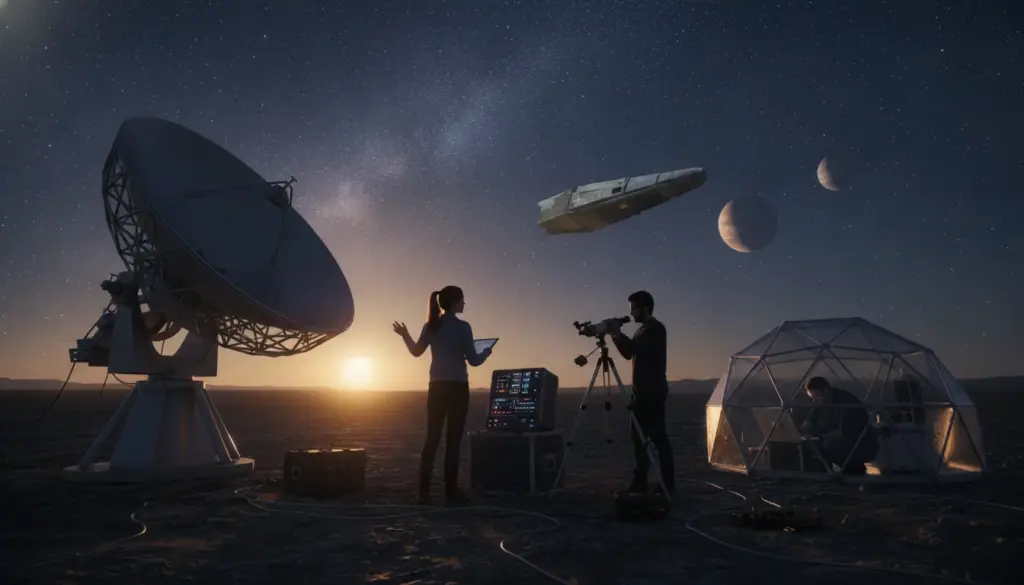
A growing community of astronomers is treating an unconventional concept with absolute seriousness. Rather than internet speculation, researchers are now conducting rigorous, well-defined investigations with measurable parameters. Their core message is remarkably clear: if unfamiliar technology is drifting through our cosmic neighborhood, they want the tools to identify it.
Moving beyond science fiction to testable science
For decades, the astronomy world has quietly entertained the notion that remnants of an extraterrestrial civilization might be hiding within our very own solar system. Historically, this concept lingered uncomfortably between imaginative science fiction and legitimate academic study. Today, a combination of colossal databases, innovative analytical methods, and highly advanced telescopes is dramatically shifting that narrative.
Scientists are no longer brushing off the question with a laugh. Instead, they are framing the hypothesis in a way that can be definitively answered using hard data.
The entire movement revolves around the concept of technosignatures—distinctive traces of technology that were not manufactured by humanity. While these can include radio frequencies, the focus is increasingly shifting toward physical anomalies. This might involve an unidentified probe, a highly reflective panel, or an artificially shaped metallic fragment that reflects light or moves in unusual ways.
Astrophysicists, including Adam Frank from the University of Rochester, are quick to clarify that this isn’t a sudden craze surrounding a single mysterious sighting. It represents a gradually maturing field of study, completely backed by peer-reviewed research in prestigious publications such as Scientific Reports and the Monthly Notices of the Royal Astronomical Society.
Scouring historical archives for celestial anomalies
One of the most fascinating avenues of this research doesn’t involve looking up at the modern night sky, but rather digging deep into dusty archives. Astronomer Beatriz Villarroel and her team have been meticulously analyzing vintage photographic glass plates from old observatories. Crucially, these images were all captured prior to 1957—the pivotal year humanity launched its first artificial satellite.
These historical records offer a pristine view of the heavens, long before human-made debris began cluttering Earth’s orbit. Because of this untainted perspective, the vintage plates are an absolute goldmine. If an object behaving like a modern satellite appears in these old photographs, human spaceflight cannot possibly be the culprit.
Initially, Villarroel simply wanted to use the old plates to track vanishing stars. However, she unexpectedly stumbled upon brief flashes of light that perfectly mimicked satellite trails, appearing decades before any satellites were actually built.
Unsurprisingly, these striking anomalies invite intense scientific pushback. Common counterarguments include:
- Vintage equipment errors: Unnoticed flaws in the old photographic plates or cameras.
- Atmospheric reflections: Optical illusions caused by strange weather phenomena.
- Classified aviation: Secret aircraft or early rocket tests with incomplete historical data.
- Human bias: The tendency for researchers to mistakenly interpret data to fit their theories.
The intense debate surrounding these historic images highlights exactly how sensitive the topic of extraterrestrial artifacts remains. Many professionals hesitate to touch the subject, terrified of having their academic reputations linked to UFO conspiracies. Ultimately, an anomaly only transitions from a “bizarre phenomenon” to “undeniable evidence” when an object can be physically examined up close.
Evaluating interstellar guests for artificial traits
Beyond archival photographs, the scientific community is closely monitoring transient visitors from deep space. These are interstellar bodies that briefly rocket through our solar system before disappearing back into the cosmic void, with famous examples including 1I/‘Oumuamua and 2I/Borisov.
Because these wandering objects originated around distant stars, they carry exotic materials from completely different planetary systems. This makes them the ultimate test subjects for a fascinating question: how exactly would an artificial alien construct behave compared to a standard chunk of ice or rock?
Recent academic studies are actively building concrete checklists to answer this. While virtually all experts agree that the vast majority of these strange interstellar visitors have completely natural explanations—such as fragmented comets or unusually shaped asteroids—the goal is to identify the tiny percentage that behave so bizarrely that immediate, intense scrutiny is justified.
Establishing strict criteria for potential discoveries
Developing standardized evaluation frameworks is another massive leap forward for the field. Rather than endlessly debating whether a specific object looks “suspicious,” researchers are establishing universal, objective criteria. Drawing heavy inspiration from the highly successful methods used to hunt for exoplanets, these proposed frameworks aim to create a reliable scientific standard.
The ultimate goal is to define exactly when an anomaly earns the right to be classified as a serious artifact candidate. Several critical factors are weighed during this process:
- Material composition: Can the object’s chemical makeup be completely explained by known natural processes?
- Orbital movement: Does the object follow a predictable path dictated by gravity, or does it exhibit signs of artificial thrust?
- Environmental context: Where exactly is the anomaly located, and how frequently do similar natural bodies appear there?
- Data integrity: How many independent instruments successfully tracked the object, and under what specific environmental conditions?
Upcoming facilities like the Vera C. Rubin Observatory are poised to capture mind-boggling amounts of fresh astronomical data every single night. Because millions of moving dots and fleeting light flashes will be recorded, specialized teams are already programming advanced algorithms designed to instantly flag anything behaving artificially.
Preparing humanity for an unprecedented revelation
This organized hunt extends far beyond basic astronomy, bleeding into serious discussions about global policy. If a telescope spots something tomorrow that overwhelmingly points to alien engineering, what exactly happens next?
Several monumental logistical questions are already being debated:
- Who holds the authority to launch a retrieval or inspection probe?
- What strict safety protocols must be enforced regarding potential biological contamination or the accidental activation of dormant technology?
- How rapidly, and through what channels, should this paradigm-shifting discovery be revealed to the general public?
- Which international bodies will take the lead alongside established organizations like the UN and national space agencies?
Scientists desperately want to be prepared for a positive confirmation, even if they remain highly skeptical that it will ever happen. Having these protocols in place ensures that every strange blip on a radar isn’t instantly sensationalized as definitive proof. Conversely, it also guarantees that highly credible evidence isn’t quietly swept under the rug due to a fear of academic ridicule.
Why the hunt for technosignatures is accelerating right now
Several distinct factors explain why this once-taboo research field is rapidly professionalizing today. Modern telescopes offer unprecedented sensitivity. Machine learning and sophisticated computer models can effortlessly detect subtle patterns in massive datasets that human eyes would simply gloss over. Furthermore, the exploding catalog of confirmed exoplanets makes the concept of other habitable worlds feel significantly less abstract.
Simultaneously, the overarching attitude within the scientific community is shifting. While alien life was historically lumped together with niche folklore, modern science is adopting a highly pragmatic stance: any bold hypothesis is welcome, provided it is anchored by testable, transparent predictions.
For the average reader, this means your newsfeed will likely feature an increasing number of headlines discussing ‘unexplained objects’ or ‘potential technosignatures’ over the next decade. Naturally, most of these thrilling claims will eventually fizzle out, revealed to be nothing more than sensor glitches or strange ice chunks.
Nevertheless, this rigorous approach is permanently altering how humanity views our cosmic backyard. For centuries, wandering comets and space dust were treated as mere background scenery. Today, they are actively being scrutinized as potential messengers from distant civilizations—or as definitive proof that our immediate universe is entirely composed of lifeless rock.
How to critically evaluate future astronomical claims
As this field expands, a few fundamental guidelines can help you navigate sensationalized news stories about potential extraterrestrial artifacts:
- Demand concrete data: Always ask what specific, verifiable measurements form the foundation of the headline.
- Look for consensus: Check if multiple, entirely independent research teams are analyzing the exact same data sets.
- Check for mundane answers: Note whether natural, ordinary explanations were systematically investigated and ruled out first.
- Maintain healthy skepticism: Be incredibly wary of grand claims that rely solely on blurry photographs or social media rumors.
By keeping these critical principles in mind, you can follow the search for alien technology with genuine fascination and a deep appreciation for the meticulous scientific method. The odds of a forgotten, ancient alien probe silently orbiting through our solar system remain deeply uncertain. However, the sophisticated tools required to finally confirm or deny its existence are getting sharper every single day.