Ingenious Solutions for Failing Eyesight
Our ancestors didn’t just sit around squinting when their vision failed. They came up with remarkably inventive solutions to read, work, and spot danger long before modern spectacles existed.
Today, if you struggle with nearsightedness or age-related blurriness, you simply visit an optometrist. During antiquity and the Middle Ages, that luxury was entirely unimaginable. Yet, blurred vision, double sight, and serious eye conditions have always been a normal part of the human experience.
While youthful eyes are highly flexible and naturally compensate for minor defects, nearly everyone experiences a decline in near vision around the age of forty. In an era where carving, weaving, and writing demanded absolute precision, failing eyesight posed massive practical hurdles.
Losing your visual sharpness didn’t diminish your intellect, but it certainly limited your opportunities. Certain crafts and scholarly pursuits quickly became impossible. Consequently, many individuals had to switch trades, rely on younger apprentices, or simply accept a blurrier world. However, the human drive to find visual aids never vanished.
The Earliest Optical Aids
Transparent Stones and Early Magnifiers
Long before glass lenses, ancient civilizations experimented with clear materials. Archaeologists have uncovered artifacts like the Nimrud lens, a polished piece of rock crystal discovered in modern-day Iraq dating back to roughly 750 BC. This object acts much like a crude magnifying glass.
Whether individuals actually used this specific disc to correct poor vision remains a topic of debate among historical experts. However, professionals suggest it may have served several practical purposes:
- A magnifier for intricate engraving work.
- A burning glass used to start fires.
- A ceremonial item or decorative piece.
Similar polished crystals and glassy stones have surfaced in other regions, deliberately shaped to bend light. Even if these weren’t strictly medical devices, they provided crucial early insights into the behavior of optics.
Glass Spheres and Water Bowls
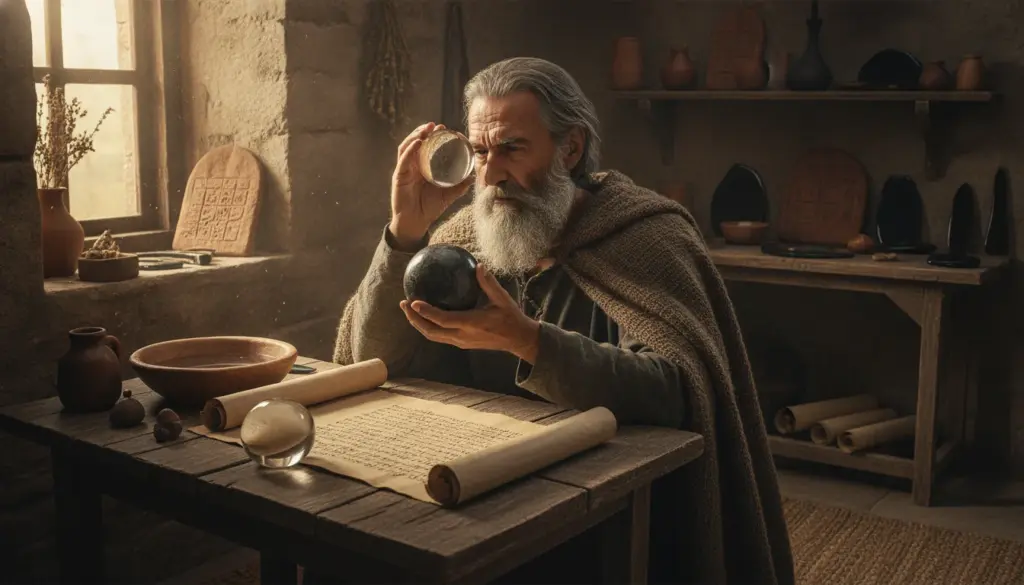
Another clever technique involved filling transparent bowls or glass spheres with water. By placing a document beneath these water-filled vessels, the letters instantly appeared larger and distinctly sharper. Historical records frequently describe these liquid-filled globes as essential reading aids for early scholars and scribes.
Naturally, you couldn’t carry these heavy water bowls around. Instead, they sat permanently on desks or lecterns. You moved the manuscript underneath the stationary magnifier rather than wearing something on your face, brilliantly solving the challenge of reading tiny text.
From Arabian Science to the European Reading Stone
Alhazen and the Birth of Optics
During the Middle Ages, the field of optics took a massive leap forward thanks to the Arabian scholar Ibn al-Haytham, widely known in Europe as Alhazen. Around the year 1000, he documented exactly how light enters the human eye, the mechanics of lenses, and the physiological reasons behind vision loss.
As his groundbreaking manuscripts were translated, they deeply influenced European thinkers. Scientists began treating glass curvature and magnification as practical engineering rather than mere curiosities.
Monks, Scribes, and Hemispherical Glass
This scientific shift birthed the European reading stone. These were thick, half-sphere lenses crafted from glass or crystal designed to magnify flat documents. Monastery monks, who spent countless hours copying manuscripts by hand, relied heavily on these tools.
By resting the flat side of the stone directly against the parchment, scribes gained both magnification and enhanced contrast. For aging monks struggling with early farsightedness, this tool was an absolute career-saver, even though it required constant sliding across the page.
Ultimately, these reading stones laid the groundwork for wearable glasses. They offered larger letters and extended working hours for craftsmen who would have otherwise retired their eyes prematurely.
The Invention of Glasses
The Revolution on the Nose
The very first true eyeglasses emerged in Italy right around the end of the thirteenth century. These initial designs lacked the familiar side arms we use today. Instead, they consisted of two round lenses connected by a central rivet or pin, which users either balanced precariously on their noses or held up by hand.
Venice, and specifically the island of Murano, served as the cradle for this invention. Local glassblowers had mastered their craft, learning how to grind glass precisely enough to focus light predictably. From these Italian workshops, optical technology slowly trickled across Europe.
A Status Symbol for the Elite
Initially, spectacles were incredibly rare and prohibitively expensive. You would exclusively find them in the possession of:
- Religious figures reading and transcribing sacred texts.
- Legal scholars managing towering stacks of documents.
- Wealthy merchants tracking their complex accounting.
Throughout late medieval and Renaissance art, glasses increasingly appeared as undeniable symbols of authority and intellect. An aging notary sporting spectacles didn’t project physical weakness, but rather profound wisdom.
Mastering Light, Distance, and Contrast
Even without physical magnifiers, people brilliantly adapted their environments to suit their failing eyes. Common historical strategies included:
- Chasing daylight: Moving workbenches directly next to windows or taking tasks outdoors.
- Altering focal distance: Pulling texts right up to the nose, or holding them at arm’s length for farsightedness.
- Upscaling text: Carving larger public inscriptions and symbols so the general public could easily decipher them.
- Boosting contrast: Using highly pigmented dark ink on exceptionally light parchment to make distinct shapes pop.
Daily routines were strictly dictated by the sun. Complex embroidery, delicate carving, and intensive reading happened strictly at midday. Once evening fell and only candlelight remained, society transitioned to rougher manual labor or oral storytelling.
Community Support and Task Delegation
Families and trade guilds developed highly practical workarounds. A master craftsman with decades of expertise but deteriorating vision would pass the microscopic details down to sharp-eyed apprentices. In exchange, the elder provided invaluable mentorship.
Similarly, young children regularly read aloud to grandparents who could no longer make out the letters. Those who struggled with distance vision naturally gravitated toward indoor tasks, while farsighted individuals handled outdoor responsibilities. Through communal teamwork, society effectively neutralized many visual limitations.
Navigating Severe Eye Conditions
Historically, vision problems extended far beyond a mild blur. Eye injuries from warfare or trades, congenital defects, and severe infections were commonplace. Long before the era of antibiotics, a minor eye scratch could easily result in permanent blindness.
Those who lost their sight entirely had to rely fiercely on their remaining senses. They mapped out routes and identified individuals purely through sound, smell, and tactile memory. By remaining in familiar market environments or taking up musical and religious roles, many maintained active, vital positions within their communities.
How the Printing Press Highlighted Poor Vision
The introduction of the printing press in the fifteenth century shifted the landscape completely. As books became drastically cheaper, reading transformed from an elite privilege to a widespread habit. Suddenly, thousands of ordinary people realized their vision was actually defective.
Demand for corrective lenses skyrocketed almost overnight. What began as a luxury item rapidly transformed into a mass-market commodity. Street vendors in bustling cities began selling ready-made spectacles in various generalized strengths, functioning much like the affordable reading glasses you find at modern pharmacies.
The printing revolution didn’t just democratize knowledge; it also exposed a massive, hidden health issue. An entire generation simultaneously discovered that words only hold power when you can actually see them clearly.
What Ancient Eyesight Teaches Us Today
The history of navigating the world without spectacles proves exactly how adaptable humans are. Without access to modern optometry, our ancestors utilized brilliant environmental tweaks, lighting manipulation, and community collaboration to survive.
Interestingly, you can still observe these ancient strategies in remote regions today where medical eye care remains scarce. Children reading under harsh sunlight, enlarged signage, and families sharing administrative duties all mirror these historical workarounds. Providing a basic pair of reading glasses in these areas today creates the exact same miraculous revelation experienced in thirteenth-century Venice.
If you’ve ever misplaced your own glasses, you instinctively revert to these ancient survival tactics. You automatically walk toward a brighter lamp, adjust the distance of your smartphone, or ask a friend to read a tiny label for you. That innate human adaptability kept our ancestors thriving for centuries before the optical technology we take for granted ever existed.