That sudden flash of brilliance often feels like pure magic, but modern neuroscience reveals a highly predictable pattern behind it. Beyond just getting enough sleep or maintaining a good mood, your physical location plays a surprisingly significant role. Expansive outdoor settings and rooms with soaring ceilings actually prime your mind to function much more fluidly.
The science behind the sudden breakthrough
Psychologist and neuroscientist John Kounios from Drexel University has spent years investigating how disparate thoughts suddenly click together. He labels these spontaneous solutions as “insight,” contrasting them with traditional, methodical problem-solving where you grind through obstacles one by one.
During his laboratory experiments, Kounios contrasts two distinct puzzle types: those requiring cold, logical deduction, and those where participants report the answer simply “popped” into their heads. By tracking brain activity using EEG technology, his research team observes distinct shifts in neurological wave patterns.
Right before a moment of insight, a brief but intense surge of neural activity sweeps through specific brain regions.
This rapid electrical signature proves that sudden inspiration isn’t just a romantic myth. Even when you feel completely stuck, your subconscious mind is already quietly churning through possibilities in the background.
How your mood dictates your mental leaps
Researchers have noticed something fascinating: these spontaneous flashes of genius do not strike at random. Specific internal conditions significantly multiply the odds of experiencing a mental breakthrough.
Your emotional state acts as a primary trigger. Individuals who feel upbeat naturally slip into a cognitive mode where the mind freely connects seemingly unrelated concepts.
A positive mindset unlocks a fluid way of thinking that perfectly accommodates fresh inspiration.
Anxiety and tension achieve the exact opposite effect. When you feel stressed, your thinking becomes cautious, sluggish, and highly restricted. This narrow focus is incredibly useful when reviewing a legal contract or hunting for a bookkeeping error, but it is deeply counterproductive when you desperately need an innovative concept.
Rest plays an equally vital role. Well-rested people consistently report that answers naturally surface after stepping away from a task or getting a full night’s sleep. The amount of pressure you put on yourself also matters. When you stop aggressively chasing a result, your brain gains the necessary breathing room to quietly reorganize information behind the scenes.
The architectural secret: open skies and high ceilings
The research becomes truly captivating when examining how our physical surroundings influence cognition. It is not that a specific office building magically increases your intelligence, but rather that certain environments gently steer your attention in a highly specific direction.
Based on neuroscientific observations, two distinct types of spaces are exceptionally beneficial for triggering sudden insights:
- Wide-open outdoor areas, such as public parks, sandy beaches, or scenic viewpoints
- Rooms featuring generous vertical height that feel bright and airy
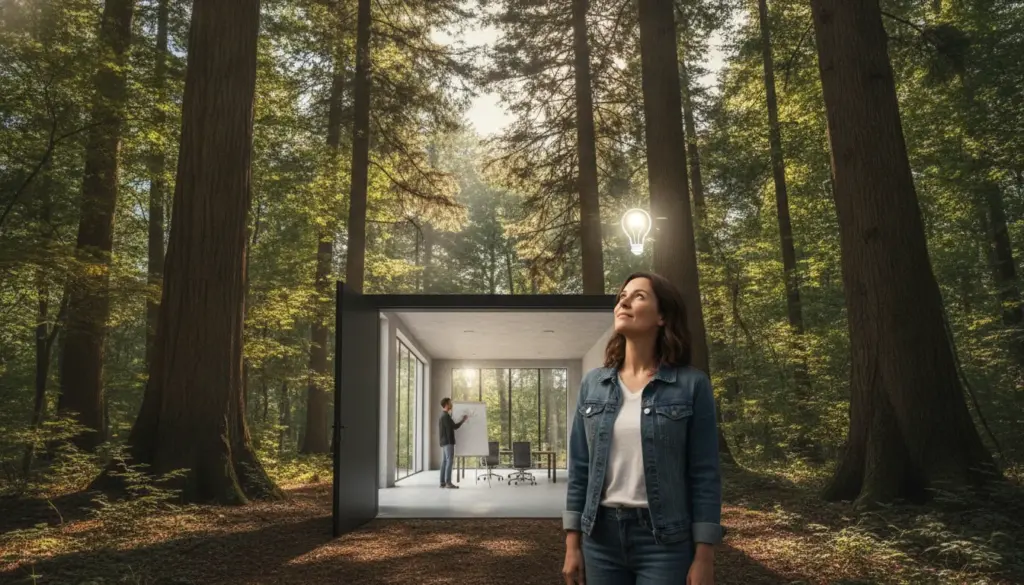
In these expansive settings, your visual and mental focus naturally broadens. You look further into the distance, your gaze drifts effortlessly, and your mind essentially scans a much wider field of potential connections.
When placed in a massive space—whether outside or beneath a towering roof—your attention literally stretches outward, almost as if trying to fill the available volume.
This expanded awareness makes it significantly easier to forge distant mental associations. As a result, unexpected links form between your existing knowledge and new concepts, all without any conscious struggling. This is the exact mental recipe required for a sudden breakthrough, especially when you find yourself stuck on a tricky decision, a complex article structure, or a difficult conversation.
The hidden benefits of a cluttered workspace
Not every environment sets the stage for an epiphany. Researchers point out that specific spaces actively force your mind into a state of rigid, microscopic concentration:
- Busy, visually dense offices packed with objects and constant stimuli
- Rooms dominated by sharp angles and highly imposing furniture
In these confined settings, your attention immediately shrinks down to the finest details. This isn’t inherently a bad thing. For detail-oriented chores like verifying data, editing documents, or debugging software, this hyper-focused state is exactly what you want. You need meticulous precision, not wild imaginative leaps.
However, for conceptual challenges, this same environment acts as a massive roadblock. If everything around you constantly demands immediate visual attention, stepping back mentally to let your thoughts wander becomes nearly impossible. And letting your mind wander is precisely how those magical, unexpected connections are forged.
Rethinking how we study and work
Most professionals try to solve complicated dilemmas in the absolute worst possible environments: cramped cubicles, dimly lit home offices, and stuffy meeting rooms with low drop ceilings.
Add in relentless deadlines, endless smartphone notifications, and back-to-back meeting invites. Together, these elements create a modern landscape that champions checking off to-do lists rather than fostering genuine innovation.
The insights from this research reveal a few simple adjustments that both companies and individuals can immediately implement:
- Encourage employees to take brief outdoor walks during their shifts
- Dedicate bright, spacious rooms specifically for conceptual thinking and brainstorming sessions
- Intentionally lower performance pressure when imaginative solutions are required
- Cultivate a workplace culture that treats genuine rest and recovery as necessities, not luxuries
This doesn’t mean every office needs to look like a high-end architectural magazine spread. It simply means providing areas where your mind can literally breathe. A quick stroll along a nearby river or spending fifteen minutes on an open balcony can completely alter how you perceive a stubborn problem.
Actionable ways to trigger your own aha-moments
If you want to apply this brain science to your daily routine, start with tiny modifications. Here are a few low-barrier adjustments to try this week:
- When wrestling with a difficult task, walk outside for five to ten minutes—leaving your smartphone behind.
- Whenever possible, relocate your heavy conceptual thinking to a larger space, a windowed boardroom, or a quiet coffee shop boasting high ceilings.
- Schedule your heavy analytical and administrative duties for smaller, quieter rooms that offer zero distractions.
- Adopt a block-working strategy: grind through the heavy logic first, then take a breathing break somewhere with a view.
You can easily play with these spatial principles at home, too. Consider shifting your desk closer to a large window, decluttering your immediate visual field, or choosing to discuss complicated issues while walking outside instead of sitting around a cramped dining table.
Why your brain demands time and space to flourish
Ultimately, these fascinating studies prove that brilliant ideas cannot be willed into existence through sheer determination. You simply cannot force yourself to be highly creative on command. What you can do, however, is architect the perfect conditions that allow your brain to effortlessly connect the dots, rather than just pushing yourself harder.
True innovation requires a degree of letting go. You have to stop glaring at your monitor, ease up on your own expectations, and gift your thoughts a change of scenery. The classic historical tales of legendary inventors and authors striking gold while taking a bath or hiking through the woods align flawlessly with what modern neuroscientists are now measuring in the lab.
By intelligently leveraging your physical surroundings, you no longer have to wait for random strokes of luck. By intentionally weaving space, natural light, and distance into your day, you drastically multiply the chances that a brilliant realization will surface exactly when you need it most.