Shielding Your Space from Prying Eyes
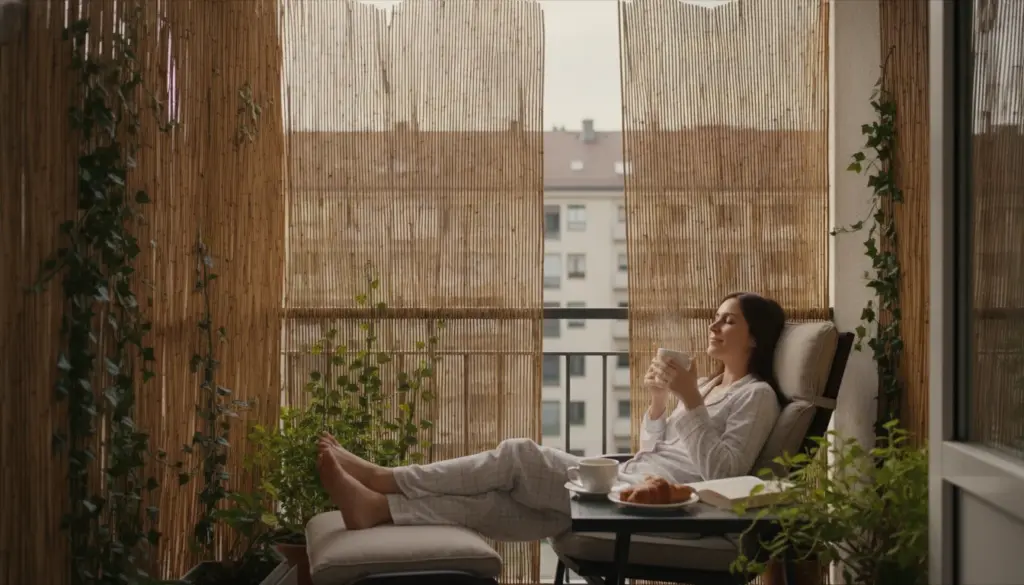
Do you ever feel like you are sitting on a display stage when you step outside? You simply want to sip your morning coffee in peace, but instead, you end up making awkward eye contact with the neighbor across the street. Suddenly, enjoying your little balcony oasis feels more like sitting in a shop window.
Thankfully, transforming your outdoor space into a genuine retreat is entirely possible with the right privacy strategies. Finding the ideal solution for your specific balcony depends on a few key structural details. Let us explore the most effective ways to reclaim your personal space.
Defending the Front: Blocking Views from the Street
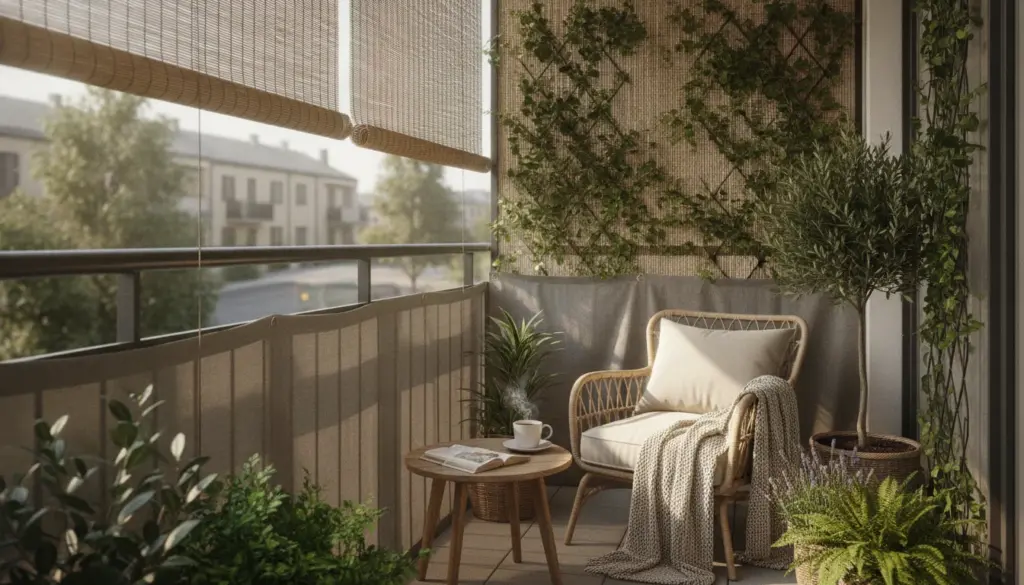
Relaxing is practically impossible when every passerby on a busy street or curious ground-floor neighbor can see straight onto your patio. The most straightforward defense mechanism is a weatherproof fabric screen. These typically feature metal eyelets, allowing you to easily secure them to your railing using sturdy cords or cable ties.
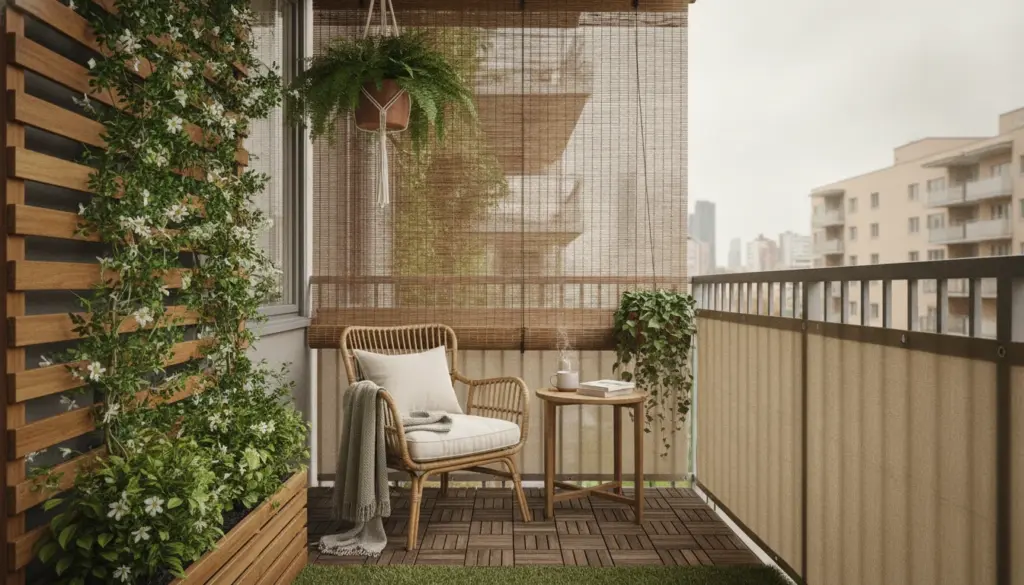
When selecting your fabric, ensuring the material is both UV-resistant and weatherproof is crucial. Without these protective qualities, the fabric will quickly fade and degrade under the elements. If you prefer a more organic aesthetic, privacy mats made of bamboo, reed, or willow are excellent natural alternatives that are just as simple to attach.
A quick pro-tip for natural mats: always leave a slight gap between the bottom edge and the floor to prevent standing moisture from causing rot. Both fabric and natural mat options are incredibly tenant-friendly. They require zero drilling and can be dismantled swiftly without leaving a trace behind.
Side Protection: Screening Off Neighboring Balconies
Modern apartment layouts often place balconies side-by-side, creating a situation where you and your neighbors have a completely unobstructed view of each other’s seating areas. Fortunately, several clever methods exist to create a lateral shield.
- Folding screens: These offer an instant, tenant-friendly fix that requires no drilling whatsoever. The catch is that they can be highly susceptible to strong gusts of wind and demand extra anchoring.
- Solid privacy walls: Delivering maximum opacity and superior stability, walls made from wood, WPC, or plastic are highly dependable. While plastic and composite are remarkably low-maintenance, timber varieties will need regular upkeep. Note that permanent installation usually requires landlord approval.
- Side awnings: These space-saving mechanisms are sleek and perfect for confined areas. Just keep in mind that mounting the hardware to the wall will likely require written permission.
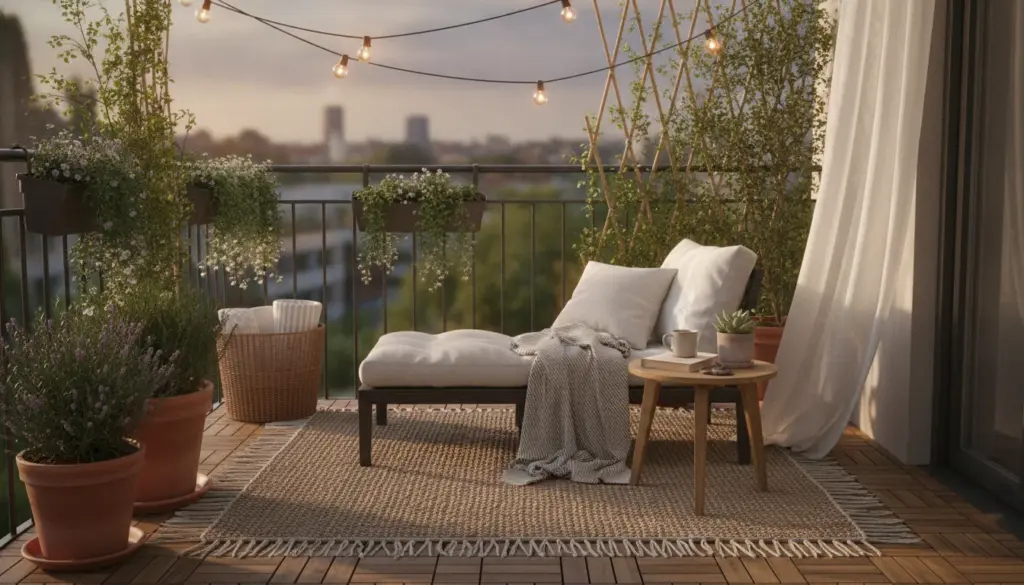
- Trellises with climbing plants: For a lush aesthetic, this is a brilliant, landlord-approved option that easily attaches to the railing with pipe clamps. However, your privacy will significantly drop during the bare winter months.
Privacy Screens in Rentals: What Are the Rules?
As a general guideline, any addition that can be removed completely without leaving a mark is usually acceptable. Potted plants and temporary fixtures rarely require special consent from property management.
Conversely, the moment you need to drill, use wall anchors, or insert screws—such as when installing heavy awnings or rigid side walls—you must secure written permission from your landlord. If you are ever unsure about a specific modification, asking beforehand is the best way to prevent stressful disputes when you eventually move out.
Overhead Shielding: Blocking Views from Above
Living in a multi-story building often comes with a specific challenge: the residents living directly above you have a bird’s-eye view of your outdoor seating. To counter this, you need a horizontal barrier, essentially functioning as a fabric roof.
For renters, a tilting parasol with an articulated joint is the most versatile and hassle-free choice. It sets up in seconds, angles easily to block sightlines, and involves absolutely zero drilling. The downside is that the coverage is quite localized, and even robust umbrellas must be folded down during heavy winds.
A tensioned sun sail provides much broader coverage and stays firmly in place. Not only does this shield you, but it also acts as fantastic protection against sunburn for your sensitive potted greenery. However, installing a sail requires drilling into the facade or railings to establish secure anchor points.
For the ultimate luxury, retractable awnings are unbeatable. Offering reliable shelter from all weather conditions at the push of a button, they are incredibly convenient. Naturally, this high-end comfort comes with the highest price tag and requires professional facade mounting.
What is the Ideal Solution for a Tiny Balcony?
When dealing with compact balconies, maximizing every single square inch is vital. The most effective strategies are those that consume absolutely no precious floor space.
Fabric coverings and natural mats hugging the railing are perfect, as they block forward views without eating into your footprint. Similarly, opt for railing planters filled with tall grasses or vertical trellises that encourage climbers to grow upward rather than outward. Retractable side awnings are also brilliant, as they tuck away completely when not needed. The golden rule for small spaces: always build up, never out.
Living Privacy Screens: The Most Beautiful Approach
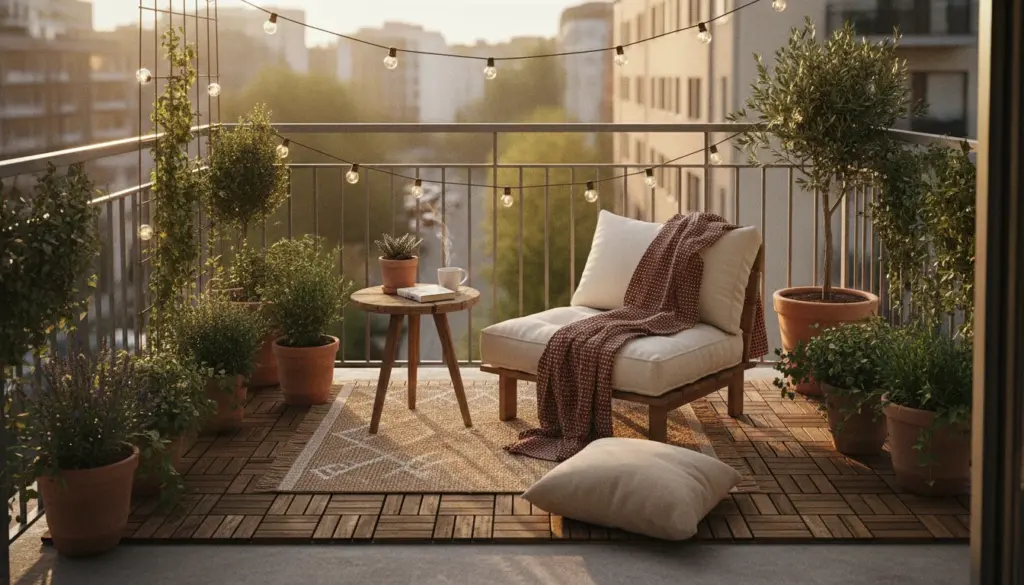
Curating a dense wall of lush plants arguably creates the most atmospheric and inviting boundary. Beyond merely blocking unwanted stares, a vibrant green perimeter casts cooling shade and injects a distinct holiday vibe right into your urban home.
- Classic Climbers: Trellises covered in creeping vines are timeless, and you can easily select varieties based on your sun exposure. Ivy thrives in dark, north-facing spots, while Clematis and Jasmine flourish in partial shade, rewarding you with intoxicating fragrances. For full sun, Virginia creeper grows vigorously and delivers spectacular crimson foliage in autumn. You might even consider a bee-friendly climbing plant to support local pollinators. If you prefer edible gardens, training beans or tomatoes up a grid is equally effective.
- Potted Grasses and Bamboo: Tall, elegant ornamental grasses or clumping bamboo species perform exceptionally well in containers. Lining several large pots closely together instantly generates a soft, swaying barrier.
- Raised Beds: If your square footage allows it, a well-placed elevated planter serves as a fantastic structural divider while doubling your gardening space.
The only real drawback to a botanical barrier is seasonal shedding. Many species drop their foliage when temperatures plummet, taking your seclusion down with them. For guaranteed year-round peace, the smartest approach is pairing your living wall with a permanent, solid matting or fabric screen hidden just behind it.