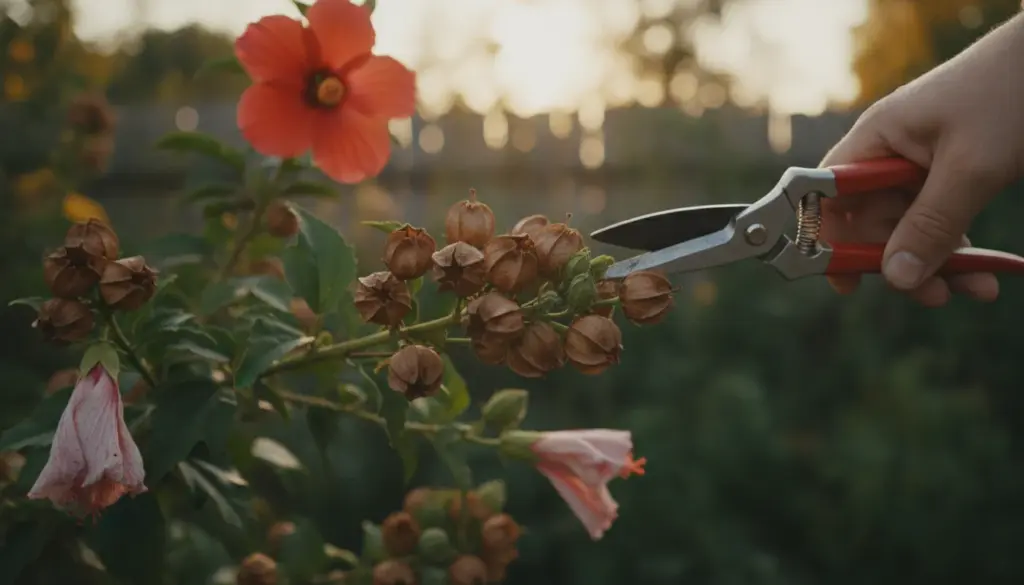
As summer draws to a close, garden hibiscus shrubs often display noticeable seed pods. This naturally leads to a common gardening dilemma: is it better to leave them alone or prune them away?
By September, the spectacular blooming phase of this popular ornamental shrub starts winding down. If you haven’t been meticulously deadheading the faded blossoms, you will likely spot these mature capsules hanging from the branches. Figuring out the best approach requires a quick look at the plant’s natural life cycle.
When do hibiscus seeds actually ripen?
During their early stages, it can be remarkably tricky to tell the difference between a new flower bud and a developing seed capsule. Both structures share a similar round, green appearance. However, while buds eventually burst into vibrant flowers, the seed pods gradually turn brown and dry out over time.
Beneath that drying exterior, the actual seeds are busy maturing. Once fully ripe, the capsule cracks open to reveal its contents. Hibiscus seeds are tiny, slightly bristly, and covered in a tough outer shell. This rigid casing provides excellent protection for the delicate interior, though it simultaneously makes the germination process much more challenging.
Should you clip the pods or leave them on the branch?
Generating seeds demands a significant amount of energy from any plant. This is valuable fuel that could otherwise be directed toward producing more gorgeous flowers. Throughout the active growing season, it makes perfect sense to interrupt this cycle.
By consistently snipping off wilted blooms, you prevent the fruit from ever developing into a pod. Keep in mind that a comprehensive structural pruning is generally reserved for the spring months, though a light autumn trim is acceptable in certain exceptional cases.
If the brown capsule has already formed, the plant has already invested its energy reserves into the process. Snipping it off at this late stage won’t magically redirect power back into blooming. Therefore, the decision to remove them now boils down to entirely different gardening goals.
Do indoor hibiscus plants produce seeds?
Several hardy varieties thrive wonderfully outdoors as long as basic planting mistakes are avoided. Indoor varieties, on the other hand, are typically Chinese hibiscus. These tropical houseplants rarely, if ever, develop seed capsules.
Indoor hibiscus plants are almost exclusively sterile hybrids. Furthermore, your living room lacks the natural insect pollinators required to successfully fertilize the blossoms.
Managing the natural seed drop
As a general rule, any mature pods left on your outdoor shrub will eventually pop open naturally. This scatters the contents directly onto the soil below. Depending on the local moisture and ground conditions, you might find a dense thicket of young saplings sprouting around the base of the mother plant next year.
If you prefer to keep your garden layout tightly controlled, harvesting or clipping the capsules is highly recommended. Once collected, you can either toss them in the compost bin or deliberately try your hand at growing seedlings in a controlled environment.
Why growing hibiscus from seed is rarely recommended
Gardeners looking to multiply their beautiful shrubs have a few propagation methods at their disposal. However, trying to grow new plants from collected seeds is notoriously difficult. A significant portion of these seeds will flat-out refuse to germinate, even when provided with absolutely perfect conditions. Those few sprouts that do emerge tend to be incredibly fussy and demanding to care for.
Most importantly, seeds will not yield an exact genetic clone of your original shrub. Because most modern garden varieties are complex hybrids, the genetic lottery means the offspring will display unpredictable traits. The resulting flower colors and shapes will always be a complete surprise. For a much higher success rate and predictable results, propagating through stem cuttings remains the superior choice.