
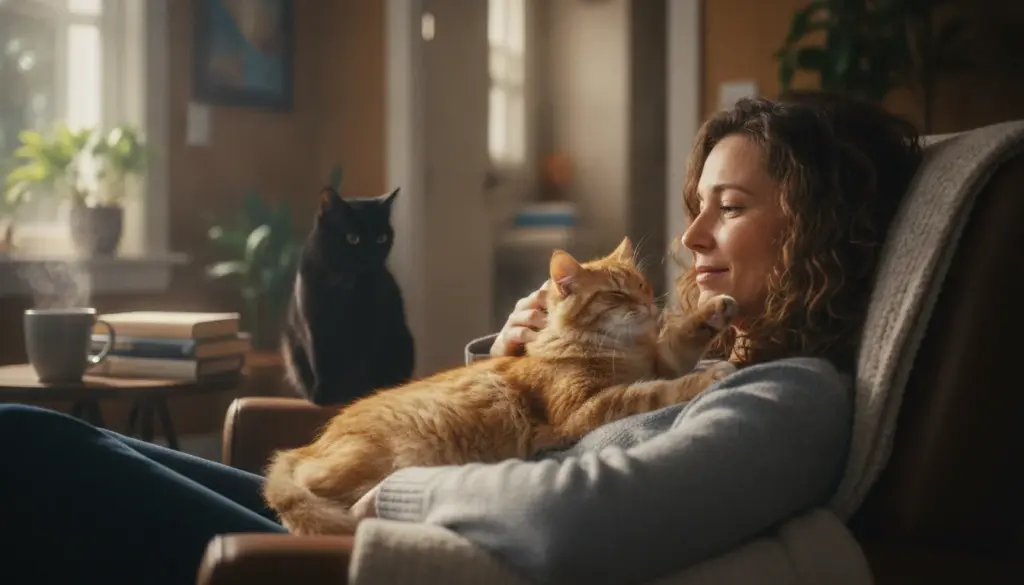
They vibrate with a deep purr, leisurely close their eyes while looking at you, and insist on accompanying you to the restroom. Are these just random feline quirks, or a silent declaration of love?
Anyone who shares a home with a feline companion knows that their actions can often feel like a puzzle. However, those little behavioral oddities are rarely accidental. Felines have incredibly nuanced ways of showing exactly who holds the top spot in their heart, versus who simply exists to fill the food bowl.
Why feline devotion looks so different from canine love
While dogs express joy by jumping, licking, and wildly wagging their tails, cats typically prefer a much more understated approach. Because they descend from solitary hunters, our feline friends spent millennia learning to mask any signs of vulnerability. Despite this independent lineage, domestic cats form remarkably deep attachments to their caretakers.
Rather than shouting their devotion from the rooftops, they whisper it through daily routines, delicate gestures, and physical proximity.
Once you learn to interpret this unique body language, you will suddenly realize just how many affectionate messages you receive daily. It can be anything from a gentle nudge of the head to the rather unusual experience of receiving a lifeless mouse as a special token of appreciation.
Signal 1: The headbutt — a scented signature
One of the most undeniable signs of feline love occurs when your pet gently—or sometimes forcefully—bumps their forehead against your arm, chin, or hand. Animal behaviorists often refer to this as bunting.
Cats possess special scent glands around their cheeks, ears, and forehead. By rubbing these areas against you, they are essentially claiming you with their unique pheromones. In their language, this translates to: “You are part of my family, and I feel safe with you.”
- A single, gentle tap: A sign of budding trust and cautious affection.
- Persistent rubbing and bumping: Indicates a deeply rooted bond and a strong desire for connection.
- Bunting combined with purring and relaxed eyes: The ultimate state of comfort and bliss.
Whenever your cat marks you with their head, they are quite literally welcoming you into their most exclusive inner circle.
Signal 2: The slow blink — a gaze of absolute trust
Have you ever noticed your pet staring at you, slowly squeezing their eyes shut, and then lazily opening them again? They are not just feeling sleepy; this is a highly sophisticated social cue.
In the animal kingdom, an unblinking stare usually signals tension or an impending attack. A deliberate, sluggish blink communicates the exact opposite. It proves that the animal feels entirely secure and is willing to lower their defenses in your presence.
How to return the compliment: Lower yourself to their eye level, hold their gaze for a brief moment, and slowly close your own eyes. Pause for a second before opening them again. Often, your companion will return the gesture, creating a beautiful moment that noticeably strengthens your emotional connection.
Signal 3: Purring — deciphering the vibrations
Most pet owners immediately associate a rumbling chest with a delighted animal. While this is usually accurate, a purr can occasionally indicate that an animal is frightened or in pain. Therefore, evaluating the surrounding environment is crucial.
If your pet actively seeks you out, curls up in your lap, and begins to motor loudly, you can be certain it is a display of genuine affection. They are showing love for you as an individual, rather than just viewing you as the automatic food dispenser.
Signal 4: Decoding tail positions
A feline’s tail acts as an emotional barometer. Pay close attention to how they hold it when they stroll into the room to greet you.
- Carried perfectly vertical: Signals happiness and a positive anticipation of interacting with you.
- A slight hook at the tip: Suggests a relaxed, friendly, and playful mood.
- Upright with a vibrating base: Indicates an overwhelming sense of joy and excitement upon seeing you.
When a cat approaches you with a tail standing tall like an exclamation point, accompanied by a tiny chirp, it is one of the warmest greetings they can possibly offer.
Signal 5: The dedicated bathroom escort
Countless owners report that their pets shadow their every move. They trail behind into the kitchen, the bedroom, and famously, the bathroom.
This constant supervision simply means they crave your company. It is not always about begging for treats; sometimes they just want to sit nearby while you work on your laptop or read a book. They might not even demand to be petted. For them, shared space is affection enough.
Nurturing this habit: Speak to them in a calm tone when they follow you. Consider placing a cozy blanket or a small bed near your desk. Providing them with a designated observation post makes them feel valued and deepens your relationship.
Signal 6: The rhythmic kneading
When an animal rhythmically pushes its front paws into a soft blanket, a pillow, or your stomach, it is a behavior widely known as “making biscuits.” Kittens instinctively perform this motion against their mother to encourage milk production.
When an adult feline kneads on you, they are reverting to a state of absolute childhood comfort. If this rhythmic pawing is accompanied by a loud purr, a relaxed posture, and perhaps a tiny bit of drool, they feel exceptionally safe. Not all cats do this, but if yours does, you share a truly special bond.
Signal 7: Delivering unusual gifts
While finding a captured insect or a toy mouse in your shoe might not be your favorite experience, the intention behind it is incredibly meaningful. This type of offering is an exclusive privilege.
Dropping a toy or a “catch” at your feet indicates that your cat views you as a crucial member of their family unit. Sharing their prized possessions is a profound display of trust, similar to a toddler handing you their favorite stuffed animal.
Why felines play favorites
Every animal possesses a unique personality. Early life experiences, genetics, and how they were socialized play a massive role in their social behavior. While some remain fiercely independent, others form an unbreakable attachment to a single, specific person.
Typically, a cat will choose a favorite person who displays the following traits:
- Respects personal space: Never forces interaction or overwhelming cuddles.
- Allows the animal to initiate: Lets the feline decide when it is time for affection.
- Maintains a calm environment: Uses a soft voice and avoids sudden, loud noises.
- Provides consistency: Sticks to predictable feeding and playing routines.
Safely building a stronger connection
If you want to earn that highly coveted “favorite person” title, patience is your best tool. Never pick up an animal that is actively trying to walk away. Instead, sit quietly on the floor, extend a single finger, and allow them to close the distance.
Engaging in short, daily play sessions is another fantastic bonding method. Use a wand toy to simulate a hunt, and always conclude the game with a small treat. Over time, your pet will begin to associate the thrill of a successful hunt directly with your presence.
Recognizing the limits
Even the most affectionate companion has a threshold for physical contact. Pay close attention to subtle stress markers, such as flattened ears, a rapidly twitching tail, or sudden body stiffness. These are polite requests to stop petting.
An animal that feels its boundaries are respected will always return for more attention later. Conversely, ignoring these warning signs will eventually cause the animal to withdraw.
Debunking common feline myths
One of the most easily misinterpreted behaviors is when a cat rolls onto its back and exposes its stomach. While a dog does this to request a belly rub, a cat is often just stretching out in a relaxed state—or adopting a strategic defensive posture where all four paws are ready to strike. Reaching in for a rub might result in a swift scratch.
Another widespread misconception is the idea that cats only care about the person who provides their meals. Behavioral research indicates that felines easily recognize their owners by scent and voice, entirely independent of meal times. If your pet chooses to sleep next to you long after breakfast is over, they value you for far more than just your pantry access.
Are you their number one?
Imagine arriving home after a stressful day. Before you even take off your coat, your companion is waiting in the hallway with a quivering, upright tail and a soft meow. They trot happily toward the sofa and wait for you to sit down before immediately claiming your lap. If this sounds familiar, you are undoubtedly their favorite person.
Consider another scenario: perhaps your partner is the one who religiously fills the food bowl every morning, yet the cat consistently chooses to sleep on your side of the bed. They might tolerate the rest of the household, but they save their purrs exclusively for you. This proves that food is rarely the deciding factor in feline loyalty.
The mutual benefits of a strong bond
This deep connection benefits both species immensely. Sharing your life with a bonded animal has been shown to significantly lower human stress hormones. Simultaneously, a cat that feels entirely secure will maintain a healthier heart rate and exhibit far fewer behavioral issues.
As you become fluent in their subtle language, your shared life will become much more harmonious. You will experience fewer misunderstandings and discover a wealth of quiet rituals that enrich both of your lives. Somewhere between that lazy, slow blink and a gentle tap of the forehead, the truth becomes perfectly clear: to this tiny predator, you are the most important person in the world.