Why your washing machine secretly smells—and the role of detergent sludge
Picture this: the washing cycle finishes, but instead of the crisp scent of clean laundry, a damp, musty draft hits your face. You open the door, take another sniff, and frown. The towels might be washed, yet they carry an unmistakable wet-basement aroma you wouldn’t want any houseguest to encounter. Running your finger along the rubber seal reveals a slimy gray residue, leaving you wondering how this happens when you always use detergent.
Eventually, you might stumble across a peculiar piece of advice while browsing your phone: toss a single dishwasher tablet into an empty drum and run a sixty-degree cycle. One tablet. Zero clothes. Goodbye grime and odors. It sounds like one of those internet tricks that is either brilliantly effective or complete nonsense. But this is exactly where things get interesting.
We rarely give our washing appliances a second thought until they completely break down, often ignoring a slight musty scent. However, that subtle odor is the starting point. Deep inside the drum, tucked behind the rubber gaskets and within the hidden pipes, a nasty cocktail of body oils, leftover soap, and hard water minerals begins to accumulate. This mixture creates what appliance experts call “scrud”—a greasy, gel-like substance that occasionally shows up as gray flakes on your freshly washed garments.
These flakes are far more than just a visual nuisance; they are the root cause of that stale, suffocating stench. It is a stubborn odor that deeply embeds itself into plush towels and clings relentlessly to synthetic sports fabrics. Day by day, this buildup silently thickens, and washing at low temperatures only accelerates the unpleasant process.
Many of us have experienced grabbing what should be a pristine stack of towels, only to realize they smell neither dirty nor genuinely clean. Across countless neighborhoods, people find themselves frantically searching for solutions to “washing machine smelling like a sewer” or “gray sludge in the rubber seal.”
Consumer appliance data shows a massive shift toward running cycles consistently at 30 or 40 degrees to conserve energy. While financially and ecologically logical, this habit drastically increases the risk of scrud buildup. Hotter maintenance washes are rarely utilized, transforming the damp interior into the ultimate breeding ground. Detergent sludge absolutely thrives in lukewarm conditions.
The mechanics behind this grime are remarkably straightforward. Liquid detergents and fabric softeners struggle to dissolve entirely in cooler water. The unmixed residue clings to the outer tub, drainage hoses, and rubber collars, creating a sticky trap for dead skin cells and fabric dirt. Bacteria naturally flock to this gelatinous coating, feasting on the organic matter and causing the entire mess to ferment.
With every subsequent wash, microscopic fragments of this fermented layer break off. These foul particles drift freely among your clothes, embedding into the textile fibers and transferring their distinct scent. Short cycles packed with heavily perfumed softeners simply mask the underlying issue for a few days, while the bacterial cycle quietly continues beneath the surface.
Why a 60-degree dishwasher tablet wash is a surprisingly powerful weapon
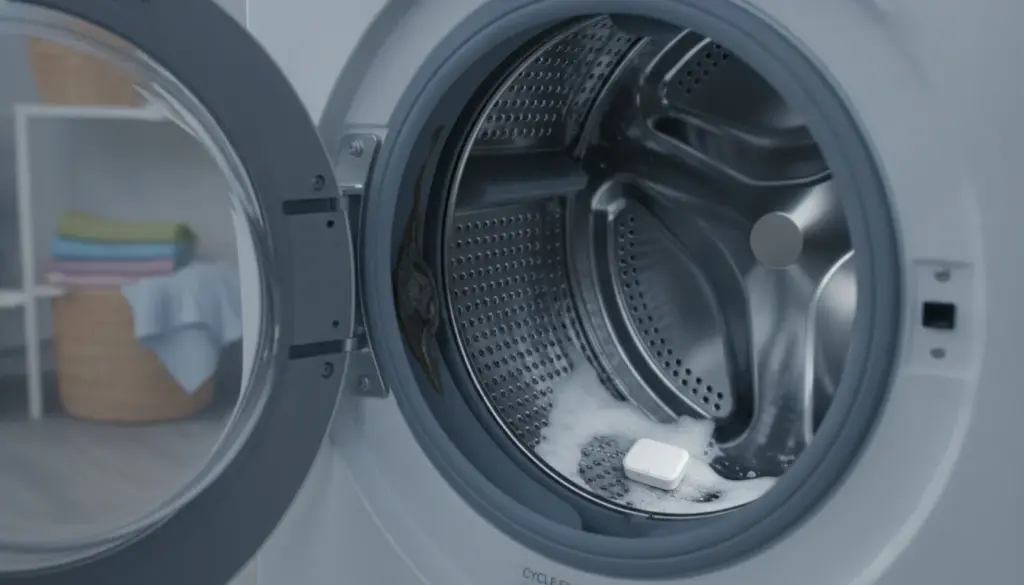
The methodology is remarkably uncomplicated. Simply place a single dishwasher tab directly inside the empty drum of your machine, shut the door, and select a standard 60-degree wash. Do not add any laundry or extra soap; you are essentially putting the appliance itself through a wash cycle. As the tablet breaks down in the hot water, powerful enzymes and concentrated cleaning agents are released to attack the stubborn greasy film lining the machine’s internal components.
The high water temperature is crucial, as it allows the dissolved tablet to penetrate the most inaccessible crevices. Behind the door seal and along the outer tub wall, a chemical reaction occurs that you cannot see, but will certainly notice afterward. The strategic combination of sustained heat, potent degreasers, and mechanical water pressure effectively breaks down the thick sludge and eliminates that lingering sewer-like draft.
Consider the experience of one homeowner who spent years battling smelly athletic wear before attempting this exact method. Despite owning a premium, energy-efficient machine that was less than six years old and frequently run empty, her laundry would smell sour within a single day of sitting in the closet. Frustrated on a weekend morning, she finally tested the theory: one dishwashing tablet, an empty drum, and a sixty-degree setting.
Upon opening the door after the cycle finished, the difference was immediately apparent. The interior smelled entirely neutral, reminiscent of a brand-new appliance. Her next load of thick bath towels emerged flawlessly fresh, requiring absolutely no artificially sweet fabric softener to hide any lingering dampness. She later joked about why nobody had shared this practical wisdom a decade earlier.
From a technical standpoint, the science behind this is perfectly logical rather than magical. Dishwasher tablets are specifically formulated with highly active degreasers, biological enzymes, and oxygen-based bleaching agents. They are engineered to strip baked-on food proteins and hardened cooking fats from plates and pans, operating optimally at temperatures between 55 and 65 degrees. This is the exact thermal range where sticky sludge breaks down and odor-causing bacteria perish.
By introducing this concentrated tablet to your laundry routine, you are essentially performing a specialized deep clean. It utilizes the exact same cleaning mechanics: breaking down heavy fats and tough residues using relatively high heat and a powerful surfactant. While some appliance manufacturers might raise an eyebrow at this off-label usage, practical results in countless households prove its undeniable effectiveness as a periodic reset, provided it is not overused.
How to properly tackle washing machine sludge without the guilt
Establishing this maintenance routine requires minimal effort. Begin by ensuring the washing drum is completely empty. Toss exactly one dishwasher tablet straight into the main drum—do not place it in the pull-out soap dispenser. Select a standard 60-degree cycle with a normal duration, avoiding any quick-wash settings. Simply press start and let the machine run its full course.
Once the machine beeps to signal completion, grab a clean cloth and thoroughly dry the inside of the rubber door gasket, wiping away any loosened gray sludge. Pull out the detergent drawer completely and give it a quick rinse under the kitchen tap to clear out stray powder or liquid. Finally, leave the main door slightly ajar for a few hours to ensure the interior dries entirely. This pairs the chemical strength of the tablet with the timeless, highly effective practice of proper ventilation.
Many appliance owners carry a strange sense of guilt upon realizing how neglected their expensive machines have become, akin to forgetting to water a prized houseplant. There is no need for this. Modern washers are heavily marketed as autonomous cleaning robots, making it incredibly easy for internal maintenance to slip our minds completely.
Realistically, nobody perfectly tends to their domestic appliances on a daily basis. Running a dedicated hot wash just once a month represents a massive improvement for the average household. If you choose to utilize the dishwasher tablet trick, doing so every two to three months is perfectly sufficient. Between these deeper cleans, occasionally washing durable items like bed sheets or heavy towels at sixty degrees offers great preventative benefits.
An experienced repair technician, who spent two decades servicing broken household appliances, perfectly summarized the situation: “Ninety percent of washing machine malfunctions stem from accumulated dirt that was never flushed out. Customers constantly assume they have a complex mechanical failure, but the culprit is usually just congealed grease and old soap.”
To keep things simple, here is an easy-to-remember checklist for appliance longevity:
- Monthly: Run an empty cycle at 60 degrees (with or without a cleaning tablet).
- After every load: Leave both the main door and the detergent drawer slightly ajar to air out.
- Every few weeks: Wipe down the rubber door seal with a damp cloth to catch early buildup.
- Biannually: Unscrew and rinse the small drain filter located at the bottom front of the unit.
A truly clean appliance shifts more than just the laundry’s scent
Once you have experienced the absolute neutrality of a thoroughly descaled drum, you immediately begin recognizing that distinct “old washer smell” everywhere else. You will catch whiffs of it in vacation rentals, guest bathrooms, and college dormitories. It serves as a surprising olfactory reality check, making you realize how long you previously tolerated semi-fresh clothing.
A sanitized interior also allows your regular laundry detergent to perform significantly better. With zero competing grime to fight, you will notice fewer soap streaks, less residue on dark fabrics, and no more desperate reliance on excessive fabric softeners to mask funky odors. Your wardrobe maintains its quality longer, and bath towels regain their intended absorbency rather than feeling like perpetually damp rags.
This discussion regarding detergent sludge touches on a much broader behavioral pattern: how heavily we rely on complex appliances without understanding their basic needs. We blindly trust rapid eco-cycles and heavily perfumed scent boosters to do all the heavy lifting. Meanwhile, the incredibly basic combination of hot water and a concentrated degreasing tablet consistently outperforms shelves full of specialized, expensive cleaning liquids.
This undeniable effectiveness is precisely why the hack spreads so quickly through word of mouth. A neighbor shares it across the fence, coworkers discuss it over lunch, and family members text the instructions to one another. Before long, entire apartment buildings are running empty washing machines on a Saturday afternoon, letting a small, unassuming tablet do the hard work.
You might soon find yourself standing in front of your own open appliance, holding a dishwashing tablet and feeling slightly skeptical. But then you will remember those sour-smelling gym clothes, the musty bath mats, and the time a houseguest politely asked if you had a different blanket because theirs smelled a bit strange.
The ultimate beauty of this method is its sheer accessibility. You do not need to become an obsessive cleaner to see results. You merely need to adopt one effortless monthly habit: an empty drum, sixty degrees, and a single tablet. The results will naturally follow—first in the crisp air of your laundry room, then in your wardrobe, and finally in the quiet satisfaction you feel when you open the washer door and smell absolutely nothing.
Frequently Asked Questions
Can a dishwasher tablet permanently damage my washing machine?
When utilized occasionally (roughly once every two to three months), the risk to internal components is incredibly low. Never use multiple tablets at once, and avoid selecting boiling-hot cycles above 60 degrees.
Is it safe to use an eco-friendly dishwasher tablet?
Yes. As long as the environmentally friendly tablet contains active degreasing agents and is formulated to dissolve at temperatures around 55 to 60 degrees, the cleaning principle remains entirely the same.
How do I definitively know if my machine is suffering from scrud?
The most common indicators include laundry that smells slightly sour after drying, mysterious gray flakes sticking to dark clothing, and a noticeable swampy odor escaping when you open the appliance door.
Does this method work better than purchasing specialized washing machine cleaners?
Dishwasher tabs are generally much cheaper and feature highly aggressive degreasers. While commercial washing machine cleaners are explicitly formulated for the appliance, both products operate on highly comparable chemical principles.
Should I completely stop buying dedicated washing machine cleaners?
You can easily alternate between the two. The tablet serves as a highly effective, budget-friendly deep clean, while dedicated appliance cleaners can be used in between if that provides you with better peace of mind.