
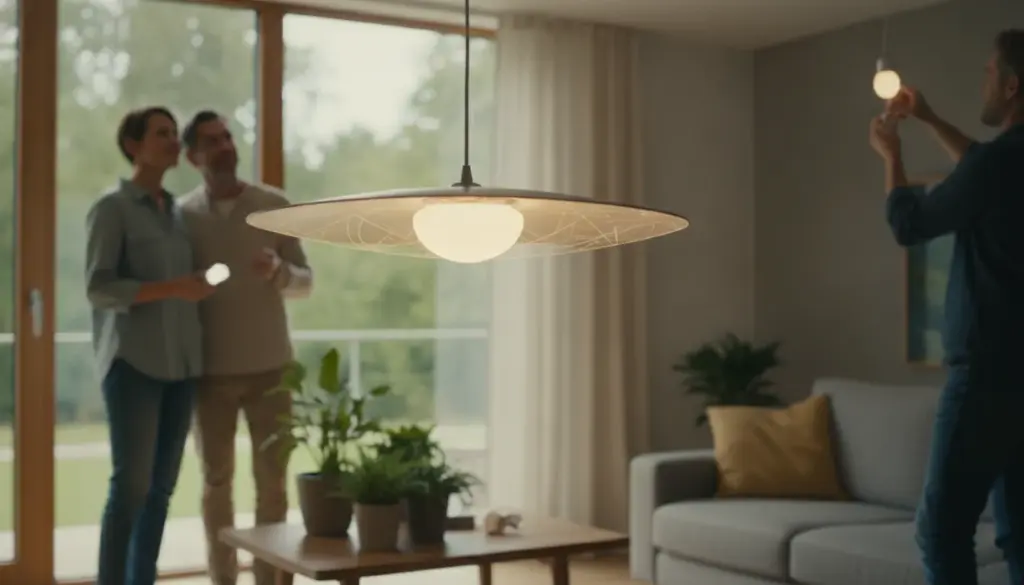
The Next Evolution Beyond Traditional LEDs
A growing number of homeowners assume their journey to energy-efficient lighting ended the moment they installed LED fixtures across their houses. For years, the LED bulb was championed as the ultimate finish line in power conservation. With its minimal energy draw, fantastic lifespan, and excellent color accuracy, the case seemed definitively closed.
However, the global lighting industry is far from stagnant. Engineers are constantly experimenting with fresh materials, alternative power generation methods, and hyper-efficient circuitry. Because of this relentless innovation, a formidable new alternative is now stepping into the spotlight, putting serious pressure on traditional LED technology.
Understanding Our Massive Shift to LED
The widespread adoption of LEDs truly kicked off when the classic, heat-generating incandescent bulb was regulated out of existence. Suddenly, everyday consumers had to navigate unfamiliar concepts like wattages, lumens, and complex energy labels. While it required a bit of a learning curve, the financial benefits became immediately apparent.
Let’s break down a common household scenario: an 8-watt LED bulb. Assuming an electricity rate of roughly 40 cents per kWh, running that single bulb costs a mere 0.32 eurocents per hour. If it stays on for an average of three hours a day, your annual operating cost sits comfortably under four euros. When stacked against an old-school 60-watt bulb, you easily pocket around ten euros per year, per socket.
Modern LEDs have drastically slashed domestic electricity bills by consuming 80 to 90 percent less energy than classic incandescent models.
Beyond the immediate financial relief, high-quality LED bulbs simply refuse to die quickly. Lifespans spanning ten to twenty thousand illuminated hours are now the industry standard. For the average consumer, this felt like a practical revolution—fewer trips to the hardware store, drastically less glass waste, and zero maintenance headaches.
The Quiet Decline of the CFL Energy Saver
Before LEDs truly dominated, there was an awkward transitional phase: the compact fluorescent lamp (CFL). These squiggly glass tubes were marketed heavily as the ultimate eco-friendly choice, yet they were essentially a compromise riddled with obvious flaws.
- Higher electrical draw compared to an LED pushing out the exact same brightness.
- Sluggish warm-up times before reaching maximum illumination, particularly in cold environments.
- Toxic mercury content, making safe recycling an absolute nightmare.
- High sensitivity to being flicked on and off frequently, which severely degraded their lifespan.
Environmental protection agencies across Europe have spent years warning the public about the mercury hidden inside these older fixtures. The ongoing guidance remains strict: always check the packaging symbols and drop off old CFLs at dedicated recycling centers. They absolutely never belong in your standard household trash bin.
Meet the New Challenger: OLED Illumination
While plenty of living rooms are still just settling into the LED era, visionary manufacturers are already perfecting the next major leap: Organic LEDs, commonly known as OLEDs. You likely recognize OLED technology from premium television screens and high-end smartphone displays, yet this exact same technology holds massive potential for illuminating our physical spaces.
A standard LED acts as an intense, singular point of light, which is exactly why it usually needs to be hidden behind frosted diffusers or metallic reflectors. Conversely, an OLED panel is a whisper-thin, perfectly flat surface that glows intrinsically. This creates incredibly smooth, beautifully diffused lighting completely free of harsh glare or sharp shadows.
Under laboratory conditions, these highly efficient OLED panels emit perfectly uniform light and can achieve an impressive lifespan of up to 50,000 hours.
The Mechanics Behind an OLED Fixture
Broadly speaking, an OLED is constructed from ultra-thin organic layers sandwiched tightly between two active electrodes. The moment an electrical current flows through this microscopic structure, the entire surface begins to glow. While the foundational physics share similarities with standard LEDs, the specific materials and micrometer-thin layers ensure the illumination radiates from a broad canvas rather than a harsh, single dot.
Slashing Waste and Unlocking Design Potential
A frequently highlighted advantage of OLED technology is its minimalist material footprint. Because these panels rely primarily on wafer-thin organic compounds, they significantly reduce raw material consumption and manufacturing waste. Compared to standard LED modules that require bulky metal heat sinks and complex plastic lenses, an OLED panel is incredibly streamlined.
Thanks to this incredibly flat, and sometimes fully flexible architecture, interior designers can execute concepts that were historically impossible with traditional bulbs. Imagine a desk surface that emits its own soft glow, cabinet interiors with perfectly seamless illumination, or a ceiling designed to look like a radiant, glowing cloud.
For architectural experts, OLED panels represent a paradigm shift: lighting no longer needs to be a physical object hanging in a room, but can instead become a native, glowing part of the surface itself.
Analyzing the True Efficiency: OLED vs. LED
The ultimate question for the pragmatic consumer remains: how will this impact my monthly utility bill? In highly specific scenarios—particularly when illuminating large, uniform surface areas like wall panels or ceiling grids—modern OLEDs perform just as well as top-tier LED setups, sometimes requiring even less wattage.
Yet, a crucial bit of nuance is necessary. Standard E27 socket replacement bulbs are still firmly dominated by traditional LEDs. On raw technical specifications, high-end LEDs currently boast slightly better energy efficiency than the latest OLED panels. However, because OLED technology distributes its light so perfectly evenly, humans perceive the exact same level of visual comfort at significantly lower absolute brightness levels.
If you are currently replacing old halogen or CFL bulbs with a premium LED, you are still making an incredibly smart financial decision. OLED should be viewed as a complementary technology that allows us to reimagine the physical shape of our light fixtures.
What This Shift Means for Your Living Space
You are highly unlikely to rip out all your perfectly good LED bulbs tomorrow morning. Instead, the broader perspective on interior design is shifting. Rather than relying on isolated lamps, fully integrated architectural lighting is becoming the new standard.
Here are a few highly probable scenarios for the near future:
- Bathroom mirrors featuring integrated OLED borders that draw almost zero electricity while providing perfect facial lighting.
- Kitchen cabinetry that glows softly from within, completely devoid of bulky, visible fixtures.
- Office environments utilizing massive OLED ceiling tiles that perfectly mimic natural daylight to drastically reduce employee eye strain.
For traditional or older homes, this technology will likely arrive via targeted, high-end upgrades: a sleek OLED panel hovering over a home office desk, a futuristic architectural fixture in the dining room, or an ultra-minimalist reading lamp. Meanwhile, standard LED bulbs will continue managing the basic ceiling spotlights.
Navigating the Disposal of Outdated Bulbs
Upgrading your lighting setup inevitably leaves you with old bulbs to discard, a process where many consumers still make crucial errors. Far too often, broken incandescent, CFL, and even LED bulbs are carelessly tossed straight into the standard kitchen trash.
Depending on the bulb type, this can be illegal due to hidden electronics or heavy metals. Keep these golden rules in mind:
- Incandescent and halogen bulbs: Generally accepted in standard household waste, though it is always wise to double-check your local municipal guidelines.
- CFLs and fluorescent tubes: Must absolutely be surrendered to a certified recycling center due to their toxic mercury content.
- LED bulbs and electronic fixtures: Should always be treated and processed as small electronic waste (e-waste).
As advanced technologies like OLED gain market share, they will eventually receive their own strict recycling protocols to harvest their valuable internal materials. By disposing of your lighting properly, you directly ensure precious raw materials re-enter the manufacturing ecosystem.
Calculating the Realistic Financial Upside
A sober mathematical breakdown helps keep our financial expectations grounded. Imagine a typical household running twenty 8-watt LED bulbs for three hours every single day. That translates to an annual energy consumption of roughly 175 kWh. At a rate of 40 cents per kWh, your yearly lighting cost hovers right around 70 euros.
Even if a futuristic OLED installation improves your home’s lighting efficiency by an additional 30 percent, that specific portion of your energy bill would only drop from 70 to about 49 euros. A pleasant 21-euro discount, certainly, but hardly a financial earthquake. You will still secure far greater utility savings through simple behavioral tweaks: turning off lights in empty rooms, ditching unnecessary ambient lighting, and finally replacing massive energy hogs like a twenty-year-old refrigerator.
If your home is already fully transitioned to LED, you have already conquered the most significant drop in power consumption. Moving forward, OLED is primarily about elevating your daily comfort and unlocking stunning interior design.
Demystifying the Jargon: Lumens, Watts, and Lifespans
With technology evolving so rapidly, it is incredibly easy to get lost in a sea of technical specifications. Three essential terms dictate lighting performance:
- Watt (W): This dictates the raw electrical power being consumed. If the brightness is identical, a lower wattage indicates a superior, more efficient bulb.
- Lumen (lm): This quantifies the exact volume of light the fixture emits. It is the perfect metric for directly comparing drastically different technologies.
- Rated Lifespan: The projected number of operational hours before the fixture exhibits a noticeable, permanent drop in its brightness.
Expert Tip: When shopping, do not just stare at the wattage. Instead, look for the lumens per watt ratio. This specific calculation provides the most realistic picture of a product’s true efficiency. Thankfully, both LED and OLED manufacturers are increasingly highlighting this exact ratio right on the front packaging.
Smart Upgrades You Can Make Today
Even if you aren’t quite ready to invest in premium OLED panels, you can still optimize your current setup immediately. Pay close attention to the color temperature, measured in Kelvin (K). For cozy living rooms and bedrooms, most people prefer the warmth of 2,700 to 3,000 K. Conversely, active spaces like home offices or bustling kitchens benefit greatly from crisper, cooler light sitting around 4,000 K.
Furthermore, never overlook dimming capabilities. Older or cheaper LEDs notorious for flickering wildly or shifting colors when paired with a dimmer switch. The newest generations of both LED and OLED solutions prioritize incredibly smooth dimming curves. This allows a single room fixture to effortlessly pivot from intensely bright daytime productivity to a soft, relaxing evening ambiance.