
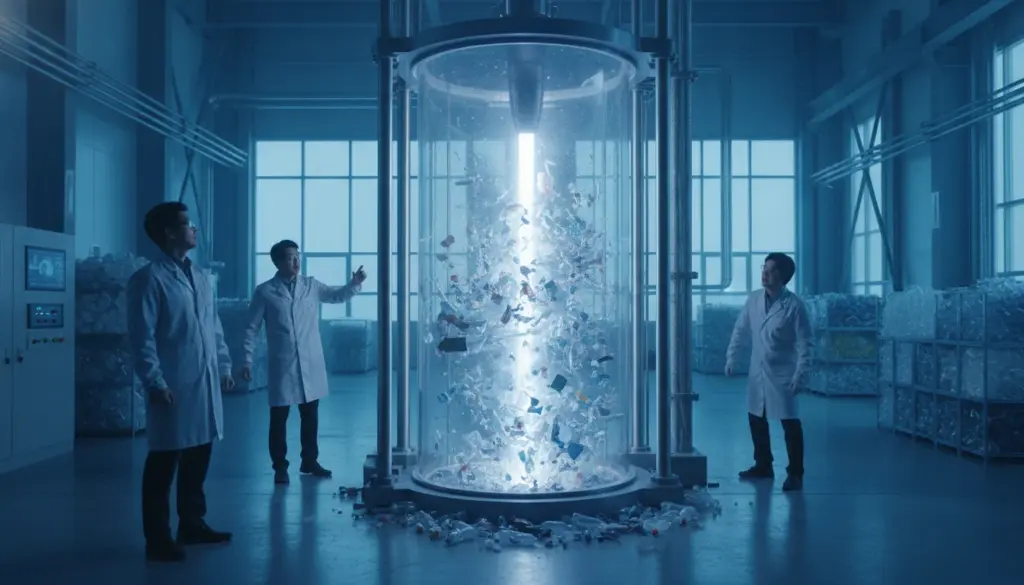
A Radical Shift in Material Recovery
South Korean researchers have unveiled an innovative technological breakthrough. This advanced development has the potential to reach far beyond traditional laboratory walls and conventional incinerators, offering a completely fresh perspective on waste management.
Why Traditional Plastic Recycling Is Hitting a Wall
While waste separation has become a daily household habit for many, the reality behind the scenes remains incredibly complex. Only a tiny fraction of our sorted materials ever transforms back into fresh consumer goods. Instead, the vast majority is ultimately downgraded, exported across the globe, or simply thrown into massive municipal incinerators.
One of the most widespread processing methods currently utilized is pyrolysis. This technique involves heating shredded refuse to roughly 600 degrees Celsius, forcing the material to break down into a messy combination of solid residues, gases, and oil-like liquids. Because only a minute percentage of this resulting output is viable as fuel or raw manufacturing material, the rest remains highly problematic.
This conventional approach consistently struggles with three primary roadblocks:
- Massive CO₂ emissions caused by the initial burning and subsequent post-combustion phases.
- Highly toxic flue gases that require heavily specialized and incredibly expensive filtration systems.
- Residual waste streams that possess almost zero economic value in the current market.
Consequently, the modern recycling chain often just shifts the environmental burden elsewhere. We essentially trade highly visible mountains of garbage for invisible carbon footprints and stubborn chemical residues. As global industrial demand for synthetic materials continues to surge, the catalog of genuinely viable countermeasures remains painfully short. Now, a new high-temperature approach—closer to advanced molecular chemistry than standard incineration—aims to bridge this massive gap.
What Sets the South Korean Plasma Torch Apart?
Engineers at the Korea Institute of Machinery & Materials recently announced a sophisticated process capable of converting unsorted plastic refuse directly into pure base chemicals. According to the development team, this represents the very first commercial breakthrough utilizing advanced plasma technology for this highly specific application.
Rather than subjecting the collected waste to a slow, traditional heating cycle, the material is blasted with an intensely hot stream of ionized gas. Operating at extreme temperatures between 1,000 and 2,000 degrees Celsius, this environment far exceeds the typical thermal thresholds of standard pyrolysis.
The most remarkable aspect of this engineering feat is the sheer speed of the reaction. Within a mere 0.01 seconds, complex polymers completely disintegrate into basic molecular structures. This lightning-fast transformation primarily yields two highly sought-after compounds:
- Benzene – a fundamental building block essential for countless industrial chemicals and synthetic materials.
- Ethylene – one of the most critical foundational components required to manufacture fresh, high-quality plastics.
By sourcing ethylene and benzene from discarded consumer goods rather than extracted crude oil, the manufacturing sector could finally inch closer to a genuinely closed-loop system. The research institute emphasizes that this innovation provides much cleaner output streams alongside superior efficiency. Impressively, the facility is designed to seamlessly handle thoroughly mixed batches of waste, completely eliminating the need for meticulous, energy-intensive pre-sorting.
Hydrogen Power: Is It Truly Climate-Friendly?
Generating such extreme, localized heat inherently demands an enormous amount of energy. However, this specific Korean design avoids relying on coal or natural gas, opting instead to power the intense electrical arc entirely with hydrogen.
While this sounds environmentally ideal on paper, the actual climate benefits hinge entirely on the specific type of hydrogen utilized. Green hydrogen, generated via renewable electricity, dramatically slashes overall emissions. Conversely, blue or gray variants derived directly from fossil fuels simply push the carbon footprint further up the industrial supply chain.
The engineering team argues that their high-tech setup can aggressively minimize environmental impact, potentially pushing emissions near zero, provided that a steady, reliable supply of clean hydrogen is maintained. As European nations aggressively develop their own green energy strategies, this operational requirement will serve as a crucial testing ground for widespread global adoption.
A Global Milestone, Yet Not a Magic Bullet
Environmental organizations frequently emphasize that processing waste alone will never entirely solve our broader ecological crisis. The persistent industry notion of infinite material recyclability has long been critiqued as a myth, as physical quality inevitably degrades after multiple mechanical cycles, consistently leading to environmental leakage.
While this superheated gas technology doesn’t erase those fundamental critiques, it completely shifts the industrial conversation. By moving away from low-grade mechanical downcycling, significant volumes of garbage can now be transformed back into high-value monomers. This monumental shift provides major chemical manufacturers with a genuine financial incentive to establish truly closed, sustainable supply chains.
The overarching challenge naturally evolves from simply finding a place to dump collected packaging to figuring out how to keep precious carbon atoms circulating within an industrial loop indefinitely.
Nevertheless, significant hurdles regarding structural safety, operational cost, and overall scalability remain. Running a plant that disintegrates materials in a fraction of a second necessitates highly heat-resistant infrastructure, rigorous safety protocols, and an incredibly stable supply chain. Municipalities and regional waste handlers will need to secure robust logistical contracts before this futuristic concept can operate on a massive, meaningful scale.
Implications for the European Industrial Hub
Regions with historically strong chemical sectors are aggressively hunting for actionable pathways to reduce their deep reliance on imported fossil fuels. A high-tech thermal facility aligns perfectly with this strategic industrial transition, offering a localized solution for complex material recovery.
This creates an entirely new playing field for regional governments. Rather than funding the expensive, carbon-heavy export of hard-to-process garbage to distant nations, establishing local processing hubs could become a highly lucrative commercial alternative. Everything from standard household packaging and mixed corporate waste to heavily soiled agricultural films could suddenly serve as incredibly valuable input materials.
Potential regional advantages of adopting this tech include:
- Reduced incineration of synthetic materials in traditional municipal energy plants.
- Fresh financial investments directed toward sustainable, circular chemistry clusters.
- Job retention within the heavy processing industry through a modernized, greener operational profile.
- Decreased dependency on imported natural gas and foreign oil for chemical manufacturing.
Technical and Societal Hurdles
Ensuring Output Quality
The core promise of this engineering team relies heavily on delivering immaculately pure streams of ethylene and benzene. For this concept to thrive outside a laboratory, operators must definitively prove that their recovered molecules can seamlessly compete with standard petrochemical alternatives. This reality demands highly reliable continuous processing alongside incredibly strict quality control measures.
Managing Processing Costs
Operating a plasma-driven facility involves immense technological complexity. Initial infrastructure investments will undoubtedly dwarf the costs associated with basic pyrolysis lines or classic incinerators. The financial equation only balances if carbon emissions face heavier taxation, the price of virgin fossil resources climbs continuously, and governments offer long-term stability through highly supportive financial policies.
Securing Social Acceptance
For nearby residents, the concept of vaporizing local garbage with a roaring, superheated electrical arc sounds inherently intimidating. Transparent public communication regarding advanced safety standards, continuous emission monitoring, and strict operational protocols is absolutely essential. Failing to deeply engage the community risks triggering intense pushback, much like the historic resistance faced by massive chemical parks and older waste burners.
Understanding the Science: What Is Plasma?
Many discussions surrounding this innovation skip past the fundamental physics of the process itself. Plasma is widely recognized within the scientific community as the fourth state of matter, existing distinctively alongside gases, liquids, and solids. It occurs when a standard gas is subjected to such extreme heat that electrons literally rip away from their parent atoms. This resulting soup of highly charged particles conducts electricity beautifully and reacts with other substances at astonishing, almost instantaneous speeds.
We routinely observe these dynamic forces in nature through lightning strikes and the northern lights, while commercial applications heavily utilize them in neon signage. In heavy manufacturing, these charged torches harness those exact properties to rapidly slice, melt, or—in this specific scenario—rip materials apart at a microscopic, molecular level.
By forcing discarded packaging through this intensely energetic flame, incredibly long polymer chains are violently pushed back into their simplest foundational building blocks in mere milliseconds.
Looking Ahead: Scaling a Nascent Industry
According to the development institute, the next critical phase involves comprehensive demonstration projects alongside an aggressive push toward commercialization. This strategic move means transitioning to semi-industrial testing environments capable of handling massive metric tons rather than mere grams. Industry stakeholders, from consumer manufacturers to municipal disposal companies, will meticulously analyze how well the machinery performs under wildly fluctuating input conditions.
For policymakers focused on global sustainability, this engineering innovation presents a unique opportunity to carefully evaluate competing operational models. How does high-temperature molecular breakdown stack up against reusable packaging models, strict material bans, or the rapid rise of bioplastics? A heavily blended strategy is widely anticipated, with advanced thermal recycling stepping in specifically to conquer the absolute most problematic, hard-to-treat residual streams.
Professionals looking deeper into industrial sustainability often evaluate a broader family of advanced techniques, including gasification, depolymerization, and complex solvolysis. Sophisticated modeling frequently simulates how these combined strategies could drastically slash global demand for virgin polymers over the coming decades. This lightning-fast South Korean development simply adds a highly specialized, ultra-high-temperature tool to that rapidly growing environmental toolkit.
For large manufacturing hubs, the most practical immediate step involves rigorously auditing their existing material flows to identify contamination levels, total volumes, and specific polymer types. That precise baseline data will ultimately dictate whether a localized plasma reactor remains a specialized niche concept, or beautifully blossoms into a foundational pillar of the upcoming circular economy.