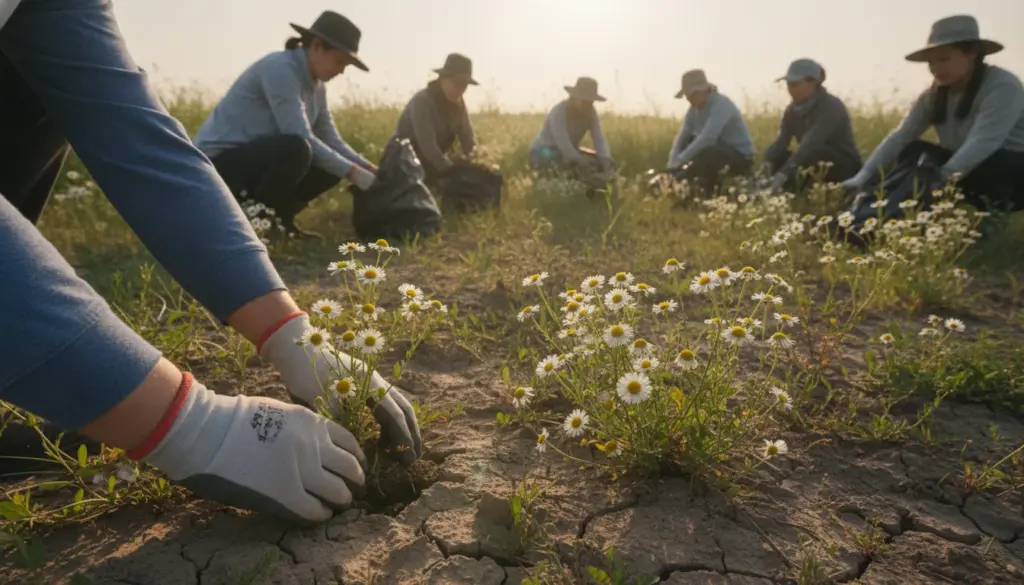
Yanking a beautiful flower from the soil always feels a bit wrong. However, when dealing with this specific plant, there is simply no alternative. Recently, I joined a local nature conservation group for a hands-on neophyte management session. While it might sound like a dry academic lecture, it actually involved grueling outdoor work under the blazing sun, battling mosquitoes and ticks.
Our primary target? A highly invasive little plant you have almost certainly walked past without noticing. The annual fleabane (Erigeron annuus) looks incredibly charming, resembling an overgrown daisy. Despite its delicate appearance, it is rapidly taking over home gardens. If you spot it, remove it right away, or it will claim your entire yard as its territory.
Why is annual fleabane such a massive problem?
When passersby see you aggressively tearing a cute flower out of the ground, they often give you confused looks. Yet, hiding behind that innocent, cheerful facade is a highly aggressive invasive neophyte originally from North America. This stubborn intruder establishes dominance in our meadows and garden beds before we even realize it has arrived.
Once it takes root, annual fleabane ruthlessly crowds out native grasses and wildflowers. It creates incredibly dense patches where local flora simply cannot survive, leading to a severe drop in biodiversity. As a gardening enthusiast, the sheer speed of this takeover absolutely shocked me. A single plant can generate up to 50,000 airborne seeds. These feather-light seeds are easily carried by the wind across vast distances and remain viable in the soil for more than five years. If you are hoping the problem will just resolve itself over winter, you are out of luck. Consistent, hard work is the only way to banish it from your property.
The magical history behind its name
In Germany, the plant is known as “Berufkraut,” which stems from an ancient superstition. Hundreds of years ago, people believed this herb offered powerful protection against dark magic and evil spirits. It was commonly used in protective rituals, such as placing a few sprigs inside a newborn’s cradle. While its magical warding abilities are highly questionable today, we know for a fact that it will not miraculously disappear from your flowerbeds without physical intervention.
How to identify the invasive fleabane
To effectively manage your yard, you need to know exactly what you are looking for. Here is a quick breakdown of the annual fleabane’s distinct characteristics:
- Origin: Hails from North America and was originally brought to Europe as a decorative ornamental.
- Growth habit: An annual or biennial herbaceous plant that shoots up to 1.20 meters tall on a noticeably hairy stem.
- Flowers: Blooming from June through October, it features numerous tiny flower heads with bright yellow centers surrounded by fine, thread-like white or pale lilac petals.
- Foliage: The light green leaves grow alternately along the stem and are fuzzy on both sides. The shape transitions from round at the bottom to narrow and lance-like near the top.
- Spread: It multiplies exclusively through seed dispersal, dropping up to 50,000 flying seeds per specimen.
- Preferred locations: Thrives in open, sun-drenched areas. You will frequently spot it along roadsides, in empty lots, across wild meadows, and right in the middle of cultivated gardens.
Beware of look-alikes
Before you start a massive weeding campaign, make sure you are targeting the right species. It is incredibly easy to confuse annual fleabane with true chamomile. However, chamomile features divided foliage and fewer, much wider petals. You might also encounter similar relatives like the Canadian fleabane or the native acrid fleabane, though these tend to have noticeably shorter petals. Some gardeners also cultivate the low-growing Spanish daisy or Mexican fleabane as perennials, which are equally non-native but visually similar.
Your action plan: Getting rid of fleabane for good
The golden rule of weed management is to strike before the plant has a chance to blossom and set seed. Stay vigilant between April and October, yanking out any suspicious sprouts immediately. Half-hearted weeding is actually worse than doing nothing, as the plant will often respond with even more aggressive growth.
- Tackling minor invasions: If you only have a few rogue plants, pull them out manually. Make sure to extract the entire root system, because any leftover root fragments will quickly sprout anew. The ideal time for this is spring, right before the June blooms. Check the area every three to four weeks. Expert tip: Wait until after a heavy rainstorm; the softened earth makes uprooting a breeze. Use a small digging fork for compacted soil.
- Handling large infestations: If a whole field is overrun, you must mow the area deeply three to six times a season to prevent flowering. Leaving the cut grass behind is a massive mistake—pulled weeds can undergo emergency ripening and still produce viable seeds. Be aware that mowing just once will only stimulate the plant to grow back stronger.
- Proper disposal methods: Any plant material containing flowers or seed pods must go straight into your household garbage to stop the cycle of spread. If you manage to catch them early, stems and leaves without blossoms or roots are perfectly safe to toss on your compost pile.
It certainly feels strange to destroy such a delicate-looking bloom. Yet, doing so protects our fragile local ecosystems. If you stay consistent with your eradication efforts, you will see a dramatically cleaner, healthier garden by next spring. That kind of tangible success is incredibly rewarding for any dedicated gardener!