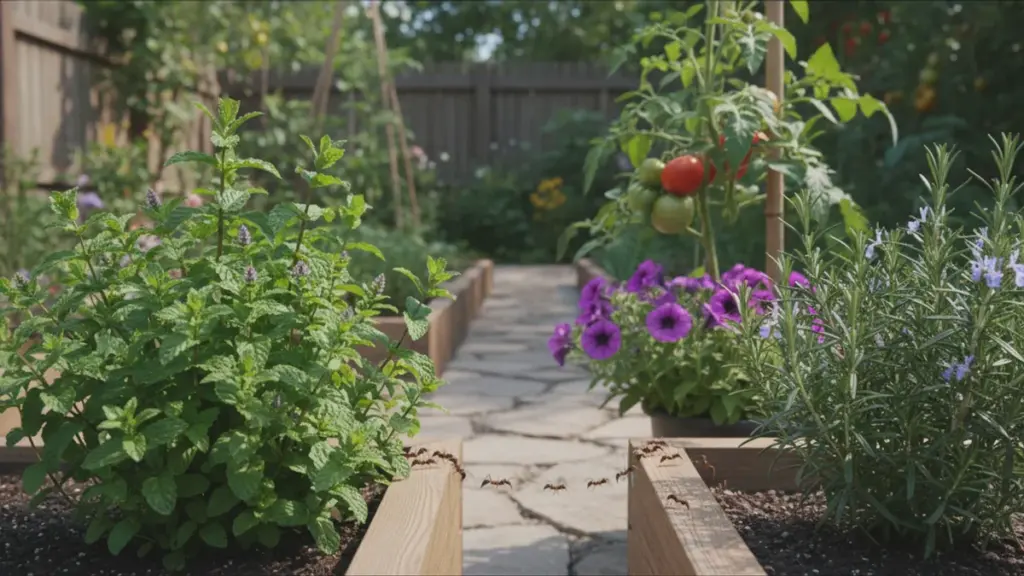
Within a matter of days, ants can spread through vegetable and flower beds. Chemical sprays may look like the easiest answer, but they pose a genuine risk when used in a productive garden.
That is why more and more gardeners are turning to a gentler approach: growing plants whose natural fragrance discourages ants from marching across tomato plants and petunias. Just two familiar, widely available and pleasantly scented herbs may be enough to reduce these unwanted visitors significantly in the garden’s most vulnerable areas.
Why ants communicate through scent – and how gardeners can use this to their advantage
Ants live in vast colonies and navigate the garden by following scent trails laid down by worker ants. One ant discovers a food source, leaves a “perfumed” route behind it and the rest of the colony follows.
To disrupt the traffic, the trail needs to be broken or masked. Once the scent signals become confused, ants lose their bearings and often lose interest in the area as well.
Strongly aromatic herbs work in precisely this way. Their essential oils create a kind of scented screen in the air, making the ants’ delicate chemical signals much harder to detect. To us, it is the pleasant aroma of lavender or mint. To an ant, it is an overwhelming maze of competing smells.
Why ants find certain herbs so difficult to tolerate
Strongly scented plants do not poison ants. Instead, they interfere with the colony’s communication system, encouraging the insects to redirect their activity elsewhere.
Plants commonly associated with deterring ants include basil, lemon balm, rosemary and tansy. In practice, however, two herbs stand out for being both effective and easy to grow: lavender and mint.
Entomologists confirm that essential oils produced by aromatic plants can disrupt ants’ chemical communication. Worker ants are no longer able to follow pheromone trails as efficiently, so the colony struggles to forage successfully in that particular area. This is why strongly scented herbs can work as a natural barrier without the need for conventional insecticides.
Specialists at botanical and university gardens often recommend combining several aromatic species around vegetable beds. This kind of planting does more than discourage ants: it can also attract valuable pollinators, including bees and bumblebees. Lavender and mint can therefore offer a double benefit for the garden’s ecology.
Lavender as a fragrant barrier around beds and patios
English lavender, Lavandula angustifolia, is the classic variety seen in postcards from Provence. It serves two purposes in the garden: it adds colour and structure while also acting as a natural aromatic barrier.
Its fragrance is particularly unappealing to ants, which tend to avoid areas where the plants grow closely together.
A low lavender edging works especially well around beds containing lettuce, strawberries or carrots. This fragrant border makes it harder for large numbers of ants to march towards young plants.
A few lavender plants in a rose bed can also restrict the movement of ants that protect aphid colonies on fresh shoots.
Lavender can be just as useful in containers. A single pot placed directly on a busy ant trail may be enough to make the insects change direction. Planters positioned beside a back door, entrance or patio can also discourage ants from moving closer to the house.
Lavender needs full sun and free-draining, preferably fairly dry soil. In heavy, waterlogged ground, it will quickly decline.
• A low lavender border around strawberry and lettuce beds
• A few plants in rose beds to help limit aphids and ants
• One pot positioned directly on a busy ant trail
• Planters beside the door and patio as a fragrant barrier
• Lavender in a rockery beside garden steps
• A row of plants along the lawn edge next to the vegetable beds
It is worth trimming lavender lightly each year after flowering. This encourages dense, compact growth and creates a continuous scented line of defence.
A few pots of lavender placed at key points around the garden may prove more useful than scattering ant powder every few days.
Mint as a movable deterrent with a habit of spreading
The second plant that ants find particularly troublesome is mint. For people, its scent brings to mind tea, desserts or a refreshing jug of lemonade. Ants, however, find the aroma intensely irritating. Both spearmint and peppermint can be used.
Mint does have one major drawback: planted directly in the ground, it can spread rapidly, take over a large section of the garden and force its way between neighbouring plants.
Experienced gardeners therefore tend to grow mint in pots, troughs or bottomless buckets sunk into the soil. This method provides another advantage: the containers can be moved to wherever an ant problem appears. Mint effectively becomes a mobile scented barrier.
The stronger the plant smells, the more noticeable the effect may be. On warm days, gently rubbing or brushing the leaves releases additional essential oils and temporarily intensifies the fragrance.
Researchers at botanical gardens note that pot-grown mint can develop a concentration of essential oils comparable to that of plants growing freely in the ground. Container growing does not, therefore, necessarily reduce its deterrent effect.
How to position ant-deterring plants strategically
Even the most aromatic plants will have little impact if they are placed at random. Begin by observing the garden and mapping the ants’ regular routes: along walls, beside steps or around particular beds. These are the places where pots and lavender borders should be positioned.
The best results are achieved by creating a “scent corridor” – a line of containers and planted areas that ants would have to cross to reach their food source.
Particularly useful arrangements include a strip of lavender along the edge of a lawn where it meets the vegetable plot, pots of mint beside plants that are prone to aphids, and a combination of lavender and mint near the compost bin and pathways where ants frequently build nests.
Experts recommend observing ant movement for at least a week before planting. This makes it possible to identify the main routes and the places where the insects are most concentrated.
The herbs can then be positioned to create an effective and targeted scented barrier. Scattering lavender pots randomly around the garden will not have the same effect as placing them directly along the routes the ants actually use.
Other herbs that support lavender and mint
To strengthen the effect of this “ant-deterring duo”, several other aromatic plants can be added. Particularly useful options include:
• Rosemary, which enjoys conditions similar to lavender and works well in pots beside steps
• Garden sage, which fills gaps in rose beds and may limit the movement of both ants and aphids
• Lemon balm, which has a delicate appearance but a powerful fragrance that many insects find disruptive
• Basil, an excellent companion for tomatoes and peppers, which may receive fewer visits from ants
• Tansy, which can be effective but is toxic and must be handled and planted with care
• Marjoram, which adds another layer of fragrance while providing food for pollinators
• Common thyme, a low and resilient plant well suited to the gaps between paving stones
These plant combinations do more than discourage ants. They can improve the microclimate around the beds and attract beneficial insect life. Bees and bumblebees are particularly fond of flowering lavender, sage and thyme.
Experienced gardeners often combine lavender and rosemary in rockeries or beside raised vegetable beds.
Ants, aphids and good garden hygiene
It is important to remember that ants rarely appear without a reason. They are very often attracted by aphids, which produce a sugary substance known as honeydew.
For ants, this is a free canteen, and they guard the aphids almost as carefully as a farmer tends livestock. Wherever there are large numbers of aphids, ants will continue to return, even when the surrounding area smells strongly of lavender.
Ant-deterring herbs should therefore be combined with other measures. Regularly wash aphids from young shoots using water with a small amount of soft or insecticidal soap, avoid carrying infested cuttings over to healthy plants, clear food scraps and sugary drinks from the patio, and reduce places where water is allowed to collect in plant saucers or sheltered corners.
When the available food is reduced and lavender and mint simultaneously create a dense layer of competing fragrance, ant colonies will often relocate to quieter areas. They may move into the lawn or beneath a hedge, where they are less likely to disturb useful plants.
Researchers at entomological institutes emphasise that ants and aphids have a symbiotic relationship. The ants protect aphids from predators and receive honeydew in return.
To reduce ant numbers over the long term, the aphid problem must therefore be dealt with first. Once that has been done, aromatic herbs can keep ants away from the beds far more effectively.
Practical advice for new gardeners
People creating their first garden often wonder whether they need to plant long lines of lavender and fill several troughs with mint straight away. They do not.
A few well-positioned pots may be enough to produce a noticeable change in the ants’ behaviour.
Begin by choosing two or three places where the ants cause the greatest nuisance and concentrate the aromatic plants there. This makes it much easier to assess which arrangements are actually working.
It is also worth viewing these plants as more than a “protective shield”. They can be an attractive feature in their own right. Lavender and mint can be used to prepare homemade infusions, scented sachets for drawers and wardrobes or simple table decorations – all while keeping ants at a safe distance from the vegetable beds and patio.
Could there be a more enjoyable way to protect a garden while making the most of its fragrances and produce?