The ocean remained a deep, inky blue when the event began. Just a faint pink glow stretched across the horizon, accompanied by a gentle swell and the steady cadence of oars hitting the water. Having spent days in total isolation, the solo rower grew accustomed to hearing nothing beyond creaking wood and his own rhythmic breaths. He was surrounded by an absolute, profound silence, completely void of roaring engines or human voices. Then, that quiet shattered in an instant.
A low, muffled thud resonated from beneath the hull, followed quickly by another one slightly closer. Wiping salt spray from his vision, the man noticed the water rippling in an unnatural way, as if the ocean floor itself was forcing something upward. The spectacle that unfolded next defies all expectations.
When the Horizon Springs to Life
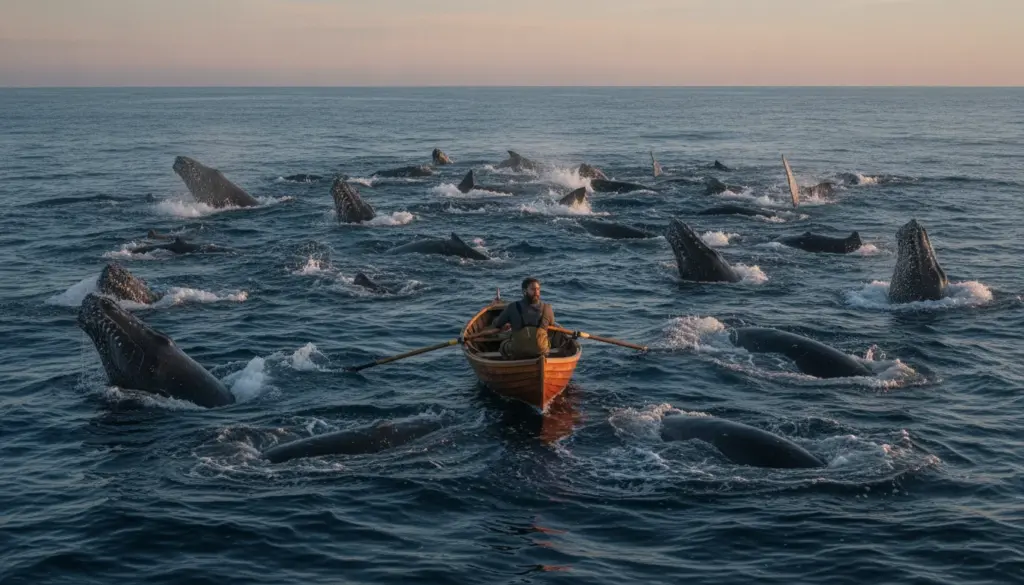
At first, his mind seemed to be playing tricks on him. A fleeting shadow appeared on the port side, soon followed by a dark, glistening back catching the morning twilight. A massive spout of water erupted skyward like a reverse downpour. Within mere moments, the count jumped from a single creature to dozens, and then hundreds. Whales surrounded him in every direction.
The previously barren skyline transformed into a dynamic wall of breaching backs, slapping tails, and towering blowholes. Frozen in his tiny vessel, the rower watched these marine giants glide effortlessly beneath the hull and surface just inches away, exhaling with immense power. The surrounding air grew thick with a warm, salty mist, carrying the distinct, musky scent of breathing wildlife. His solitary journey had abruptly ended.
Once he returned safely to shore, marine researchers worked to contextualize this incredible account. Analyzing his GPS coordinates alongside video footage, experts estimated the pod contained nearly a thousand individuals. This colossal gathering of humpbacks was likely moving along a major migration corridor or feasting on a sudden abundance of prey.
Looking at the captured recordings, the small rowboat appears entirely swallowed by the churning mass of marine life. At times, a mere three feet separated the wooden gunwales from an enormous dorsal fin. In other frames, the sheer density of exhaling spouts makes the surface look like a boiling cauldron. You can hear the man muttering quiet curses interspersed with breathless chuckles—the unmistakable nervous laughter of someone experiencing a monumental event they cannot quite process yet.
Marine biologists note that solo sailors and small expedition crews are reporting these massive gatherings with increasing frequency. While whales continue to travel ancient migratory paths, their populations are steadily rebounding in certain regions thanks to decades of strict conservation efforts. Consequently, the probability of crossing paths with a pod is rising, especially along quiet, remote stretches of water.
Simultaneously, modern adventurers are pushing deeper into previously inaccessible territories. Thanks to lightweight vessel designs and advanced satellite communication, navigating the open ocean is no longer an activity reserved solely for massive commercial freighters. As human exploration and recovering marine populations intersect, these paths occasionally collide to create surreal, magical encounters.
How to React When the Ocean Suddenly Fills Up
So, what is the right move when nearly a thousand cetaceans suddenly surround your tiny craft? Reflecting on the ordeal, the rower explained that his immediate instinct was to pull the oars out of the water and freeze entirely. He avoided any sudden jerks, fought off the rising panic, and simply focused on his breathing while observing the chaos.
That deliberate stillness likely saved his boat from disaster. Although whales possess a natural curiosity, their vision above the waterline is far from sharp. A frantic, wobbling human could easily startle or confuse the massive animals. By remaining perfectly motionless, he blended into the environment, acting as little more than a harmless piece of driftwood. He later described his strategy as simply blending into the background rather than trying to steal the spotlight.
Anyone who frequently takes a kayak or small yacht offshore knows this peculiar vulnerability. You can extensively prep for fierce gales and towering waves, yet nothing readies a person for raw, unadulterated scale. Having massive wild animals in such close proximity triggers a primal response, blending intense awe with sheer terror.
People often overestimate how bravely they would handle this type of situation in hindsight. In reality, it is impossible to properly train for a thirty-ton mammal brushing against your hull. Most individuals either freeze completely or start babbling aloud just to maintain their sanity. Still, clinging to that tiny shred of composure remains your greatest defensive tool.
The adventurer shared a profoundly memorable takeaway during his debriefing:
“They didn’t look at me as a threat or a hero. I was just a speck in their day. That was humbling and freeing all at once.”
This realization fundamentally shifted his perspective on the marine environment we arrogantly claim as our own. Humans are merely temporary guests on the water. The creatures we are lucky enough to stumble upon actually inhabit this harsh realm every single second of their lives.
For those who regularly venture out to sea, this encounter offers a few vital lessons:
- Maintain absolute stillness when giant marine life approaches, avoiding sudden arm flailing or loud shouting.
- Let the vessel drift naturally, and never attempt to steer directly toward a swimming pod.
- Prioritize situational awareness over capturing footage; personal safety always outranks social media content.
- Keep a respectful distance, remembering that these are unpredictable wild animals rather than theme park attractions.
- Give yourself grace afterward to mentally process the intense adrenaline dump you just experienced.
The Psychological Impact of an Extreme Encounter
During the days that followed this brush with nature, the solo traveler noticed a strange lingering effect. The visual memory of a thousand breaching humpbacks was powerful, but the crushing realization of scale was even heavier. He suddenly grasped how insignificant he was compared to the vastness of the natural world, highlighting the razor-thin margin between bold adventure and foolish hubris.
Lying alone in his small cabin at night, he could still hear the phantom hisses of those massive blowholes. That deep, rushing exhale blended seamlessly with his beeping navigation gear, the water slapping against the hull, and his own heartbeat. He had never felt more incredibly vulnerable, yet so undeniably alive.
Frequently Asked Questions
How rare is it to witness nearly a thousand whales at once?
Spotting a group of this magnitude in a single field of view is exceptionally uncommon. However, massive gatherings do happen during peak migration seasons or aggressive feeding frenzies, particularly in highly nutrient-dense waters.
Are whales a threat to people on small boats?
These cetaceans almost never intentionally attack humans. The primary danger stems from their sheer, colossal mass, which can cause devastating accidental damage. Remaining perfectly calm and avoiding any deliberate approaches significantly minimizes the risk of a collision.
Are you allowed to approach marine life closely for photographs?
Strict approach limits and minimum distance regulations are enforced in many jurisdictions worldwide. The basic rule of thumb is to never steer toward them. Cut your engine, drift quietly, and let the wildlife decide if they wish to investigate you.
How do these extreme encounters affect sailors psychologically?
Survivors often undergo a powerful combination of intense awe, profound humility, and deep existential contemplation. A large number of adventurers view these raw moments as turning points that permanently alter their relationship with the natural environment.
Can you effectively prepare for a massive wildlife encounter?
You can certainly build a foundation by studying typical marine behavior, mastering basic safety protocols, and mentally running through emergency scenarios. Still, facing down hundreds of giant animals in reality will always far exceed any theoretical preparation.