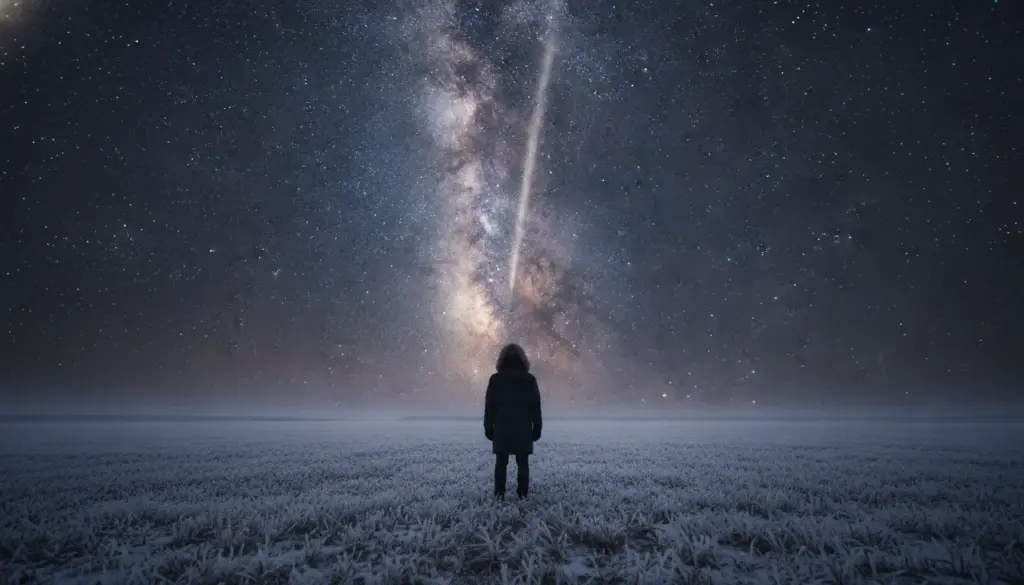
Step outside on a freezing, crisp winter evening, and the vast expanse of the night sky feels overwhelmingly close. As the daily chaos fades into silence, your gaze might drift past frosty fields up toward Orion, tracing the milky haze that slices across the darkness. While these celestial bodies sit unimaginably far away, an innate feeling often suggests that this vast distance isn’t the entire truth. A concealed connection has subtly woven our planet into the deep, intricate tapestry of the universe for eons.
Astrophysicists now describe this phenomenon as an imperceptible cosmic corridor—a structure that has bound our world to remote stars for millennia. You cannot see it with the naked eye.
Yet, it influences absolutely everything around us.
The Universe’s Secret Magnetic Highways
When experts mention a “tunnel,” they are not using the term loosely. Instead, researchers are describing colossal plasma filaments and magnetic architectures that act as invisible transit routes between our Sun, Earth, and the distant reaches of the Milky Way. These are not the fantastical wormholes found in science fiction movies where spaceships instantly warp across galaxies. They are actually vast corridors brimming with radiation, charged particles, and shifting magnetic fields. Relentless, silent, and incredibly stable.
For countless ages, our planet has rested comfortably within this intricate web, constantly bathed in cosmic flows originating from ancient, deceased stars and active stellar nurseries. The nighttime heavens may appear tranquil from our backyards, but beneath that calm facade, it is a bustling, chaotic environment.
Back in 2021, a bold proposition from a Canadian astronomer named Jennifer West captured global attention. She hypothesized that our entire Solar System could be encased within a massive, tube-like magnetic framework. This structure bridges two puzzling cosmic radio emissions known to experts as the North Polar Spur and the Fan Region.
Historically, these regions simply looked like fuzzy clouds of radio waves on astronomical charts. However, viewed through this updated astrophysical model, they transform into the sturdy walls of a gargantuan magnetic cylinder. This invisible enclosure wraps securely around Earth, extending outward for hundreds of light-years into the cosmic void.
The imagery is so profound that even the most rigorous scientists have begun adopting everyday terminology like bridge, road, and tunnel. Raw astronomical data—particle flows, field strengths, and light-year distances—struggles to capture the sheer awe of realizing we actively reside inside an encompassing cosmic structure.
Once you embrace this updated framework, our galaxy ceases to be a flat, static photograph and transforms into a dynamic, living nervous system. Elongated threads of magnetism and interstellar gas seamlessly connect quiet neighborhoods like ours to violent supernova remnants and bustling stellar nurseries.
High-energy fragments known as cosmic rays do not merely shoot through space in perfectly straight lines. Instead, they glide and spiral along these magnetized pathways, navigating unseen cosmic rails much like a roller coaster. Consequently, a massive stellar explosion that occurred millions of years ago can still deliver a delayed, energetic whisper to our atmosphere today.
This reveals that the cosmic tunnel is not a swinging door that temporarily opens and shuts. It acts as a permanent, enduring conduit where galactic forces travel continuously. Over deep stretches of time, this persistent flow subtly shapes our atmosphere, our night sky, and perhaps even long-term climate patterns.
How This Concealed Cosmic Network Impacts Earth
To visualize this phenomenon in everyday terms, consider the routine space weather forecasts sometimes featured on the evening news. Those vibrant graphics displaying incoming solar storms are essentially real-time snapshots of the invisible current flowing through our specific section of the tunnel at this very moment.
Our Sun frequently ejects massive gusts of charged material, which catch a ride on these localized magnetic structures. When these energized solar winds slam into the upper boundaries of Earth’s atmosphere, they violently spiral and collide with atmospheric atoms. The result? The breathtaking, illuminating dance of the auroras.
Every time a polar flight is suddenly rerouted for safety, or your smartphone’s GPS stutters for a brief second, you are witnessing a tangible, earthly consequence of this deep-space connection to the wider galaxy.
A fascinating anomaly occurred a few years back at a monitoring facility in Finland when an anticipated geomagnetic storm registered surprisingly weak. Upon reviewing the complex data sets, researchers discovered that the volatile solar particles hadn’t miraculously “missed” our planet.
Instead, the energetic wave followed an alternative branch of the overarching magnetic architecture. The particles navigated down a neighboring corridor, deflecting just enough to protect our orbital satellites while simultaneously triggering an outrageous display of vibrant green auroras across the Canadian wilderness.
During that very event, a photographer stationed in Yellowknife captured an aurora that resembled a glowing cosmic highway vanishing beyond the horizon. He shared the spectacular image online, noting it felt like standing beneath a colossal bridge. Unknowingly, his poetic observation was incredibly scientifically accurate.
From an astrophysical perspective, proposing a galactic tunnel is actually quite logical. The entirety of the Milky Way is intricately laced with these filamentary networks. As our Sun continuously orbits the center of the galaxy, our protective bubble of space sweeps through various magnetic ecosystems, much like a commercial jet traversing shifting atmospheric wind currents.
Across millions of years, this unhurried cosmic voyage alters the intensity and variety of cosmic radiation bombarding Earth. Some experts cautiously tie these lengthy cyclical shifts to historical climate variations or sudden bursts of biological evolution. While the fossilized evidence remains fiercely debated and complex, the overarching theme is undeniable. Earth is never isolated; it remains permanently plugged into a sprawling network far older and grander than humanity itself.
Shifting Your Perspective of the Night Sky
The next time you find yourself outdoors after dark, try a remarkably simple observational experiment. Select a prominent, glowing star or focus on the dusty band of the Milky Way, holding your gaze steady for at least thirty seconds. Put away your phone, ignore your camera, and allow your eyes to fully adjust to the surrounding darkness.
Now, mentally visualize incredibly faint, ghostly threads extending from your own chest directly up to that distant point of light. Treat this not as a playful fantasy, but as a mental representation of the very real streams of radiation and particles bridging the gap between you and that burning stellar giant.
You are quite literally standing inside an immense tunnel you cannot see, yet you can choose to feel its presence.
Generations of students were taught from textbooks that space is merely a vast, empty black void lightly sprinkled with isolated dots of light. While that simplified image is easy to digest, it severely diminishes our profound sense of cosmic belonging.
Everyone experiences moments where daily life feels claustrophobic, and the sky above seems like an impenetrable, distant ceiling rather than a limitless environment we actively inhabit.
When you recall the existence of this hidden tunnel—the swirling radio fog, the immense magnetic fields, and the cosmic rays currently passing right through your physical surroundings—that restrictive ceiling shatters. It doesn’t crush you with existential dread, but rather offers a grounding, quiet reassurance of universal connection that requires no massive telescopes or complex jargon to appreciate.
“We live in the galaxy the way fish live in the sea,” an astrophysicist once noted during a casual conversation. “They don’t see the currents, but the currents carry them all the same.”
- Visualize Earth not as a lonely rock drifting in a void, but as a critical, active node within a sprawling galactic web.
- Understand that visible starlight is merely the top layer of the cosmos; particle corridors and magnetic tunnels form the deeper underlying foundation.
- Rely on this mental framework when the night sky feels particularly cold or indifferent; you are an integrated piece of the system, not an outside observer looking in.
An Ancient Cosmic Tale That Is Just Beginning
Once you internalize the concept that space is brimming with activity rather than empty, a profound mental shift occurs. The notion that an unseen tunnel has tethered Earth to remote stars for millions of years sheds its mystical aura. It simply becomes a fascinating, ordinary fact of nature—comparable to mapping complex ocean currents after centuries of assuming the sea was just flat, featureless blue water.
You slowly begin noticing how frequently our modern daily routines brush up against this invisible reality. Vital satellite communications bounce through an agitated magnetic ocean, terrestrial power grids hum nervously under shifting geomagnetic pressure, and breathtaking polar auroras trend across social media platforms whenever the broader galaxy delivers its latest atmospheric weather report.
There is no neatly packaged moral to this astronomical discovery, nor a final philosophical lesson. Instead, it serves as a persistent, open invitation to look upward and vividly imagine those unseen corridors. They are older than any recorded human history, yet they continue to manipulate the chemistry of the air we breathe and the subtle flicker of our digital screens.
Far out in the deep black, a massive star violently collapsed and detonated millions of years ago. Its final energetic echo is still racing along those magnetized tunnels, headed straight for our solar system. We are already right in the middle of the conversation.
Frequently Asked Questions
- Is this cosmic “tunnel” a tangible physical structure or merely an imaginative metaphor?
Based on current astronomical data, it is a real physical structure comprised of measurable magnetic fields, interstellar gas, and charged particles, though it lacks the solid, touchable walls of an earthly tunnel. - Could a futuristic spacecraft actually travel through this tunnel like in science fiction movies?
No, these are not space-time wormholes designed for rapid transit. They are simply vast, magnetized pathways where cosmic radiation and energy naturally flow across the galaxy. - Does this underlying magnetic tunnel directly affect my daily life?
While you can’t feel it physically, the space weather it funnels toward Earth routinely disrupts aviation paths, stutters GPS navigation, and alters visual phenomena like the northern lights. - How do modern astrophysicists manage to detect these invisible magnetic pathways?
Researchers utilize advanced observational models and mapping techniques to study complex radio emissions—like the Fan Region and North Polar Spur—allowing them to visualize the galaxy’s underlying magnetic architecture. - Will uncovering this structure change the way humanity views the Galaxy moving forward?
Absolutely. Understanding that Earth is not isolated, but rather actively moving through different shifting magnetic environments, reshapes how we view our long-term cosmic history and our physical place in the universe.