
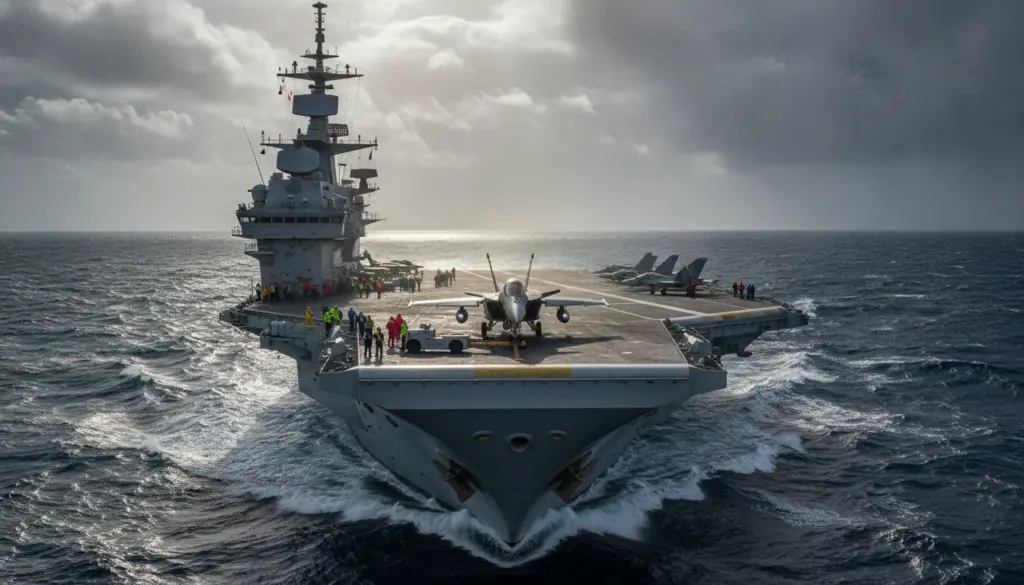
Sunlight eventually pierces the thick Atlantic overcast, striking the warship’s ash-grey exterior like a freshly sharpened knife. Out on the flight deck of the Charles-de-Gaulle, crew members clad in brightly colored vests scramble with a highly coordinated intensity. They guide a Rafale fighter jet into its launch position. However, this aircraft isn’t pointing toward the familiar, sun-drenched Mediterranean basin. Instead, it aims squarely at a freezing, turbulent expanse. Down below, the massive vessel’s steel corridors echo with the relentless, vibrating hum of its nuclear engines.
As the radar monitors show the French shoreline fading into a faint green blur, the ship’s commander delivers a brief but telling message to the personnel: they are embarking on a mission that is “extremely rare.” No one aboard is entirely certain what kind of narrative they are sailing into.
Why This Unexpected Atlantic Journey Feels Like a Geopolitical Thriller
For roughly twenty years, the Charles-de-Gaulle has projected French military influence almost exclusively toward the East and the Global South. Its usual operational theaters include the Indian Ocean, the Mediterranean Sea, and the coastlines of Iraq and Syria. Naturally, when military officials in Paris discreetly ordered their sole nuclear-powered aircraft carrier to venture into the Atlantic Ocean, defense analysts immediately took notice. This journey is far more than a simple exercise to keep the naval fleet active.
Operating in the Atlantic presents a vastly different reality. The waters here are darker, deeper, and heavily monitored by adversarial submarines. It serves as a silent arena where global powers continuously probe each other’s defenses without firing a single shot.
Visualize the strategic landscape off the coasts of Ireland and Brittany. NATO vessels routinely navigate these waters, carefully sweeping sonar dead zones for stealthy Russian submarines. Simultaneously, American destroyers run tactical drills while British frigates monitor unusual acoustic activity near the crucial underwater cables that sustain Europe’s energy grids and internet connections.
Stepping into this hidden game of chess is a massive floating fortress equipped with E-2C Hawkeye early warning aircraft, attack helicopters, escort destroyers, and Rafale squadrons. For residents in coastal maritime hubs like Lorient or Brest, spotting this colossal vessel breaking the horizon feels completely surreal—almost as if a high-stakes espionage movie is playing out in their backyard.
The strategic motivation is crystal clear. Military leadership wants to demonstrate their capacity to deploy elite naval forces into the North Atlantic, especially following the sharp increase in Russian maritime activity tied to the war in Ukraine. By positioning their prized flagship in these frigid waters, France sends a stark message to both partners and adversaries: they are not just visiting; they intend to hold their ground in this domain.
Simultaneously, these deployments force aviators to operate in unforgiving weather, refine their joint tactics with NATO allies, and practice highly classified maneuvers. While officially labeled as routine training, these operations are fundamentally a grueling stress test of Europe’s immediate defense capabilities.
The Relentless Daily Rhythm of an Atypical Deployment
If you observe a carrier strike group from miles away, it appears almost motionless against the horizon. Yet, step aboard, and the tempo is absolutely punishing. Long before sunrise, the interior smells heavily of sea salt, jet fuel, and strong coffee. When the initial steam catapults fire off, the sheer kinetic force violently rattles coffee mugs in the mess halls deep below the flight deck. The aviation crew operates within incredibly narrow safety margins; a single misjudged hand signal or delayed reaction can trigger a catastrophic failure.
Navigating the Atlantic introduces punishing variables. Biting winds, towering swells, and unpredictable weather severely limit the window for safe flight operations. Aviators must perfectly calculate violent crosswinds that threaten to push their multi-million-dollar jets sideways mere seconds before touchdown. Complacency simply doesn’t exist out here.
Junior officers often characterize the atmosphere on the ship as quietly on edge. You notice it in the hurried pace of sailors moving through the narrow passageways and the obsessive scrutiny of meteorological charts pinned to the walls. During previous deployments to the Middle East, the tactical objectives were incredibly direct: eliminate terrorist strongholds, patrol defined airspace, and provide close air support for ground operations.
In this northern theater, the threat is decidedly more abstract. The adversary might take the form of an unidentified radar blip, a submerged contact that refuses to surface, or a strange burst of electronic interference. Some evenings, the only pulse-pounding moment happens when a Rafale performs a rapid scramble, thundering into the night sky to investigate an unauthorized aircraft. Sometimes these incidents amount to nothing. Other times, the tension is entirely justified.
Beneath the surface-level action, this unique mission functions as a sophisticated maritime laboratory. French naval commanders continuously exchange sensor feeds with their British and American peers, stress-test secure communication networks, and run simulated electronic warfare scenarios. It lacks the explosive glamour of combat footage, but this rigorous, repetitive grinding is exactly how a naval fleet ensures it can execute flawlessly during a genuine crisis.
Decoding the Shift in European Defense Strategy
To grasp the true significance of this deployment, you have to recognize the shift in geographical focus: the gaze has turned north. For a very long time, European security discussions centered entirely on Mediterranean migration, counter-terrorism, and stabilization efforts in the Sahel. The Charles-de-Gaulle was synonymous with warm-water patrols and desert conflicts.
Today, the compass points directly toward freezing maritime currents, vulnerable seabed infrastructure, and a historic rivalry with Moscow that has roared back to life. This isn’t just a reboot of Cold War paranoia. It represents a vital strategic pivot to a modern battlefield where traditional fleet maneuvers intersect with submarine tracking and digital warfare.
For the average citizen, massive warships operating hundreds of miles offshore feel entirely disconnected from daily life. People commute, drop children off at school, and casually ignore complex headlines about maritime exercises. However, the moment a crucial natural gas pipeline mysteriously ruptures or a severed fiber-optic cable causes widespread internet blackouts, that distant ocean suddenly feels uncomfortably close.
We all eventually reach a breaking point where the vague concept of national security directly impacts something tangible, like skyrocketing heating bills or failing video calls. It is precisely in those moments that an unseen warship guarding the horizon becomes incredibly relevant to your everyday existence.
Naval command fully grasps this reality, even if they rarely state it publicly. Official press releases focus heavily on partnership, deterrence, and interoperability. Behind closed doors, however, military experts acknowledge that the Atlantic Ocean has transformed into an active frontline devoid of traditional trenches. Consequently, NATO forces are scrutinizing Russian naval movements with unprecedented intensity, from the Bay of Biscay all the way up to the Arctic Circle.
As one Parisian defense strategist candidly noted, sending a nuclear carrier into these waters is comparable to flipping on a high-wattage floodlight in a pitch-black room. You instantly see everything hiding in the corners, and more importantly, everyone else sees you. Behavior changes immediately.
This stark illumination highlights several undeniable realities:
- The Atlantic has evolved beyond a commercial shipping lane into a highly contested strategic theater.
- Deploying a single aircraft carrier fundamentally alters the regional balance of power and caution.
- Routine maritime exercises frequently serve as subtle but powerful diplomatic warnings to both friends and foes.
- Modern European security relies just as heavily on protecting the ocean floor and underwater cables as it does on securing land borders.
Navigating a Rapidly Changing Geopolitical Horizon
Watching this colossal warship carve its path through massive ocean swells is ultimately about more than just military hardware and naval doctrine. It perfectly symbolizes how drastically our collective understanding of global threats is shifting. Just a few years ago, security analysts envisioned future conflicts taking place on dusty roads or in crowded urban ports. Today, the most volatile games of power are unfolding hundreds of kilometers offshore, deep underwater, and high above freezing, grey oceans.
This evolution extends far beyond NATO or French military ambitions. It challenges our fundamental understanding of vulnerability and peace. Protecting an underwater data cable is now just as critical as fortifying a physical border crossing. A single, unidentified blip on a radar screen can spark far more frantic diplomatic scrambling than a highly publicized political speech at the UN.
When the government quietly labels the movement of their premier strike group as an “extremely rare” event, it serves as a potent reminder that global security is constantly in flux. Threat vectors rotate, navigational routes adapt, and risks evolve. The only constant is the dedicated personnel navigating those cramped metal corridors, executing vital jobs that the public barely glimpses through grainy photos.
Ultimately, the most pressing question isn’t why the carrier deployed to the North Atlantic this time around. Instead, we should be asking how many other monumental geopolitical shifts are currently unfolding just out of sight, operating quietly beyond the edges of our comfortable, familiar horizons.
Frequently Asked Questions
Why is this specific maritime deployment considered “extremely rare”?
The French flagship typically spends its time patrolling the Indian Ocean, the Middle East, or the Mediterranean. Sending a complete carrier strike group into the North Atlantic is an exceptional move, reserved for highly specialized deterrence operations and critical training exercises.
Does this sudden shift have anything to do with the conflict in Ukraine?
Indirectly, absolutely. The ongoing friction between NATO and Russia has resulted in a surge of adversarial naval activity. This has forced European nations to redirect their attention to the North Atlantic, prioritizing the defense of vital strategic routes and monitoring submarine movements.
Are we looking at a potential direct confrontation at sea?
The primary objective is actually conflict prevention. By demonstrating overwhelming readiness and a formidable presence, potential adversaries are forced to reconsider any aggressive actions. The vast majority of these maritime encounters involve mutual observation, radar tracking, and strategic signaling rather than actual combat.
What is the actual day-to-day role of the aircraft carrier in these waters?
The vessel serves as a mobile command center. It coordinates complex anti-submarine warfare drills with escort ships, launches fighter jets for intercept training, drastically improves tactical coordination with NATO partners, and establishes a massive protective surveillance bubble over the region.
Does this military maneuvering actually impact regular civilians on land?
Not in a way that disrupts your daily routine. However, by actively deterring threats to critical sea lanes, underwater data cables, and energy transport routes, these naval operations silently safeguard the digital and economic infrastructure that modern society fundamentally relies upon.