Collision of the Stone Age and the Middle Ages
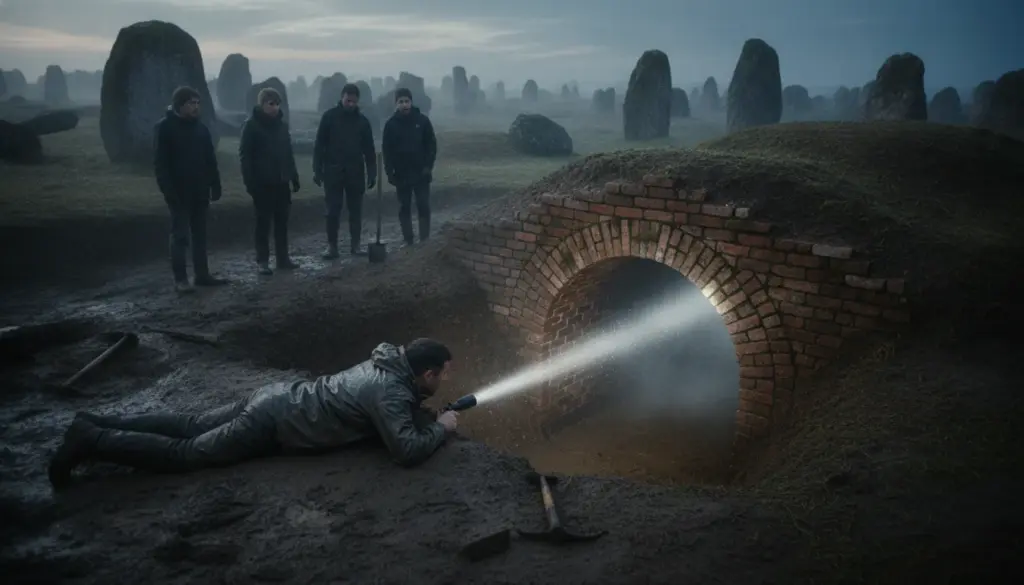
The atmosphere inside the excavation pit shifted entirely the morning the team breached a hidden void. Still drenched from overnight downpours, a researcher crawled onto his stomach to shine a flashlight into a black crevice that simply hadn’t existed yesterday. A blast of frigid, subterranean air rushed out, almost like the ground was exhaling a breath trapped for centuries. Suddenly, the entire site grew completely silent.
Caught in the beam of light was a perfectly arced brick structure, far too uniform to be a natural fissure in the earth.
Hidden directly below a 6,000-year-old resting place, a medieval passageway had just revealed itself.
The ancient burial ground had already been deemed a spectacular find. This Neolithic cemetery, dating back six millennia, featured subtle burial mounds resembling slumbering creatures across the terrain. While generations of farmers had unknowingly cultivated the land around these gentle elevations, modern researchers brought drones, ground-penetrating radar, and meticulous dedication to the site.
Experts anticipated finding burial pits, ancestral tombs, or perhaps remnants of timber enclosures.
Nobody anticipated a masterfully crafted stone corridor slicing directly through prehistoric earth.
Initially, the passageway manifested as merely a faint blur on geophysical monitors. Technicians debated whether this ghostly anomaly was a modern tractor rut or a historical drainage ditch, since it didn’t align with known Stone Age or Bronze Age layouts. However, as the trench deepened to expose an intentionally vaulted brick ceiling, the narrative shifted dramatically.
These specific building materials belonged nowhere near antiquity; they closely mirrored the architectural style of cellars and sanctuaries constructed a mere millennium ago.
Discovering a medieval structure severing through one of the oldest sacred sites in the region stunned the archaeological crew.
In archaeological science, soil layers function as sequential chapters of time. Whenever newer construction tears through ancient strata, it feels remarkably intrusive, akin to vandalizing a priceless artifact. Yet, this medieval pathway was unapologetic, plowing straight across ritual boundaries and breaching invisible perimeters that had remained undisturbed for thousands of years.
This abrupt intersection of timelines prompts immediate intrigue.
Were these medieval stonemasons entirely oblivious to the prehistoric resting place they were dismantling, or had the local memory of the site completely faded?
Uncovering a hidden medieval secret
Faced with this monumental anomaly, the excavation team instantly shifted gears into painstaking preservation mode. Before a single ceiling stone was removed, specialists thoroughly documented its placement and sifted every surrounding soil sample for microscopic evidence. Flashlights illuminated soot stains, tool gouges, and even a faint cross etched into a block midway down the passage—a subtle blessing from the original laborers.
To map the underground trajectory without causing structural damage, researchers deployed laser scanners and miniature camera systems, effectively performing an endoscopy on the terrain.
Gradually, a digital map materialized on their screens, revealing a direct route pointing straight toward the remnants of a fortified medieval estate.
Historical texts frequently reference clandestine passageways connecting manors and chapels to secure forested escape routes. While modern minds often dismiss these accounts as romanticized folklore, this physical corridor proves that certain legends were quite literally set in stone.
Interestingly, local residents shared tales of an “old hollow” nearby where livestock occasionally sank into the earth, a specific location their grandparents had deemed cursed.
That notorious depression in the landscape aligned flawlessly with a collapsed central segment of the ancient tunnel.
Why would anyone dig a massive trench under an area that was already considered ancient history during the biblical era? The motivation was likely highly tactical. It served as a covert transit route for moving individuals, provisions, or contraband during territorial disputes and sieges. Conversely, spiritual motivations often drove medieval builders toward older sites. Without grasping the full history, they frequently repurposed Roman ruins and ancient mounds, inexplicably drawn to their residual authority.
Even if the true origins were forgotten, a prehistoric burial landscape would have still looked distinctively unusual to medieval eyes.
Decoding a subterranean message
Analyzing this anomaly required a highly focused, detail-oriented methodology. Specialists measured individual bricks, comparing their dimensions and firing techniques against the masonry of surviving local church towers. Meanwhile, laboratory technicians extracted microscopic charcoal fragments from mortar samples to conduct precise radiocarbon dating. Even the specific interlocking patterns of the masonry provided intimate clues about the construction crew’s techniques.
Gradually, these cumulative data points isolated the building phase to a handful of specific decades during the High Middle Ages.
Rather than just a void in the dirt, the corridor transformed into a definitive architectural fingerprint from a distinct era.
When people hear about secret tunnels, their imaginations often leap to theatrical escapes, knights, and hidden fortunes. However, professional investigators approach such finds with extreme caution, systematically ruling out mundane purposes first. They searched for signs of drainage systems, quarry transport routes, or underground storage cellars. Finding zero water channels, lacking extraction marks, and absent of storage alcoves, the structure’s purpose became clear. It was a purely functional, meticulously engineered path leading from a prominent stronghold down toward safer, unexposed terrain.
To validate these theories without indulging in fantasy, researchers cross-referenced initial architectural sketches with historical conflict chronicles and local tax archives.
“Tunneling through dense earth and total darkness requires immense motivation,” noted the lead site director while cleaning debris from a block. “Choosing to dig directly beneath a landscape already reserved for the dead suggests a fascinating compromise with the past.”
To synthesize this complex discovery, the investigative team outlined four primary functional theories:
- Covert escape trajectory: The passage links a prominent estate to an obscured lowland exit, creating a perfect emergency getaway from approaching threats.
- Stealthy supply line: During intense local conflicts, this corridor allowed weapons, rations, or couriers to bypass hostile forces and observant villagers.
- Spiritual repurposing: Establishing a route beneath an ancient cemetery may have been a deliberate attempt to absorb the protective energy of an ancient sacred space.
- Generational folklore: Modern oral traditions about a “cursed” sinking hollow likely originated as ancestral warnings about the deteriorating, hazardous void below.
What this buried corridor reveals
Gazing down into the newly opened shaft offers much more than a lesson in historical masonry. While this medieval corridor physically slices through Stone Age resting places, our modern fascination pierces through both eras simultaneously. Current researchers project their own inquiries onto the hasty construction of the past, attempting to decode the silent agreements early builders made with the earth.
Though merely one narrow trench in a vast world, this specific route magically bridges disparate realities: ancient mourners, medieval stonecutters, diligent engineers, and modern digital readers.
Whenever earth is turned on a site layered with history, there remains a thrilling possibility of unearthing someone else’s desperate shortcut or long-forgotten emergency exit.
You certainly don’t need professional credentials to experience the sudden chill of seeing a stone-lined void emerge right where you assumed history was entirely solid.
Frequently Asked Questions
How can experts confirm the grave field is truly 6,000 years old?
Researchers utilize a comprehensive approach that includes radiocarbon dating organic materials found within the graves. They also analyze specific ceramic styles and cross-reference these findings with other extensively documented Neolithic settlements in the surrounding region, ensuring a highly accurate chronological profile.
What evidence proves the tunnel is strictly medieval?
The precise dimensions of the bricks, the specific lime mortar formulation, and the distinctive tooling marks align perfectly with regional medieval architecture. Additionally, rigorous laboratory dating of tiny charcoal particles trapped within the mortar helps pinpoint the exact historical timeframe.
Could this passageway have facilitated historical smuggling?
While illicit activities were entirely possible during later centuries, physical evidence of smuggling has yet to materialize. The highly sophisticated engineering and direct connection to an elite historical property strongly suggest it was initially designed for strategic protection and discreet logistical movement.
Is the subterranean structure safe to explore today?
Access is strictly limited to professionals equipped with structural support systems. Centuries of gradual erosion and partial collapses have rendered many segments highly unstable. Before any human entry occurs, specialized engineers deploy robotic cameras and laser mapping technology to assess structural integrity.
What happens to this underground discovery after excavation concludes?
Every inch of the site undergoes rigorous documentation, capturing high-resolution 3D models and vital soil analytics. While exceptionally fragile sections are carefully backfilled for protection, stable portions may be preserved in situ. Ultimately, this hard-earned data enriches museum exhibits and immersive digital reconstructions for public education.