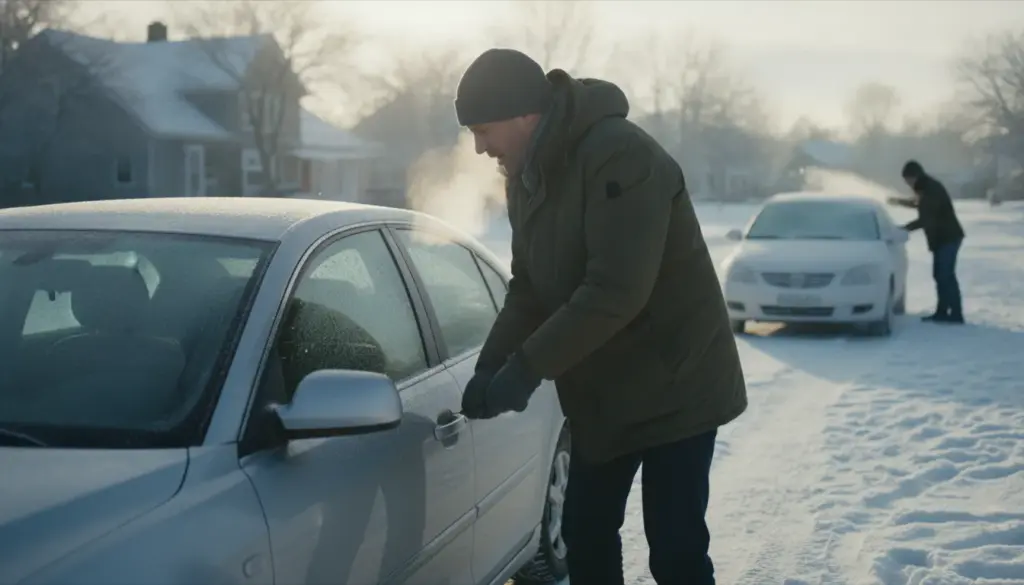
The initial freeze of the season always paints a familiar picture. You walk outside into the crisp air, your breath visible, only to find your vehicle coated in a stubborn sheet of frost. The neighborhood is practically silent, broken only by the rhythmic scraping of ice from windshields and muttered complaints from people running behind schedule. After yanking the frosty door open and sinking into the freezing seat, you turn the ignition. Then, a sinking feeling hits. The parking brake lever refuses to budge. It is frozen solid, leaving your vehicle completely immobilized.
Meanwhile, further down the road, another driver starts their engine and effortlessly glides away. No struggle. No locked-up cables. Their secret? They left the car in gear the previous night instead of engaging the parking brake.
This stark contrast might leave you questioning if your winter routine has been fundamentally flawed all along.
Why your parking brake suddenly turns into a winter liability
During dry summer months, pulling the handbrake is an afterthought. It is an act of pure muscle memory, executed without hesitation as you switch off the headlights and shut the door. However, the moment temperatures plummet below freezing, this deeply ingrained habit morphs into a mechanical hazard. It will not cost you your driver’s license, but it can certainly ruin your brake cables.
Winter moisture has a sneaky habit of infiltrating every conceivable crevice. It seeps around your brake cables, settles into the protective housing, and bypasses rubber seals. When the thermometer drops sharply, that trapped water turns into ice, essentially welding your handbrake to the vehicle’s undercarriage.
Speak with any seasoned mechanic in a Dutch or Belgian auto shop during the season’s first deep freeze, and you will be met with a knowing smile. They anticipate the influx of frantic morning phone calls. These are drivers insisting they did nothing unusual, yet their cars simply refuse to budge. Vehicles are left squealing, groaning, or entirely locked in place.
A mechanic based in Groningen recalled a particularly brutal Monday morning when the temperature hit minus eight degrees. Six different vehicles were lined up outside his workshop, all suffering from frozen parking brakes. One frustrated owner had attempted to force the car to move by accelerating aggressively, ultimately burning through the brake shoes and requiring a full cable replacement. An innocent parking habit rapidly transformed into an expensive repair bill.
The underlying mechanics are incredibly straightforward. Most handbrakes rely on physical cables connecting the lever to the rear brakes. While these cables feature a protective sleeve, they are rarely completely airtight. Condensation, driving rain, and slushy snow inevitably find a way inside. Engaging the parking brake creates tension on that wire while forcing the braking mechanism into an engaged position. If that tensioned, moisture-laden assembly freezes overnight, it loses all ability to release.
Conversely, leaving your vehicle in gear utilizes the sheer mechanical resistance of the engine and transmission to prevent rolling. There is no stretched cable involved. There are no delicate, moisture-exposed components waiting to seize up. It acts as a robust mechanical lock, which is precisely why veteran motorists instinctively abandon the handbrake during winter in favor of parking in gear.
A smarter winter parking method: choosing the gearbox over the handbrake
The fundamental rule is remarkably simple. If you drive a manual transmission, park your car in gear during the winter months rather than pulling the handbrake. On a completely flat surface, shifting into first gear is standard practice. If you are parked facing downhill on an incline, many drivers opt for reverse gear instead, ensuring the engine provides opposing resistance against the vehicle’s natural rolling direction.
Before turning the ignition off completely, slowly release the clutch pedal until you feel the car faintly catch and settle into place. Only then should you remove your foot from the footbrake. Skipping the familiar clicking sound of the handbrake might feel unsettling the first few times, but it quickly becomes second nature.
Naturally, some hesitation is common among first-timers. Drivers often worry their vehicle might spontaneously roll away, causing undue stress to the transmission. We all harbor that nightmare scenario of our unattended car slowly gliding down the street to intimately meet a neighbor’s parked bumper. In reality, this almost never happens, provided you apply a bit of geographical logic to your parking spot.
Take the experience of a young motorist in Eindhoven. After shelling out cash for a hefty repair bill on seized brake cables, he entirely switched to parking in gear. For the first few nights, he barely slept, terrified he would wake up to find his car rolled three meters down the street. Months later, after enduring dozens of freezing nights, the vehicle had not drifted a single millimeter. As for his handbrake? He barely touches it anymore.
From a purely technical standpoint, the contrast is night and day. A dormant engine, working through the gearbox, offers immense rotational resistance to the wheels. To make the vehicle roll, gravity would have to force the entire internal drivetrain to crank over. This requires massive force—far more than a standard driveway incline could ever generate.
A brake cable, by comparison, is slender and flexible. Frozen water trapped near that cable easily jams the inner wire or the linkage itself. Your handbrake lever will either feel completely immovable or fail to disengage fully when lowered. Attempting to drive through this resistance causes the brake pads to drag continuously, leading to accelerated wear, severe overheating, and sometimes even smoke. That is hardly the kind of winter warmth anyone desires.
Practical winter routines for stress-free mornings without frozen brakes
The most effective routine actually begins the night before, just as you shut off the engine. Think of it as a three-step checklist: transmission, tires, and finally, the brake. First, maneuver the gearstick into the correct position. Use first gear for level ground, or reverse if the front of the car is pointing downhill. Next, turn your steering wheel slightly toward the curb or edge of the road. This ensures that if the car were to unexpectedly move, the tires would immediately wedge against a physical barrier.
Only after taking those steps should you ask yourself: do I genuinely need the handbrake right now? On a flat driveway or level parking lot, the answer is almost always no. If you must park on a severe incline, you can pull the lever up very gently—just one or two clicks. This minimal application ensures the cable isn’t stretched to its absolute maximum tension, significantly reducing the chances of a hard freeze.
The majority of winter parking mistakes happen because we are in a rush. You pull up to the house, yank the handbrake up aggressively, toss the shifter into neutral, slam the door, and hurry inside. That thoughtless sequence works perfectly fine until a frosty morning arrives, shattering your daily schedule because your rear wheels are paralyzed. Tweaking this small parking habit instantly eliminates a significant amount of cold-weather stress.
It is also important to remember that perfection isn’t required. You do not need to treat every mildly chilly evening like you are parked on an extreme Alpine mountain pass. A damp night hovering around plus three degrees Celsius poses a very different risk profile compared to a crystal-clear evening with biting winds and minus six temperatures. Realistically, no one expects you to obsessively refresh a weather app before turning off the engine. However, on nights when that distinct, icy bite is in the air, consciously choosing to park in gear is a highly rewarding decision.
Sander, an automotive technician with two decades of experience, sums it up perfectly: “The cheapest repair you will ever pay for is the damage you successfully prevented. People firmly believe the handbrake keeps them safe, but during wintertime, it is the primary reason they end up in my shop behind a tow truck.”
- Rely on your gearbox as the primary anchor: When leaving your vehicle on flat or gently sloped surfaces, make it a habit to use first gear or reverse, leaving the parking brake completely disengaged.
- Pay attention to your tire direction: Turn your steering wheel so the tires point toward the curb or sidewalk, creating a failsafe physical block in the rare event of movement.
- Use the handbrake sparingly in freezing conditions: When extreme cold sets in, avoid it entirely if the terrain allows, or apply only the lightest possible pressure with a single click.
- Address a stiff handbrake early: If your parking brake lever feels slightly sticky or sluggish during mild autumn weather, it is almost guaranteed to seize up completely once the frost hits. Have a professional inspect it.
- Plan ahead for extended parking: Leaving your vehicle sitting idle for a week during a cold snap? Parking in gear becomes even more crucial, as cables left under tension for days are highly susceptible to deep freezing.
A minor winter adjustment that delivers unexpectedly significant results
If you pay close attention over a few winter seasons, a distinct neighborhood pattern emerges. One resident clicks their car into gear, turns the key, and casually departs into the frosty morning. Another neighbor stands shivering near the rear bumper, blowing clouds of condensation while frantically trying to figure out why the wheels won’t turn, ultimately surrendering and calling roadside assistance.
This divide rarely stems from deep mechanical expertise. It all originates from a tiny micro-habit: how you secure your vehicle when the mercury drops. It is a fleeting decision made in the quiet seconds before you close the car door for the night.
Interestingly, this subtle choice regarding the handbrake impacts far more than just automotive engineering. It is fundamentally about reclaiming control over your early morning routine and avoiding entirely predictable delays. You are not just preventing seized cables; you are actively dodging that sinking realization that your trusted vehicle has suddenly let you down.
On those frigid mornings when the outside world looks like a frozen photograph, it is incredibly satisfying when your car does exactly what it is supposed to do. Moving forward smoothly, quietly, and without a fight. Perhaps that is the greatest hidden benefit of parking in gear. You experience less friction with your vehicle, and significantly more peace of mind.
Frequently Asked Questions
Should I completely avoid the handbrake on hills during winter?
Not necessarily. If you are parked on a minor incline, leaving the vehicle in gear while turning the front wheels toward the curb is usually sufficient. On much steeper hills, you can carefully apply the handbrake alongside leaving it in gear. Just use a lighter touch so the internal cable is not stretched to maximum tension.
Does parking in gear cause damage to the transmission?
Under normal circumstances, absolutely not. Modern gearboxes are meticulously engineered to handle this type of static resting load with ease. The gravitational pull of a standard hill is practically nothing compared to the intense mechanical forces the transmission handles while actually driving.
What is the best fix if my handbrake is already frozen?
Never attempt to force the vehicle forward with heavy acceleration. Start the engine and let the exhaust naturally warm up the undercarriage. If necessary, you can use a hairdryer or a sealed bag of warm water pressed against the exposed cables. Never pour boiling water directly onto the brake drums. If the system remains jammed, it is time to contact a local garage.
Do these rules apply to cars equipped with electronic parking brakes?
Electronic parking brakes rely on different mechanisms than traditional wire cables, but they can still experience freezing or seizing in extreme weather conditions due to moisture or motor wear. While the overall risk is lower, shifting into gear provides an excellent supplementary layer of security.
How can I identify moisture or wear issues in my brake cables early?
Watch out for early warning signs, such as a handbrake lever that lacks a smooth upward pull, an illuminated dashboard brake warning light that refuses to turn off, or a sensation that the car is dragging slightly while driving. Having these symptoms inspected before the first winter freeze hits can save you considerable trouble.