
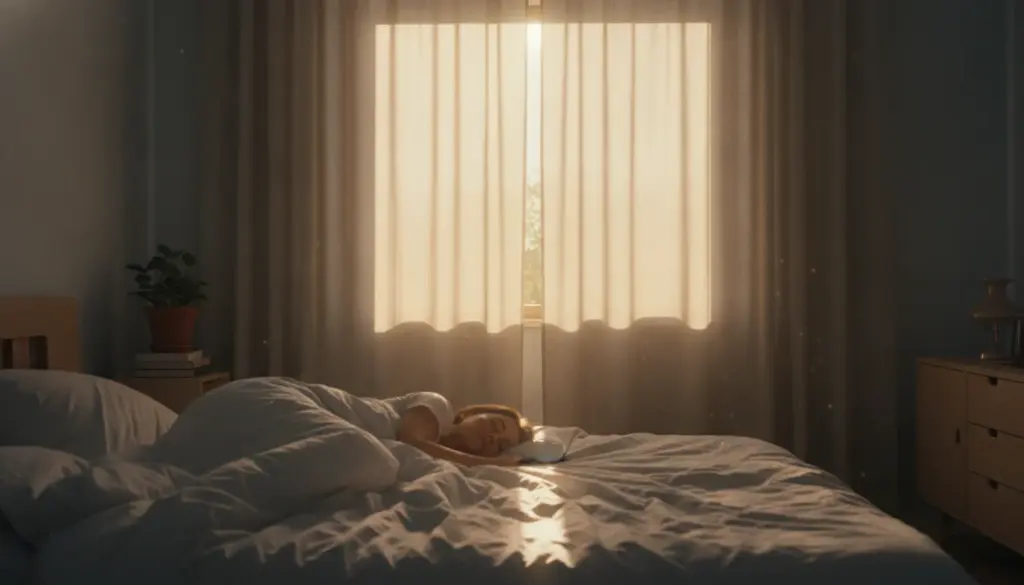
The subtle power of a cracked window drape
Opening or shutting your drapes every night feels like a mindless habit. Yet, that tiny sliver of morning illumination creeping into your bedroom might impact your rest more significantly than you realize. Imagine being roused not by a blaring alarm or buzzing phone, but by a soft glow seeping through the fabric as night transitions into day.
For some, this gradual brightening brings immense peace, while others find it frustratingly wakes them up an hour too early. While sleep specialists and researchers have their perspectives, your own physiology usually offers the clearest explanation of what occurs when you decide against drawing the blinds completely.
What happens in your brain when morning rays slip past the fabric
Leaving a tiny gap in your window coverings initiates a very subtle environmental shift before you even open your eyes. The room’s lighting slowly transitions from a cool, dusky blue to a warm golden hue. Even with your eyelids firmly shut, your brain registers this environmental change.
Your retinas contain specialized receptor cells designed specifically to detect luminosity rather than shapes. These cells dispatch an immediate signal to your internal biological clock, announcing that morning has arrived. Consequently, your body decreases the production of melatonin—the hormone responsible for sleepiness—and begins gearing up for wakefulness.
This biological process is exactly why you sometimes wake up naturally, experiencing a gentle transition into consciousness rather than a sudden jolt. In clinical sleep environments, specialists frequently utilize sunrise simulation lamps for this exact reason, helping individuals wake up calmly and reducing the urge to hit snooze.
You can recreate this clinical approach right at home through that narrow streak of daylight. If your alarm is set for 7:30 AM, but natural light begins filtering in around 7:00 AM, your slumber gradually lightens. This often results in waking up slightly earlier, but avoiding that heavy, groggy feeling.
Studies consistently confirm that receiving a dose of natural illumination early in the day boosts daytime alertness and makes drifting off at night considerably easier. That one small opening in your drapes carries surprising weight for your daily rhythm.
When natural illumination backfires on your rest
However, this natural strategy isn’t universally flawless. If your bedroom faces a bustling street illuminated by streetlamps and passing headlights, nighttime brightness can easily disrupt your rest. Your brain struggles to distinguish between intrusive artificial glare and genuine morning sunshine.
Similarly, early summer sunrises can inadvertently steal precious hours of rest. When dawn breaks at 5:00 AM and your window treatments are too sheer, you might consistently lose an hour of deep sleep. After just a few days, this deficit often shows up as mood swings, poor concentration, and even unexpected shifts in appetite.
The secret lies in proper timing and brightness levels. Exposure between roughly 7:00 and 9:00 AM properly calibrates your internal clock. Conversely, midnight streetlights or pre-dawn sun can throw that same clock completely out of sync, meaning you need to find your personal sweet spot for window coverage.
Using your window treatments for better rest (without strict rules)
Many sleep coaches recommend a highly practical approach: absolute darkness overnight, followed by a gradual increase in morning brightness. While this sounds straightforward, you can fine-tune the execution without adopting an exhausting regimen.
Start by testing the waters. Instead of pulling the fabric halfway across the glass, purposefully leave just a slender gap on the side farthest from any outdoor streetlamps. Try this setup for roughly a week while monitoring two specific metrics: how smoothly you wake up, and your energy levels between 10:00 AM and noon.
If you find yourself waking up peacefully before your alarm rings and skipping the mid-morning energy crash, you have likely found your ideal setup. Should you feel overly tired, you may need to darken the room further or perhaps widen the gap slightly.
Let’s be realistic: very few people have the bandwidth to maintain a daily sleep diary for these experiments alongside work and family obligations. Fortunately, basic rules of thumb offer substantial benefits.
If you reside in a brightly lit urban area, investing in blackout curtains paired with a lighter, sheer layer behind them works wonders. Keep everything tightly shut overnight, and simply pull back the heavy layer slightly just before your waking hours if possible.
For shift workers or those who naturally thrive on a later schedule, early sunshine can actually be detrimental. In these scenarios, treating your bedroom like a dark cave is perfectly fine. You can seek out your daily light exposure later on, perhaps by drinking your coffee near a bright window or stepping outside.
Building the ultimate morning lighting strategy
Everyone knows the jarring sensation of waking up panicked, disoriented, and waiting for your brain to reboot. For those desperate to eliminate this grogginess, controlled illumination is frequently the missing variable.
As one sleep medicine expert aptly summarized the phenomenon: “It isn’t your alarm clock, but rather your light exposure that dictates how your day truly begins.”
To implement this practically, consider these straightforward arrangements:
- Blackout panels with a fixed gap: Block ambient noise while letting in a sliver of dawn on one specific side.
- The dual-layer system: Combine heavy drapes with sheer curtains to clearly separate nighttime from morning.
- Complete darkness plus technology: Keep everything sealed shut, but utilize a wake-up light for a highly controlled simulated sunrise.
- Seasonal tweaks: Opt for heavier darkening during the bright summer months, while letting more natural dawn enter during the dark winter.
Remember, the setup doesn’t require perfection; it merely needs to complement your individual circadian rhythm.
Why morning light might be the exact thing you are missing
Early daylight provides far more than just a pleasant ambiance; it serves as a potent physiological trigger for virtually every system inside your body. The biological clock located deep within your brain uses this initial brightness as the starting pistol for your entire day. Your core temperature, hormone production, and digestion all synchronize to this visual cue.
Whether you stand by the glass shortly after rising or let the sunshine slowly creep across your floorboards, your internal systems receive a definitive message that morning has started. Interestingly, this morning anchor actually helps you feel appropriately sleepy at a consistent time later that evening.
Individuals battling insomnia often discover that establishing a steady light exposure routine delivers better results than adding another sleep supplement to their cabinet.
There is, naturally, a flip side to consider. If you struggle to fall asleep and only drift off late at night, early dawn creeping in might prematurely end your rest. This leads to a chronic shortage of the restorative deep sleep your body desperately requires to repair itself.
Furthermore, migraine sufferers frequently exhibit high sensitivity to early morning brightness. Even a weak beam cutting through a thin drape can trigger sensory overload far earlier than is comfortable.
In these specific situations, a hybrid approach proves highly effective. Maintain absolute darkness with heavy window coverings all night long. Then, the moment you intend to wake up, throw the drapes wide open and immediately seek out natural daylight on a balcony, through an open sash, or near the brightest area of your home. Use light as an activation switch, but strictly on your own schedule.
Combating the winter blues with strategic window light
For those who experience seasonal sluggishness during wintertime, morning sunshine often acts as a free form of light therapy. Scientific literature indicates that individuals dealing with a winter dip benefit immensely from getting at least 30 minutes of bright exposure within the first two hours of waking.
While premium sunrise alarms attempt to replicate this effect, having an east-facing window that naturally catches the morning glow provides a fantastic organic alternative. The real trick involves balancing how much brightness you allow in without inadvertently cutting your total rest time short.
One highly practical, often ignored tip: Evaluate the environment immediately outside your window. A leafy tree, an awning, or a slanted roof can beautifully diffuse the incoming rays, providing a gentle illumination rather than a harsh, blinding flood of dawn.
Deciding to leave your drapes slightly open isn’t some monumental lifestyle overhaul. Rather, it represents a tiny, daily decision backed by fascinating physiological science. Taking a moment to analyze how you transition into wakefulness often reveals a crucial truth: sleep quality isn’t just about how you get into bed at night, but also how the morning finds you.
It might be worth evaluating your sleeping environment with a fresh perspective. Take note of where the sun hits, what time it arrives, and whether that timing actually aligns with your professional schedule and natural tendencies. Adjusting your fabric by mere inches can mean the difference between jolting awake in a panic or surfacing peacefully into the day.
Frequently Asked Questions about sleep and daylight
Do I always need to leave a gap in my curtains for healthy rest?
No, it is not a strict requirement. If your bedroom faces a highly illuminated, busy street or you work late shifts requiring you to sleep into the afternoon, maintaining maximum darkness is far superior. You can actively seek out your essential daylight later by fully opening the blinds the moment you do wake up.
Is natural morning sunshine through a window as effective as a dedicated wake-up light?
Natural daylight is significantly more powerful, though admittedly less predictable than artificial devices. A sunrise alarm offers exact control over the timing and brightness curve, whereas a gap in the drapes is completely free and often just as effective. Many people find success by combining the two: utilizing blackout curtains overnight and relying on a light-based alarm to wake up.
What should I do if the dawn wakes me up much too early?
This is a clear indicator that your window treatments are either too sheer or letting sunshine in prematurely. You should upgrade to thicker, light-blocking materials, ensure they fit snugly against the frame, or install a secondary sheer layer to diffuse the intensity. You can always soak in the sun later in the morning to stabilize your biological rhythms.
Can morning light actually help alleviate seasonal gloom or winter dips?
For a significant number of people, yes. Research demonstrates that 20 to 30 minutes of bright exposure shortly after waking can drastically improve mood during the darker, colder months. You can achieve this using a specialized therapy lamp, sitting by a large, clear window, or taking a brisk morning walk.
If I suffer from insomnia, is adjusting my light exposure enough to fix it?
While illumination is a highly influential biological trigger, it is rarely the only piece of the puzzle. Chronic stress, late-night screen time, caffeine consumption, and erratic bedtime routines heavily impact your ability to rest. Nevertheless, optimizing your window coverings and managing how you wake up remains one of the simplest, most foundational steps you can take toward better sleep hygiene.