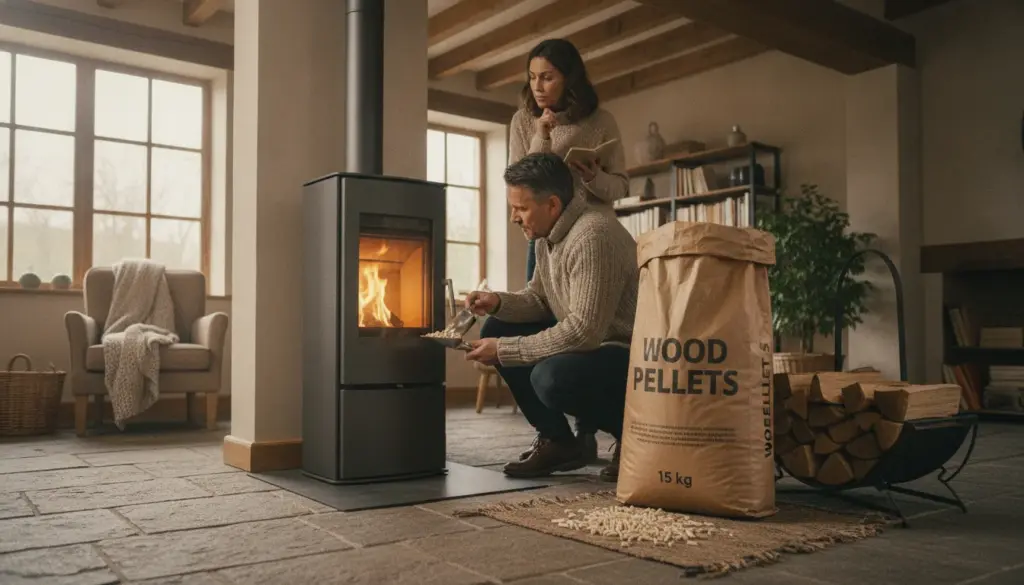
The Real Lifespan of a 15 kg Pellet Bag
Countless households find themselves wondering the exact same thing once the cold weather hits. What is the actual burning time of a standard fifteen-kilogram bag of wood pellets? You might even notice that your neighbor seems to stretch their supply much further than you do.
The truth is that a single, universal number simply does not exist. The duration depends heavily on your specific appliance, the thermal efficiency of your home, your daily habits, and the physical characteristics of the wood fuel itself.
In everyday use, a standard 15 kg bag will last anywhere from 6 to 40 hours. That massive gap comes down to the operating capacity. Most manufacturers state an hourly consumption rate ranging between 0.5 and 2.5 kg per hour, which perfectly explains why some homeowners restock constantly while others barely touch their stash.
Stove Output: The Primary Consumption Driver
High Capacity: Rapid Warmth, Rapid Depletion
Contemporary pellet stoves generally operate between 6 and 10 kW. When you push the device to its maximum setting, the internal auger feeds fuel into the burn pot almost without pause, causing your hopper level to drop rapidly.
- Operating at roughly 8 kW of power burns through approximately 2 kg every hour.
- Under these conditions, your 15 kg bag will be completely empty after just 7 to 8 hours of active heating.
- This heavy-duty scenario is incredibly common in drafty homes or during severe winter freezes.
While that “turbo” warmth feels fantastic, it will cause your seasonal expenses to skyrocket. Many users mistakenly leave their appliance on maximum power out of habit, even when the room is already comfortable.
Eco-Mode: Slower Burns for Lasting Comfort
Switching to a low setting or eco-mode shifts the appliance into maintenance heating. It produces less intense heat but maintains a beautifully consistent room temperature.
- Dialing down to 2 to 3 kW slashes your hourly usage to just 0.5 kg.
- Suddenly, that same 15 kg bag can easily provide heat for 30 to 35 hours.
- This gentle approach is ideal for mild autumn days or highly efficient, tightly sealed homes.
By relying more heavily on your eco-settings, you drastically extend the lifespan of every single bag you purchase.
Home Insulation: The Silent Game Changer
How much thermal energy does your living space actually require? Heating professionals typically rely on a basic rule of thumb: you need roughly 1 kW of power for every 10 m² of standard living space. However, a drafty older home in an exposed area will demand significantly more, while a newly constructed property needs far less.
Properties upgraded with modern glazing, adequate roof insulation, and minimal thermal bridging allow the heating unit to relax. Because the room retains its warmth, the stove doesn’t need to aggressively compensate. That retained heat translates directly into fewer trips to buy fuel.
Not All Pellets Are Created Equal
When shopping for fuel, you will frequently spot certifications like ENplus or DINplus stamped on the plastic. These crucial labels guarantee a regulated composition, minimal dust, and strictly controlled moisture levels.
- Wood pellets with less than 10% moisture deliver superior combustion efficiency.
- Premium fuel produces minimal ash and prevents slag buildup, keeping your system cleaner and highly efficient.
- Lower dust content significantly reduces the risk of mechanical jams in the feed screw or burner pot.
Bargain-bin, uncertified options might look tempting at the hardware store, but they universally lead to higher consumption rates and frustrating maintenance issues. If you burn through several pallets each winter, the financial penalty of cheap fuel becomes glaringly obvious.
Smart Settings and Routine Care
The Power of Regular Maintenance
A heating system choked with soot, ash, and hardened slag loses its ability to transfer heat effectively. The machine is forced to work overtime just to hit your desired room temperature.
- Empty the ash collection pan exactly as the manual dictates—often multiple times a week during peak season.
- Wipe down the glass and scrape the burn pot regularly to ensure an oxygen-rich, stable flame.
- Schedule a professional technician annually to service the internal components and sweep the flue.
Proper upkeep helps lock in the factory-rated 85 to 95% efficiency, squeezing maximum minutes out of every kilogram you pour in.
Mastering the Thermostat
A surprising number of people set their indoor climate unnecessarily high. Lowering your target temperature by just one single degree reduces energy demand by roughly 5 to 7%. This mathematical reality absolutely applies to wood pellet consumption.
By programming smart time blocks, you can easily save dozens of bags over a single winter. Keep the temperature modest while the house is empty, raise it slightly for a cozy evening, and let it drop overnight. Integrating a smart thermostat prevents the unit from blasting unnecessary high-output heat.
Real-World Scenarios: Breaking Down the Numbers
Scenario 1: Modern Efficiency
Imagine a family living in a tightly sealed, 90 m² newer build. They primarily run their system at 2 kW in eco-mode, only bumping it to 4 kW during extreme cold snaps.
- Daily Average: Roughly 0.6 kg per hour.
- Bag Lifespan (15 kg): 25 to 30 hours.
- Winter Total: 1.5 to 2 tons, equaling about 100 to 130 bags.
Scenario 2: The Older Drafty House
Now picture a freestanding, minimally insulated 120 m² home in a freezing climate. To stay warm, their appliance operates near the 8 kW threshold constantly.
- Daily Average: Close to 2 kg per hour.
- Bag Lifespan (15 kg): 7 to 8 hours.
- Winter Total: Easily 3 tons or more, blowing past 200 bags.
These stark contrasts vividly illustrate how your home’s envelope and your chosen settings dictate your winter heating budget.
Estimating Your Winter Supply Needs
Planning ahead prevents mid-winter panic. Should you order a single pallet, or do you need three? Having a rough baseline helps you avoid running empty when the snow starts falling.
- Compact, efficient homes (80–100 m²): Expect to need 1 to 2 tons annually (70–130 bags).
- Standard mid-terrace, average insulation: Plan for 2 to 3 tons (130–200 bags).
- Spacious or poorly insulated properties: Anticipate 3 tons minimum (well over 200 bags).
If you just installed your system, track your usage carefully during the first few months. This personal data will help you build an accurate purchasing profile tailored to your specific microclimate.
Clever Tricks to Stretch Your Fuel
Strategic Zoning
Stop trying to heat the entire house simultaneously. Shut the doors to guest rooms, large hallways, or storage areas. Funneling the warm air strictly into the living spaces you actually occupy allows the stove to run on a much lower, fuel-sipping setting.
Quick Fixes for Better Efficiency
You don’t need a massive renovation budget to improve your home’s thermal retention. Several inexpensive tweaks make a substantial difference.
- Apply weather stripping to drafty window frames and exterior doors to block icy intrusions.
- Hang heavy thermal curtains to trap heat from escaping through large glass panels.
- Set the stove’s internal distribution fan to a low speed for a more even, gentle circulation of warm air.
Every single kilogram of wood fuel you save protects your wallet while simultaneously shrinking the carbon footprint of your home heating.
Simulate Your Own Usage
Want to predict your upcoming costs? You can run a quick personal calculation. Let’s assume your preferred setting utilizes exactly 1 kg per hour, and you run the unit for 8 hours daily during the darkest winter months.
- Daily burn: 8 kg.
- Bag duration: One 15 kg bag covers almost two full days.
- Monthly estimate: A harsh 30-day stretch will require about 15 bags.
Factor in the milder shoulder seasons where you run the fire less often, and you will have a solid baseline for your yearly bulk order. Ultimately, balancing your heating capacity, house insulation, fuel grade, and thermostat habits empowers you to extract every last drop of warmth from your next bag of pellets.