More and more fitness professionals are steering their clients toward a single, remarkably basic movement. Rather than prescribing convoluted workout splits or requiring expensive dumbbells, many coaches favor a foundational exercise you can perform absolutely anywhere. It only takes a few minutes out of your day. While holding this pose might not look particularly exciting, executing it correctly forces virtually every muscle in your body to work in harmony.
Why Fitness Experts Rely on This One Move
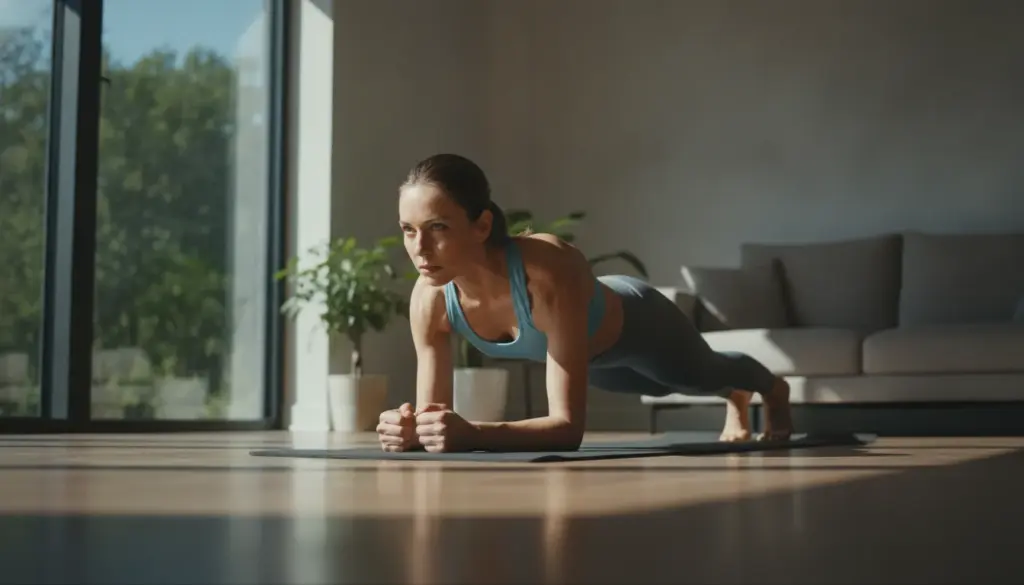
The go-to exercise that so many trainers recommend is the plank. At first glance, it appears incredibly easy: you simply hold your body motionless in a perfectly straight line. However, biomechanically, this static posture requires significantly more muscular endurance, focus, and coordination than most beginners anticipate.
Planking is never just about getting sculpted abdominals. Your entire physique has to function as one cohesive unit. Your shoulders, back, glutes, hips, and legs must simultaneously engage to keep your torso perfectly stable. Because of this intense full-body demand, holding a strict plank for thirty seconds often feels far more exhausting than repping out traditional crunches.
Instead of isolating a single muscle, the plank conditions an entire muscular network that actively supports your daily posture. Coaches love this isometric hold for three distinct reasons: it is highly effective, remarkably straightforward, and incredibly accessible. You do not need resistance bands, heavy weights, or a gym bench—just a tiny bit of floor space and a couple of spare minutes.
How Planking Transforms Your Body
Building True Core Strength
The primary target of a plank is your midsection, commonly referred to as the “core.” This complex area is much more than a visible six-pack. True core strength involves all the muscles wrapping around your torso, including your deep abdominal layers, lower back, obliques, pelvic floor, and essential stabilizing muscles.
- Your spine receives significantly better structural support.
- Your daily posture vastly improves whether you are sitting, walking, or standing.
- The risk of nagging overload injuries in the neck and lower back decreases.
- Everyday functional movements, from lifting heavy groceries to climbing stairs, feel much smoother.
Because you maintain a static hold rather than moving up and down, exercise physiologists refer to this as an isometric contraction. Your muscles remain under continuous tension without changing their length. This specific type of sustained effort creates deep muscular fatigue, particularly targeting the stabilizing muscles that tend to grow weak from prolonged sitting.
Rapid Full-Body Activation
When you hold a proper plank, you quickly realize that everything is working. You have to actively push the floor away with your forearms, brace your shoulders, draw your navel inward, squeeze your gluteal muscles, and lock your legs tight. Instead of performing five different isolation exercises, the plank acts as a highly efficient all-in-one package.
Integrating a few brief planking sessions into your daily routine often yields far better long-term results than an overly ambitious gym schedule that you eventually abandon. Because the movement requires so little time, it fits seamlessly into the most chaotic schedules. Trainers frequently start clients with just a few minutes a day to gently establish a solid fitness habit, keeping the barrier to entry low while delivering rapid strength gains.
How to Perform the Perfect Plank at Home
Mastering the Fundamental Position
To execute the classic forearm plank correctly, you need to focus on alignment. You should feel the tension radiating through your entire body, not just your stomach. While you do not need to shake violently from exertion, you absolutely must avoid collapsing into a relaxed, sagging posture.
Crucial Form Mistakes to Avoid
Fitness instructors constantly emphasize that technical precision always beats the stopwatch. Hanging out in a sloppy, sagging plank for a full minute provides far fewer physical benefits than holding a rigid, highly controlled position for just twenty seconds.
A Smart Progression for Beginners
If you are just starting out, completing three sets of 15 to 20 seconds is plenty, provided you take a brief rest in between. It might sound short on paper, but under strict tension, it feels quite challenging. Once you can hold that duration with rock-solid form and zero shaking, you are ready to progress.
A reliable progression model used by many coaches looks like this:
- Weeks 1–2: 3 sets of 15–20 seconds
- Weeks 3–4: 3 sets of 25–30 seconds
- Beyond: Gradually increase the hold time, add more sets, or introduce advanced variations.
Always listen to your body’s feedback. A deep, burning sensation in the muscle belly is a normal sign of fatigue, but sharp, pinching pain in your lower back or shoulder joints is a major red flag. If you feel joint pain, immediately drop your knees to the floor to modify the leverage.
Advanced Variations to Test Your Limits
Once you dominate the basic forearm hold, you can easily ramp up the intensity without buying any new gear. Try these popular challenge variations:
- The High Plank: Position yourself on straight arms with your hands directly beneath your shoulders. This places a greater demand on your chest and triceps.
- The Side Plank: Balance on one forearm and the outside edge of your bottom foot. This angle aggressively targets your obliques.
- Limb Lifts: Briefly raise one foot or one arm off the ground. This deliberate instability forces your core to work twice as hard to prevent your body from rotating.
- Shoulder Taps: From a high straight-arm position, slowly tap your opposite shoulder with one hand while fighting to keep your hips completely parallel to the floor.
By purposefully introducing micro-instabilities, you train your midsection to react faster and stronger to unpredictable daily movements.
Safety Guidelines and Contraindications
While planking is widely recommended, certain individuals should proceed with caution. Anyone dealing with chronic neck issues, shoulder impingements, or severe spinal conditions should clear the movement with a physical therapist first. A medical professional can offer safe biomechanical alternatives to keep you training safely.
Additionally, individuals recovering from abdominal surgeries or recent childbirth should ease back into core work very gradually. The deep pelvic and abdominal walls usually require highly targeted, gentle rehabilitation before moving on to intense isometric holds.
Integrating the Plank Into an Active Lifestyle
This simple hold functions perfectly as the cornerstone of a brief morning mobility routine or an evening wind-down. Try alternating a few sets of planks with bodyweight squats and gentle upper-back stretches. You will gradually forge a resilient, highly stable physique without ever setting foot in a commercial gym.
If you already enjoy running, cycling, or playing tennis, consistent core training offers massive performance upgrades. A rigid, powerful trunk ensures that the force generated by your legs and arms is transferred efficiently. You will move with greater economy, boosting your athletic output while simultaneously shielding your joints from overuse injuries.
Finally, do not underestimate the mental conditioning involved. Holding a strict isometric posture trains your breathing, focus, and sheer willpower. Every single second you maintain that perfect form delivers a tangible sense of accomplishment—which is exactly the kind of momentum that keeps you coming back to the mat tomorrow.