When the Desert Bloomed
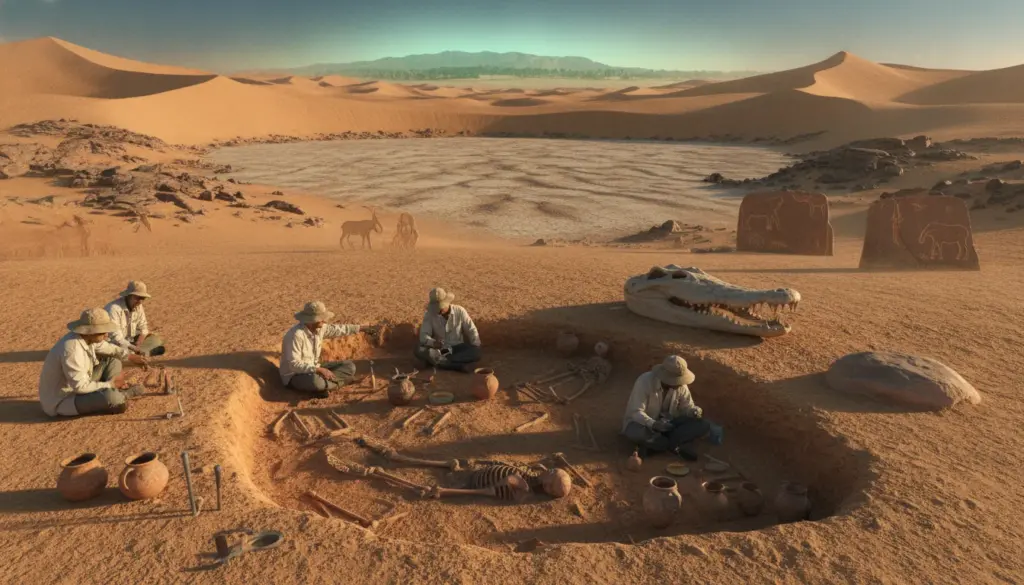
Deep within the shifting dunes of Niger lies the ancient shoreline of a long-evaporated lake. Thousands of years ago, thriving communities lived, mourned, and carefully buried their loved ones here. The remarkable discoveries unearthed from these sands force researchers to fundamentally rethink our modern perception of the Sahara as nothing more than an endless, barren wasteland.
Today, the world’s largest hot desert appears as a harsh expanse of rock and dust. However, the landscape told a completely different story roughly 12,000 years ago. Subtle shifts in the Earth’s orbit pushed tropical rain belts further north, creating an intensified monsoon cycle that fed expansive rivers, wetlands, and deep lakes across regions that are now bone-dry.
Geological surveys and satellite imagery still reveal the faint scars of ancient riverbeds cutting through the desert floor. These traces point toward a massive prehistoric version of Lake Chad that dwarfed its modern counterpart. Furthermore, ancient rock carvings and cave art depict elephants, hippopotamuses, and giraffes. Naturally, these creatures could never survive in an arid void; they required a lush environment rich with permanent water sources, shade trees, and tall grasses.
During this vibrant epoch, the Sahara functioned as a flourishing green savanna. Humans, wildlife, and abundant water supplies maintained a surprisingly stable and incredibly rich ecosystem.
The Discovery of Gobero’s Ancient Dunes
As this verdant era blossomed, human settlements naturally clustered along the edges of these essential waterways. One specific location, which would eventually be known as Gobero, developed into the most extensive Stone Age burial ground ever identified on the African continent.
The uncovering of Gobero in 2000 happened entirely by chance. While exploring the remote Niger dunes for dinosaur fossils, American paleontologist Paul Sereno stumbled upon human remains and primitive stone tools resting right on the surface. It quickly became clear that the loose sands were hiding something much more significant than prehistoric animal bones.
Extensive, systematic excavations ultimately revealed approximately 200 skeletons carefully arranged across several low sand ridges. Radiocarbon dating indicates the earliest burials occurred around 8,000 BC. To put that immense timeline into perspective, human beings were laying their dead to rest here while massive glaciers still covered vast portions of Europe.
Burials of Deep Emotional Resonance
These individuals were not casually discarded in the dirt. Many bodies were intentionally posed with profound care and reverence. One particularly moving grave captivated global attention: an adult woman warmly embracing two young children. Their intertwined skeletons rested peacefully, as if they had spent millennia waiting to be gently uncovered.
These deliberate burial practices provide crucial anthropological insights. They prove these ancient people were not simply wandering nomads, but rather deeply rooted communities who established complex rituals and inhabited the exact same location for generations.
Grave Goods Reveal a Thriving Aquatic Life
Archaeologists uncovered a fascinating collection of artifacts mixed among the human remains. These remarkably preserved items included:
- Heavy bone hooks and harpoons, indicating an intense reliance on deep-water fishing.
- Delicate beads crafted from ostrich eggshells, likely strung together for jewelry or intricate clothing embellishments.
- Elaborate pendants meticulously carved from hippopotamus ivory.
- Scattered remnants of ancient meals, featuring the bones of giant turtles, crocodiles, and large fish.
These fascinating artifacts paint a vivid picture of daily routines along the shores of an enormous prehistoric lake. The local inhabitants actively fished, hunted aquatic wildlife, and foraged along the fertile banks. Furthermore, these burial offerings hint at early social hierarchies. Placing a prized harpoon inside a grave strongly suggests the deceased was recognized as a highly skilled hunter or a prominent fisherman within the community.
Two Distinct Eras, One Sacred Shoreline
Detailed skeletal analysis reveals a surprising plot twist: Gobero wasn’t continuously occupied by a single society. Instead, two completely different populations utilized this site, separated by hundreds of years of severe drought. Anthropological assessments show clear physical and cultural distinctions between the two specific groups.
The Robust Kiffian Pioneers
The initial settlers, known as the Kiffians, thrived during the earliest and wettest climatic phase. Their skeletal remains display incredibly robust, muscular builds. This powerful physique perfectly aligns with the demanding, physical lifestyle required to hunt large aquatic prey. Burials from this older sedimentary layer consistently feature oversized harpoons and the massive bones of deep-water fish.
Around 6,200 BC, the climate experienced a severe, albeit temporary, disruption. A prolonged arid period caused lake levels to plummet, leading to widespread ecological collapse. Stripped of their primary life source, the original Kiffian inhabitants were forced to abandon the shrinking wetlands.
The Slender Tenerian Successors
Several centuries later, the monsoons miraculously returned. A completely new demographic, identified as the Tenerians, claimed the newly revitalized shoreline. Their bone structures were notably more slender and lightly built. Artifacts suggest they practiced a more diverse survival strategy, beautifully blending fishing and hunting with the early harvesting of wild plants.
Fascinatingly, the Tenerian people utilized the exact same burial ridges as their predecessors without disturbing the older remains. Excavations show almost no signs of interference with the ancient Kiffian graves. This strongly implies the new arrivals either visually recognized and respected the older plots, or they independently viewed the high dunes as a sacred, spiritually significant location.
Chemical Clues Hidden in Ancient Teeth
Modern researchers rely on more than just buried tools to understand the past. By examining the chemical makeup of ancient tooth enamel, scientists can unlock hidden details about prehistoric diets and movement patterns.
Isotope analysis of the Gobero teeth shows highly consistent chemical signatures. This indicates these individuals did not migrate vast distances across different geographic zones. Instead, they spent their entire lives anchored to this specific lake. The surrounding environment consistently provided enough water and sustenance to support a deeply settled, highly localized existence.
Additionally, skeletal trauma is noticeably absent. When compared to other prehistoric excavation sites across Europe and Africa, the Gobero bones show virtually no fractures or battle wounds indicative of warfare. This peaceful existence perfectly aligns with an environment of natural abundance, where communities rarely needed to resort to violence over scarce, hotly contested resources.
The Final Evaporation
The inevitable decline began around 5,000 BC, initiating the slow transition into the harsh Sahara we recognize today. The seasonal rain belts permanently retreated southward. Lakes gradually evaporated, rivers ceased to flow, and the lush vegetation slowly withered away into dust.
For the deeply settled residents of Gobero, this relentless aridification proved fatal to their way of life. Without a dependable water source, their aquatic-based society completely collapsed. The inhabitants migrated, likely chasing the receding moisture toward wetter southern territories, leaving the encroaching sand to reclaim the land. Shifting dunes eventually swallowed the cemetery, sealing it away in total darkness for thousands of years.
There is a profound irony in the fact that one of the most forbidden, inhospitable stretches of the modern Ténéré desert perfectly preserved this ancient world. The extreme desolation that kept human interference at bay ultimately acted as a flawless protective time capsule.
Modern Lessons from a Vanished World
The incredible history preserved at Gobero highlights incredible human adaptability in the face of erratic climate shifts—provided escape routes remain available. Even in a region globally synonymous with extreme drought, abundant water once fostered complex cultures, deep emotional bonds, and lasting societal traditions.
This archaeological treasure trove also demonstrates exactly how rapidly stable environments can undergo catastrophic changes. A landscape that seems utterly uninhabitable today served as a thriving sanctuary in the distant past. For modern discussions surrounding rapid desertification and global climate trends, Gobero offers a stark, undeniable warning: ecosystems that appear permanent can fundamentally unravel within a matter of generations.
For dedicated specialists in climatology and anthropology, this site functions as an unparalleled open-air laboratory. By combining geochemical data with fossilized flora, animal bones, and human remains, experts can seamlessly reconstruct everything from individual daily meals to sweeping continental climate patterns.
For the rest of us, this vanished oasis sparks a deep sense of wonder. When gazing across the towering dunes of the modern Sahara, it feels almost impossible to comprehend that children once splashed in shallow waters right where the dry sand now sits. It is profoundly moving to realize that grieving families once carefully arranged ostrich shell beads around their loved ones, fully believing that lush, watery paradise would be there forever.