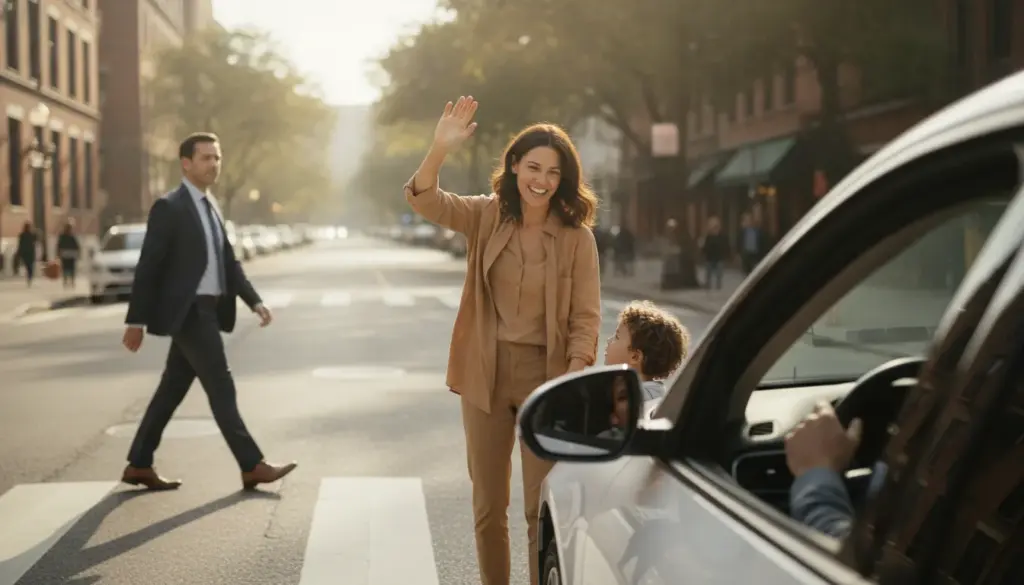
What that quick wave uncovers about your mindset
That brief nod of appreciation might feel insignificant, yet behavioral experts notice a fascinating trend hidden within it. People who intentionally raise a hand to thank a motorist yielding at a crosswalk generally navigate life quite differently compared to those who just stride across without a word.
Traffic psychologists often connect these fleeting actions to our overarching perspective on life. When examining routine acts of appreciation and politeness, a distinctly clear pattern emerges. Individuals who acknowledge others on the road generally hold a more optimistic worldview and report higher levels of overall life satisfaction.
Those who regularly practice these tiny rituals tend to notice that they:
- Possess greater faith in the people around them
- Feel significantly less defensive during chaotic moments
- Reflect on their daily experiences with more positivity
- Show a higher readiness to offer assistance to someone else
Ultimately, it extends far beyond a fleeting curbside interaction. This subtle movement frequently mirrors a fundamental capacity to recognize the positive traits in humanity and validate them.
Easing tension with just a fraction of a second
The concept of thankfulness has gained immense traction within mental health disciplines recently. It is consistently tied to reduced anxiety, improved sleep quality, and stronger emotional resilience during tough times. While the focus usually lands on evening journaling, the exact same psychological mechanism applies right in the middle of your daily commute.
Raising a hand prompts a surprising cognitive shift. For one literal second, the pedestrian pauses to process the reality: “This person halted their car for me, and I am acknowledging that.” This tiny mental break successfully interrupts the unconscious autopilot we often use to get through our routines.
Taking that brief instant to actively recognize a courteous act directly lowers physical tension and makes the entire environment feel less frantic.
Regular practicers note in behavioral studies that they:
- Maintain better composure during heavy traffic periods
- Notice a decrease in perceived hostility from fellow commuters
- Bounce back much quicker following a highly demanding workday
Connecting through empathy on the streets
Expressing gratitude outdoors is deeply intertwined with emotional intelligence and the ability to step into someone else’s shoes. Many individuals who thank drivers are motorists themselves. They intimately understand the frustration of yielding right-of-way while receiving absolutely zero eye contact or acknowledgment for the effort.
Because of their own time behind the wheel, they realize that applying the brakes, shifting gears, and staying alert drains mental energy. A simple wave validates that unseen effort. It isn’t a grand performance, but rather a quiet message conveying, “I appreciate what you just did.” These microscopic moments of validation serve as the essential glue keeping our communities functioning smoothly.
Within psychological frameworks, this is categorized as “pro-social behavior.” It involves voluntary actions designed to foster a more pleasant environment without expecting any immediate reward. That brief salute at the zebra crossing stands as a textbook illustration.
Practicing patience in a hurried world
Another hallmark trait found in folks who make these gestures is a deep sense of patience. Pausing to lift your hand requires carving out a tiny slice of your own time for a stranger, rather than remaining purely focused on your personal momentum.
Those who deliberately say thanks briefly step out of the rat race, allowing a spark of shared humanity to exist even as the clock ticks on.
Observational data highlights that individuals maintaining these habits are less prone to lay on the horn, curse at traffic, or let red lights ruin their mood. They aren’t perfect saints, but rather people who have trained themselves not to be emotionally hijacked by every minor irritation.
The surprising ripple effect on the person driving
The psychological boost doesn’t just stop with the person walking. The driver on the receiving end experiences an equally powerful impact. Studies focusing on road dynamics reveal that motorists exhibit much safer, friendlier driving habits immediately following positive reinforcement.
A driver who receives a friendly nod is significantly more likely to:
- Willingly yield for the very next person waiting to cross
- Leave a safer, wider buffer zone around cyclists
- Keep a level head when a fellow driver makes a silly mistake
In essence, one solitary second of appreciation can spark a mini chain reaction of considerate driving. It transforms an ordinary crosswalk into a spontaneous training ground for societal cooperation.
Never wave? What that actually means
If you happen to be someone who never gestures, rest assured it doesn’t automatically brand you as self-centered or cold. How we operate in public spaces relies heavily on childhood modeling, ingrained habits, and our personal feelings of safety near roads.
A lot of people are just naturally reserved. Making direct eye contact through a windshield with a total stranger feels inherently awkward to them. For others, the concept of cars stopping at designated crossings is so strictly expected that it simply doesn’t trigger a conscious need to show thanks.
Nevertheless, behavioral experts suggest that deliberately testing out small appreciative gestures can still yield personal benefits, even if it feels unnatural at first. Not because society demands it, but because of the genuine, uplifting effect it has on your own internal mood.
Building a new, effortless habit
If you find yourself curious about the benefits, the easiest approach is to start exceptionally small.
Give it a few weeks, and this minor action will likely transform into an unconscious reflex. You will stop overthinking the mechanics of it entirely, while continuing to reap the subtle emotional rewards.
The science backing micro-rituals
Academic interest in appreciation usually targets major practices, such as detailing three wonderful daily occurrences in a diary. Yet, mundane street interactions fall perfectly into that exact same therapeutic category. They don’t demand deep soul-searching, but they still successfully pivot your brain into a state of thankfulness.
Because these physical movements require practically zero time, they are infinitely more sustainable for the average person than sweeping lifestyle overhauls. You don’t need a pricey retreat or an intensive mindfulness course; a split-second motion executed at the right time does the trick.
Reaping benefits beyond the crosswalk
Those who cultivate gratitude during their commute frequently discover that this attitude begins leaking into entirely different aspects of their week. Whether it is a polite nod to the mail carrier, a warm word for the barista, or a thumbs-up to a neighbor holding the elevator doors, the core mechanism remains identical: you notice the courtesy, you accept it, and you respond.
Experts describe this snowballing effect as building a “gratitude mindset.” It is an active perceptual shift where you consciously scan your environment for minor positives. While it takes a fraction of intentional effort early on, it quickly becomes your default lens. Consequently, your brain begins storing uplifting memories at a much faster rate than frustrating ones.
Whenever life gets chaotic and irritations peak, this uncomplicated routine can be a genuine game-changer. A quick wave at the corner won’t instantly turn the modern world into a utopia, but it effectively softens the harshest edges of the day. For both the pedestrian and the driver, it creates just enough mental breathing room to navigate the remaining hours feeling a little more at peace.