As soon as a green curtain of ivy begins creeping up a trunk or covering a brick wall, many homeowners immediately grab their pruning shears. This rigorous cutting back, however, frequently produces adverse results. People quickly label the dense foliage as destructive or hazardous. Yet, botanical specialists paint an entirely different picture: stripping away this vegetation completely deprives your property, trees, and local wildlife of a powerful natural ally.
A Clever Survivor, Not a Parasite
English ivy (Hedera helix) frequently gets unfairly categorized alongside true parasitic plants like mistletoe. This is a fundamental misunderstanding. The vine’s main root system remains firmly anchored in the earth, which is where it absorbs all necessary water and nutrients. Those tiny, hair-like aerial roots clinging to your oak or siding serve purely as mechanical support rather than feeding tubes.
Ivy lives alongside its host, never feeding off it. Healthy timber rarely suffers any negative consequences from this arrangement.
Practical arboriculture demonstrates that robust trees easily maintain their vigor even when cloaked in a thick layer of vines. The climber simply utilizes the vertical structure to reach sunlight faster, rather than extracting sap. Unfortunately, the moment green shoots appear in the canopy, chainsaws often come out. Aggressively ripping these stems away usually tears off pieces of young bark and crucial protective layers, actively damaging the tree’s natural defense mechanisms.
The Natural Protective Jacket for Trunks
When clinging to a strong, healthy trunk, this evergreen functions much like an insulating coat. The overlapping foliage creates an effective buffer against extreme weather conditions, offering several surprising ecological and structural benefits:
- Sun and heat deflection: The dense leaves filter intense summer sunlight, significantly lowering the risk of bark scorch.
- Impact resistance: The vegetative layer absorbs the brunt of heavy rain and hail, preventing superficial trunk damage.
- Moisture regulation: A stable microclimate forms beneath the leaves, keeping humidity levels consistent around the wood.
- Root zone protection: Ground-level coverage shields the underlying soil from drying out and prevents erosion.
Furthermore, this vertical garden serves as an indispensable micro-habitat. Dense branches offer vital nesting spots and shelter for birds, while small mammals use it for cover. Hundreds of insect species also rely on the plant for nectar, late-season berries, and safe winter hibernation spaces. Eradicating the vine entirely effectively demolishes a bustling ecological neighborhood in a single afternoon.
When Climbing Vines Actually Become a Risk
Naturally, not every specimen can handle the exact same botanical burden. Complications primarily arise when the host is incredibly young or already in a state of decline, which shifts the ecological balance.
Intervention is highly recommended in specific structural scenarios:
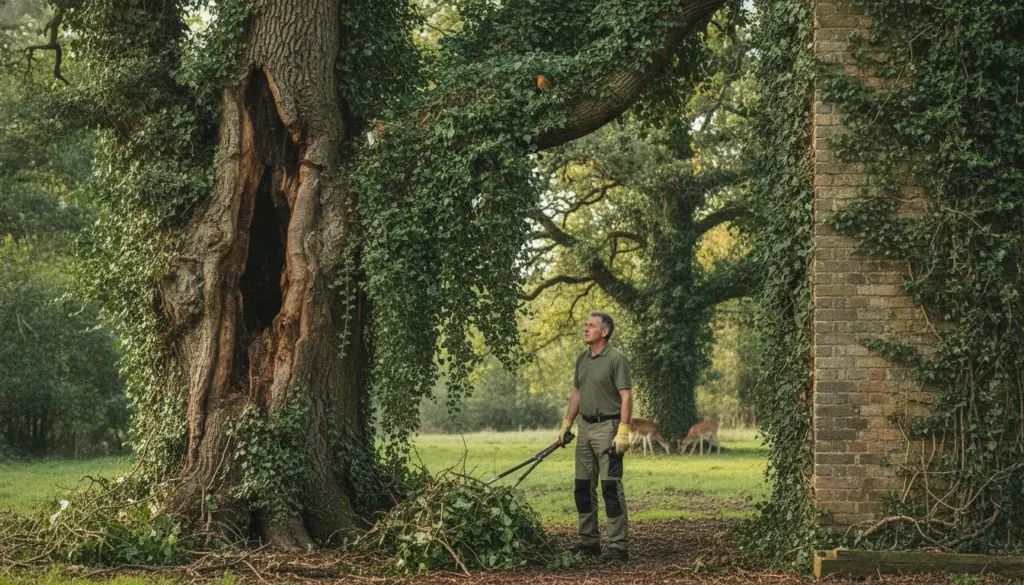
- Decaying, hollow, or ancient trees possessing weakened canopy structures.
- Freshly planted ornamental varieties and young fruit trees requiring maximum light exposure and physical space.
- Timber exhibiting major structural cracks, rotting sections, or massive historical pruning wounds.
- Trunks leaning precariously or missing significant load-bearing branches.
If you encounter these vulnerabilities, a massive weight of foliage might prove too heavy. Should doubts arise, the most effective strategy involves reducing the vine’s height to roughly two-thirds of the main trunk, keeping the upper canopy airy. Instead of violently yanking the vegetation downward, simply sever the stems at multiple base points and allow the withered leaves to detach naturally over time.
Property Facades: Destructive Barricade or Living Shield?
The presence of creeping vines on residential exteriors triggers similarly strong reactions. Homeowners generally dread the thought of ruined mortar and crumbling brickwork. However, architectural assessments reveal a much more nuanced reality: on a structurally sound exterior, this greenery provides exceptional preservation.
Provided the masonry lacks pre-existing cracks, features high-quality pointing, and boasts stable render, the aerial roots only attach superficially. They barely penetrate the surface, weaving together to form a protective biological skin.
On well-maintained masonry, this living shield actively guards against precipitation, thermal extremes, and urban pollution.
This vegetative barrier accomplishes several things:
- Intercepts driving rain, keeping the underlying brickwork considerably drier.
- Moderates intense temperature fluctuations across the building’s exterior.
- Minimizes heat absorption during blistering summer months.
- Captures airborne particulate matter and environmental pollutants.
This biological insulation can even yield favorable outcomes for indoor comfort and energy consumption, subtly reducing winter heat loss while preventing extreme summer overheating.
Recognizing When Masonry is Truly Threatened
The situation shifts dramatically if the building’s exterior already suffers from structural weaknesses. When faced with deteriorating mortar, historic fissures, or loose plaster, the clinging roots can wedge themselves inside and progressively amplify the degradation.
Classic architectural problem areas include:
- Unrenovated, aging walls constructed with soft lime-based mortar.
- Hairline fractures around window frames or building corners.
- Powdery bricks and sections of flaking stucco.
- Obstructed drainage systems and downspouts infiltrated by wandering shoots.
When combined with wind movement and moisture penetration, these tiny roots meticulously pry at compromised masonry. Water seeps deeper into the crevices, and subsequent freeze-thaw cycles inevitably accelerate the destruction, significantly elevating the risk of serious damp issues.
Before allowing nature to reclaim an exterior wall, conducting a thorough structural inspection is crucial. Any porous areas, crumbling joints, or visible fractures demand immediate professional repair before the green veil is permitted to spread.
Smart Management for Homes and Habitats
Adopting an extreme, all-or-nothing mindset rarely yields the best horticultural results. By following a few straightforward evaluation steps, you can determine the most sensible approach for your specific landscape.
Step 1: Evaluate the Host’s Vitality
Examine the canopy for lush foliage and scan for excessive deadwood. Inspect the main trunk for severe splitting or old, unhealed wounds. Finally, verify that the structure stands reasonably straight and firm. If everything appears robust, the vines can typically remain. Simply clear the uppermost branches every few years by trimming the highest reaching tendrils.
Step 2: Inspect the Structural Facade
Scrutinize bricks, mortar, and rendering for any soft or detached sections. Look closely for micro-cracks near doorways, windows, and structural edges. Clear out any organic debris clogging gutters or downspouts. If the architecture is pristine, the creeping foliage poses no threat, provided you regularly trim around the roofline and window frames. If damage is apparent, sever the vines at ground level, let the material completely desiccate, and carefully peel it away before initiating repairs.
Step 3: Factor in Wildlife and Seasonal Timing
These evergreens are irreplaceable for local fauna. Their impenetrable foliage provides year-round sanctuary, late-blooming flowers offer crucial autumn nectar for pollinators, and winter berries sustain foraging birds. When trimming becomes necessary, always schedule the work well outside of peak nesting seasons. Leave substantial sections untouched whenever possible, allowing you to manage the growth without decimating crucial habitats.
Practical Compromises for Orderly Gardens
If you prefer a highly manicured aesthetic but still want ecological benefits, practical middle-ground solutions exist. Consider training the climbers along dedicated tension wires or freestanding trellises placed slightly away from the actual siding. For woodland management, establishing a stark horizontal pruning line—perhaps at shoulder height—creates a striking visual. Everything below remains lush and dense, while the upper portions stay entirely clear.
Ensure this vigorous climber doesn’t become a monoculture. By integrating perennial beds, flowering shrubs, and diverse meadow grasses, you cultivate a dynamic environment where countless creatures thrive. Managed properly, this misunderstood vine transforms from an overwhelming blanket into one highly valuable component of a resilient, thriving ecosystem.