
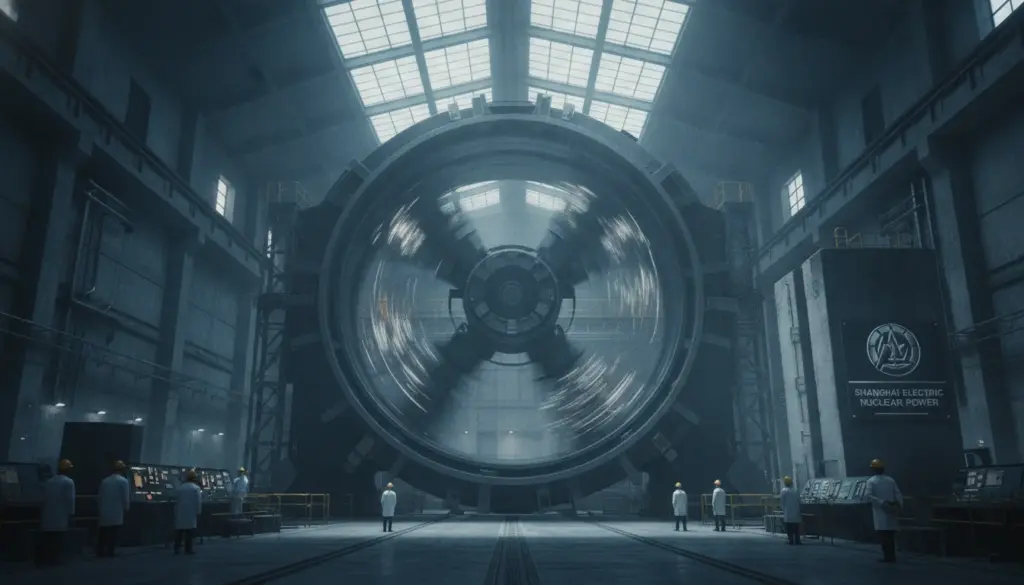
A Time Machine Built from Concrete and Steel
Behind the facade of an unassuming concrete bunker lies a groundbreaking scientific marvel. Researchers are using a colossal centrifuge to literally warp distance, gravity, and time, compressing millennia of natural evolution into just a few hours.
Crafted by Shanghai Electric Nuclear Power, this multi-ton behemoth goes by the rather clinical designation CHIEF1900. It represents a massive leap forward in scientific engineering, completely eclipsing its predecessor, the CHIEF1300, which only launched in September but already feels like a relic.
The primary scientific goal here revolves around hypergravity. While average humans experience a standard 1 g on Earth and elite fighter pilots might endure up to 9 g, this machine operates in an entirely different league. Capable of generating an astounding 1,900 g-ton, it easily claims the title of the planet’s most formidable research centrifuge.
For context, the previous global record holder—operated by the US Army Corps of Engineers in Vicksburg, Mississippi—maxed out at 1,200 g-ton. The Chinese engineering team pushed this boundary significantly, completing the sprawling complex in a breathtaking five-year window.
Fast-Forwarding Reality
At its core, the underlying physics mimic a standard centrifuge. An enormous mechanical arm spins at blistering speeds, subjecting test modules attached to its extremities to extreme centrifugal forces. While our planet’s rotation creates a tiny, almost unnoticeable centrifugal pull, this laboratory amplifies that sensation to mind-bending levels.
This artificial hypergravity acts as a fast-forward button for physical reality. Materials compact at accelerated rates, water infiltration dynamics shift, and mechanical stress accumulates rapidly. Phenomena that would normally require centuries or millennia in nature can now be closely monitored over a single weekend in the lab.
Experts frequently refer to this phenomenon as compressing space and time. It allows them to shrink massive subterranean landscapes and impossibly slow geological shifts down into a single, time-lapsed miniature model.
Six Chambers, Endless Possibilities
To maximize utility, the facility features six distinct testing environments, bridging the gap between biology, civil engineering, and environmental science. These dedicated zones include:
- Slope and dam stability dynamics
- Seismological and geotechnical engineering
- Deep-sea and offshore construction frameworks
- Subsurface environmental impact tracking
- Long-term geological transformations
- Advanced materials and industrial innovation
From Hydropower to Nuclear Safety
When studying massive infrastructure like hydroelectric dams, scientists no longer need to construct enormous reservoirs. Instead, a scaled-down model placed inside the spinning chamber experiences forces that perfectly mimic centuries of water pressure, structural strain, and gradual erosion. The miniature replica behaves exactly like a full-sized dam under real-world conditions.
Nuclear energy researchers are also leveraging the technology to evaluate deep underground disposal sites for radioactive waste. The hypergravity environment reveals exactly how bedrock might fracture or how groundwater could transport dangerous radionuclides over thousands of years, turning an incredibly slow natural process into a highly manageable experiment.
Accelerating Environmental Forensics
One particularly sensitive area of study involves environmental contamination. Environmentalists desperately need to understand how chemical spills or heavy metals sink into deep soil layers and eventually contaminate vital groundwater reserves.
Using this advanced machinery, technicians can replicate precise soil consistencies, moisture levels, and chemical profiles. The intense g-forces dramatically accelerate the downward migration of pollutants. What once required decades of agonizing environmental decay can now be mapped and analyzed in just a few days.
Overcoming Extreme Engineering Hurdles
A mere twelve months ago, the structure housing this advanced apparatus did not even exist. The rapid transition from initial blueprints to a fully operational testing hub highlights a massive strategic push in infrastructure research. However, functioning at such extreme rotational velocities subjects the equipment to mechanical stress levels typically reserved for rocket launches and space exploration.
The mounting brackets, spinning arms, and industrial bearings must endure relentless vibration and structural fatigue. Even the slightest microscopic flaw could trigger a catastrophic failure under these intense gravitational loads.
Managing the immense heat generated by friction and heavy electrical demand presents another monumental challenge. To prevent the motors and test chambers from melting down, engineers implemented a highly sophisticated vacuum-based temperature control mechanism. By combining specialized liquid coolants with targeted forced ventilation, they successfully minimize air friction and maintain safe operating temperatures.
The Strategic Push for Independence
This facility is far more than a mere vanity project; it anchors a deliberate strategy to eliminate reliance on foreign testing laboratories while simultaneously de-risking domestic megaprojects. When constructing high-altitude dams, precarious high-speed rail networks, or deep-water offshore wind farms, miscalculations can result in devastating financial and human costs. This centrifuge delivers concrete, actionable data long before construction crews ever break ground.
It also adds a distinct geopolitical edge. By controlling the world’s premier geotechnical testing site, domestic research programs can advance without navigating international export controls or collaborative restrictions. Top-tier Western firms and academic institutions looking to push the boundaries of civil engineering will now inevitably need to engage with Eastern partners.
Navigating Future Risks and Rewards
Operating a hypergravity lab is not without its caveats. Scaling physical processes isn’t always a flawless mathematical equation. Biological organisms often react unpredictably to intense gravitational shifts, and intricate subterranean geology doesn’t always translate perfectly to a shrunken physical model. Researchers must exercise extreme caution when applying laboratory findings to real-world scenarios.
Furthermore, operating such volatile equipment demands extraordinary technical proficiency. A slightly misaligned test module could lead to severe mechanical incidents, making redundant safety protocols and independent audits absolutely essential. Yet, the potential breakthroughs are staggering, paving the way for:
- Rapid validation of structural materials for modern skyscrapers, bridges, and tunnels
- Precise modeling of urban soil subsidence in cities heavily reliant on subterranean construction
- Pioneering agricultural studies under modified gravity for future lunar or Martian colonies
- Stress-testing crucial aerospace components before they endure the harsh realities of orbital launch
A New Lens on Planetary Evolution
Beyond immediate commercial applications, this colossal machine forces scientists to completely rethink their approach to planetary mechanics. By essentially speeding up time, engineers can physically test geological hypotheses that were previously considered purely theoretical.
They can watch massive fault lines form, observe gas hydrates reacting to deep-ocean pressure shifts, and track sediment erosion around offshore wind turbines over simulated centuries. While supercomputers will always play a vital role in modern science, they now have a powerful physical counterpart.
Fusing digital numerical modeling with accelerated real-world laboratory data promises incredibly robust predictions for industry leaders and policymakers. Gravity is no longer just a fundamental force to be measured—it has officially become a highly tunable tool for shaping the future of our planet.