
France draws a firm line: a defensive shield that unsettles Europe
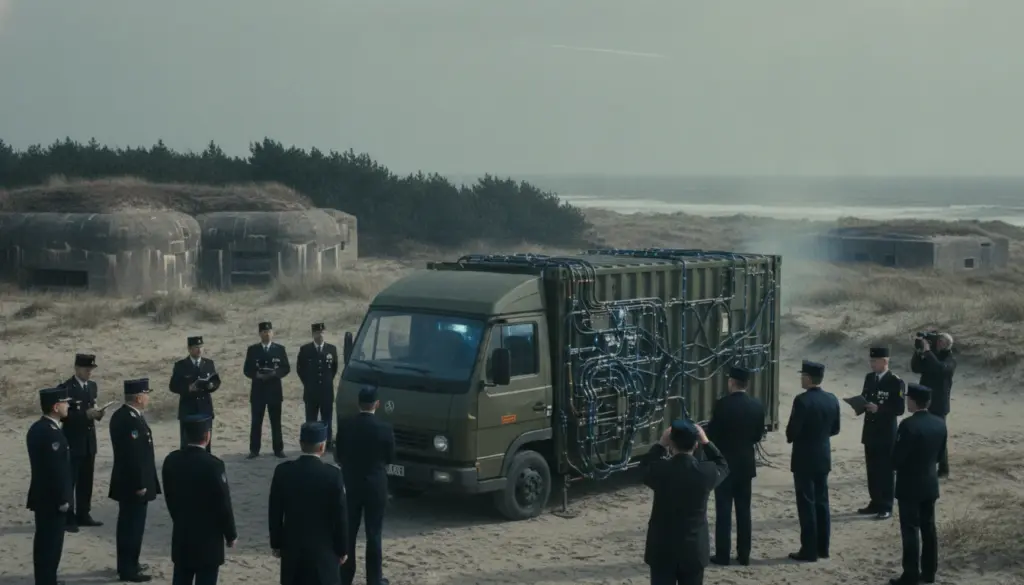
The atmosphere along the Atlantic coastline carried a distinct tension on the morning France triumphed with its latest anti-aircraft defense system. Gathered on an isolated military testing ground, nestled among pine trees and concrete bunkers from a bygone era, officials and journalists huddled together while scanning the pale winter sky. A massive metal container, roughly the size of a transit van and tangled in thick cables, hummed quietly like a beast waking from a deep slumber.
A voice nearby murmured that a successful outcome would alter the entire geopolitical landscape. Soon, a radar dish began its slow rotation, sweeping the heavens for an unseen peril. For a fleeting moment, the entire crowd held their collective breath. The profound silence that blanketed the area resonated louder than any physical detonation.
Paris wasted no time framing that morning’s events as a major strategic leap forward. Their newly unveiled, cutting-edge air defense mechanism is reportedly capable of taking down hyper-fast missiles and high-altitude drones with ease. This is no longer the stuff of speculative fiction, but a tangible, steel-clad response to an increasingly anxious global climate. The underlying signal was unmistakable: the French government doesn’t just want a seat at the table with major global powers; they intend to dictate the menu.
Across other European capitals, the reception was remarkably subdued. Behind closed doors, furrowed brows replaced applause. Whenever a single nation suddenly showcases a massive leap in aerial defense capabilities, it inadvertently places immense pressure on its neighbors. The pressing questions immediately surface: who provides protection for whom, and who ultimately holds the power of life and death over European skies?
A flawless demonstration with heavy implications
During the coastal showcase, a mock enemy projectile was fired from an offshore vessel. The scenario mimicked a hostile strike perfectly: low trajectory, blistering speed, and almost zero reaction window. Inside the control hub, a tiny dot materialized on the monitors, quickly transforming into an aggressive red trajectory line. A technician calmly punched in a series of commands. It lacked the theatrical suspense of a Hollywood blockbuster, resembling standard daily routine instead. Nevertheless, the nervous bouncing of the operator’s knee beneath the console told a different story.
Mere moments later, an interceptor missile launched skyward with surprising grace. Screen observers watched two distinct digital tracks converge until they vanished in a brilliant flash of light. Outside the command center, the resulting blast was surprisingly muffled, sounding more like a heavy thud than a spectacular fireworks display.
A high-ranking general offered a barely perceptible smile, fully aware that this exact second represented years of relentless engineering and billions of euros in funding. While the official press release celebrated a successful experimental trial, one diplomat privately noted this was the exact instance Europe realized Paris was entirely willing to force its own agenda.
The leaked data that acts as political leverage
Shortly after the event, specific performance metrics began circulating like wildfire. The system achieved a successful intercept at a distance exceeding one hundred kilometers, boasting a response window of just a few dozen seconds. Furthermore, it seamlessly integrates with current French military networks and, according to whispers in the defense community, is already primed to sync with orbital space sensors.
To a military engineer, these are merely impressive technical specifications. To a political leader, however, they represent incredibly powerful tools for diplomatic leverage. Possessing this caliber of defensive technology secures both national safety and significant weight during international negotiations.
Defense analysts are currently describing a definitive French shockwave rippling through the continent’s military establishment. While Germany consistently pushes for collaborative joint initiatives and Italy prefers a quiet, cooperative approach, the French administration is increasingly carving out an independent path. This aerial shield perfectly encapsulates that exact philosophy: designed domestically, controlled nationally, and only shared under extremely specific French stipulations. This is precisely the source of the growing continental unease. The anxiety stems less from the advanced hardware itself and entirely from the immense authority it provides.
Authorities in Brussels recognize a glaring vulnerability: the potential splintering of European military infrastructure, leading to a chaotic web of individual national systems, conflicting standards, and divergent political motives. Speaking off the record, a senior EU official summarized the dilemma perfectly, noting that a protective dome is wonderful until every country constructs their own, leaving everyone confused about who is authorized to fire at what. This apprehension goes beyond basic military strategy and touches on deep symbolic fears. If France unilaterally secures the airspace, who exactly gets to define what constitutes a valid target?
Deploying airspace security as a diplomatic instrument
Look past the dense technical jargon and patriotic grandstanding, and a remarkably straightforward strategy emerges. France plans to utilize its new anti-aircraft capabilities not merely for self-preservation, but as a high-value bargaining chip. They are essentially treating national security as a premium service. Imagine a scenario where permanent airspace coverage is provided to a neighboring European territory in direct exchange for vital political backing, lucrative commercial contracts, or leadership roles in joint military operations. This modern approach to influence relies on overlapping data streams and radar frequencies rather than rolling tanks across physical borders.
Their tactical approach is incredibly calculated: first, you prove your overwhelming capability, and then you crack the door open just a fraction. Parisian officials have already hinted that this advanced shielding could seamlessly fold into existing NATO frameworks, provided that strict French sovereignty is unconditionally maintained.
That specific caveat is far from a minor footnote. In practical terms, it ensures that French commanders will always keep their fingers firmly on the launch button, even while shielding allied nations. For smaller member states, this proposition is equally comforting and terrifying. It feels remarkably similar to purchasing a fire insurance policy from the exact same neighbor who happens to own the only working water hose in the neighborhood.
The complicated reality of sharing the umbrella
When speaking privately with military personnel, a common, exhausted sentiment echoes through the ranks: the underlying technology is overwhelmingly difficult, yet the surrounding politics make it infinitely worse. Still, the French government insists that their homegrown shield will ultimately benefit the entire continent. Insiders close to the Élysée Palace suggest the protective grid can be deployed in modular phases. Initial rollouts would likely guard critical strategic assets, such as energy grids or telecommunications hubs, before eventually expanding to cover sprawling metropolitan centers.
This phased approach introduces a massive diplomatic headache. Which major capital receives the protective dome first? Will it be Paris, Brussels, or Warsaw? These are absolutely not neutral logistical queries; they are monumental decisions capable of forging or fracturing government alliances. Let us be entirely realistic: absolutely no one wants to be relegated to the waiting list when dealing with incoming ballistic threats.
One senior French military official stated bluntly that while international cooperation remains on the table, it must always align with French structural designs. “We are perfectly willing to share this protective shield, but we will absolutely never hand over the keys,” he remarked. He further clarified that anyone seeking shelter under their umbrella must fully accept that France will be the one holding the handle.
While this rhetoric played wonderfully in domestic newspaper headlines, various European defense committees interpreted the phrasing as a very clear, thinly veiled warning. A crucial element often overlooked by the general public is the massive economic engine driving every radar dish and launch pad. Domestic arms manufacturers are already salivating over potential export opportunities throughout Eastern Europe and the Middle East.
Their sales pitch is remarkably straightforward: rigorously proven on home soil, fully operational for global deployment. This commercial aspect adds yet another layer of anxiety across the continent. When a nation relies on Paris for its critical defense hardware, saying “no” to French political demands during tense diplomatic standoffs becomes exceedingly difficult.
Strategic advantages reshaping the continent
- Unmatched negotiation leverage: A distinct technological lead grants France significant bargaining power within both EU and NATO discussions.
- Fears of overreliance: Smaller neighboring countries are deeply concerned about becoming entirely dependent on French military infrastructure and command decisions.
- Shifting geopolitical alliances: The inevitable export of this advanced weaponry has the immense potential to completely redraw traditional power blocs and international partnerships.
The psychological impact: looking beyond the hardware
When citizens turn on their evening news and witness those awe-inspiring visuals—brilliant flashes cutting through the night sky as rockets surge vertically—it is incredibly easy to overlook the silent psychological toll underneath. We have all experienced that distinct feeling when a news bulletin regarding armed conflict or missile threats suddenly resonates a bit deeper than usual. Perhaps it happens because your children are sitting quietly next to you in the living room. Or maybe the digital threat map on the screen suddenly highlights a region uncomfortably close to your own borders.
The latest French defense initiative triggers that exact visceral reaction. The underlying promise sounds deeply comforting: we possess the tools to secure your skies. Yet, across living rooms spanning the continent, a much darker question simultaneously takes root. What kind of modern era are we currently navigating where such extreme military systems are no longer viewed as optional luxuries, but absolute necessities? Exactly how much advanced technology is required before we can finally feel a baseline level of safety again?
Behavioral psychologists who analyze public threat perception frequently observe a very predictable cycle. Every time a new defensive barrier is erected, regardless of its sophistication, society’s mental baseline shifts. An impenetrable missile dome does not automatically breed public calmness. In many instances, it simply makes the looming danger feel significantly more tangible.
Whereas warfare was previously viewed as a distant, abstract concept, everyday citizens are now routinely thinking about flight trajectories, blast radiuses, and critical minute-by-minute warning windows. This transition from abstract worry to concrete reality does not offer relief for everyone.
A prominent defense analyst, speaking under the condition of anonymity, captured the sentiment perfectly, noting that nations construct massive shields to alleviate societal fear, yet these structures often serve as glaring reminders of how terrifyingly real the danger remains. You can sense this exact friction echoing throughout Europe, permeating everything from late-night talk shows to heated parliamentary debates. Citizens desperately crave protection, yet they strongly resist the idea of living their daily lives under a metaphorical glass dome fueled by constant threat alerts.
An internal technological arms race
There is also a much subtler dynamic at play. The French administration is showcasing its new defense grid as a monumental peak of engineering, framing it as a pure triumph of innovation and deep-rooted national pride. This specific narrative resonates flawlessly within a country that deeply values its strategic autonomy. However, to neighboring European partners, this messaging often translates quite differently, sounding uncomfortably similar to: “We have our own backs, good luck with yours.”
Consequently, a strange, underlying jealousy is beginning to poison international discussions. Why does one nation possess this while others do not? Why must the continent rely on a purely French design rather than a unified European framework where every member state retains equal voting power?
In certain regions, this frustration is confined to grumpy editorial columns, but in others, rival defensive projects are already being actively funded. This introduces yet another layer of immense complexity, ensuring billions more will be spent competing internally. While rarely acknowledged publicly, it increasingly feels like a