
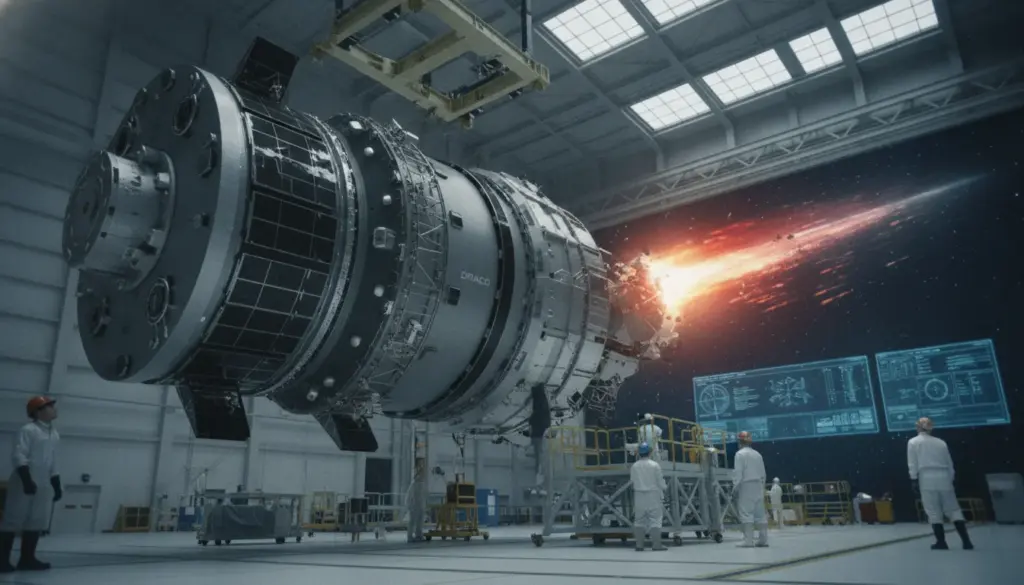
A Spacecraft Purposely Built for Destruction
This is no tragic orbital accident, but a highly orchestrated scientific experiment. The European Space Agency (ESA) is determined to uncover exactly what happens when a spacecraft bursts into flames while plunging back to Earth. To achieve this, they are engineering a unique device with a singular mission: to tear itself apart in the atmosphere while recording every fiery second of its own demise.
The project is dubbed Draco, short for Destructive Reentry Assessment Container Object. While the acronym lacks poetic flair, its purpose is crystal clear. This specialized container will meticulously analyze its own vaporization. Weighing in at a compact 150 to 200 kilograms—roughly the mass of a fully grown male gorilla—the satellite is engineered strictly for an early grave.
Once launched into low Earth orbit, Draco will not spend years circling our planet. Within a mere twelve hours, ESA controllers will intentionally command it to dive toward a remote ocean zone. Ultimately, this brief flight will culminate not in a museum exhibit, but in a spectacular fireball.
Draco represents the first European platform designed to measure its internal destruction in real-time. This bold initiative perfectly aligns with ESA’s Zero Debris vision, which dictates that future space operations must leave behind minimal clutter in orbit, throughout the atmosphere, and on the ground.
Why Europe is Intentionally Sacrificing a Satellite
Bridging the Reentry Data Gap
Modern space agencies and commercial firms are currently launching hundreds of new satellites into the cosmos. Consequently, a growing percentage of these inevitably make uncontrolled returns, partially burning up and fracturing along the way. While this glowing descent looks incredible from the ground, aerospace scientists actually understand surprisingly little about the precise physics involved.
Current computer models offer educated guesses about which materials vaporize and what debris might survive to strike the Earth, but these digital simulations severely lack real-world validation. Ground-based laboratory tests simply cannot replicate the chaotic cocktail of extreme thermal loads, supersonic velocities, and complex spacecraft materials.
Without hard telemetry gathered during an actual reentry event, every current risk assessment relies heavily on approximations. This creates a massive hurdle for aerospace engineers trying to build safer spacecraft. To improve designs, they desperately need to know:
- Which specific components vaporize entirely during descent;
- Which structural elements survive intact or splinter into massive shards;
- The exact altitudes where different composite materials fail and shatter;
- How rapidly internal pressure and temperature spike inside the chassis.
Draco is designed to eliminate this crucial blind spot. Far from being a failed mission, this doomed satellite acts as a revolutionary diagnostic tool, sacrificing its hardware to harvest invaluable telemetry.
A Flying Laboratory Packed with Sensors
Beneath its exterior, Draco resembles a complex physics experiment rather than a traditional communications satellite. Aerospace technicians have embedded roughly 200 specialized sensors throughout its framework. As the outer hull begins to scorch and tear apart, these instruments will continuously log localized temperature spikes, structural stress, pressure fluctuations, and violent vibrations.
Furthermore, four onboard cameras will visually document the spacecraft’s gradual disintegration. These lenses will capture the exact moments solar panels rip away, internal cabling melts into slag, and propellant tanks buckle under extreme heat. By syncing this video footage with sensor data, researchers can finally link physical destruction to precise thermal values.
All of this critical information routes directly into a heavily fortified capsule nestled deep inside the satellite. Functioning much like an aircraft’s “black box,” this compact vault is shielded by robust thermal plating and features an independent parachute system designed to survive the most violent phases of the plunge.
A 20-Minute Race Against the Fireball
The most brutal phase of atmospheric reentry is incredibly brief. ESA experts anticipate a tight transmission window of just about twenty minutes. This countdown begins the moment the black box capsule reaches a stable enough altitude to broadcast, and ends violently when it splashes down into the ocean.
During this frantic timeframe, the surviving capsule must rapidly beam thousands of recorded data points up to a geostationary relay satellite hovering high above the Earth. That relay then forwards the telemetry down to terrestrial ground stations. Because this destructive event cannot be easily replicated, every single lost byte of data represents a missed scientific opportunity.
If the transmission fails, the entire mission loses data captured under extreme conditions that no terrestrial facility can fake. Flight dynamics teams must execute a flawless precision operation. The capsule’s orientation, antenna deployment, parachute timing, and data stream initiation must all synchronize perfectly.
Pushing Beyond the Limits of Digital Modeling
For decades, orbital mechanics teams have leaned on numerical software to predict how falling space hardware will behave. However, these programs rely on simplified geometric shapes, standardized alloys, and theoretical breaking points.
In reality, custom-built satellites are highly intricate. Under actual reentry conditions, complex phenomena occur simultaneously: heavy metals oxidize, unpredictable fracture patterns emerge, and turbulent aerodynamic vortexes form around shedding debris. Today’s software can only estimate these reactions, not definitively measure them.
By leveraging Draco’s final broadcast, ESA can finally calibrate its predictive algorithms using irrefutable field data. Consequently, future risk models will rest on a foundation of hard facts, allowing regulators to strictly evaluate the reentry profiles of tomorrow’s mega-constellations.
Protecting the Ground, Airspace, and Atmosphere
Ensuring Safety for Aviation and Populated Zones
While falling space junk poses a statistically low threat to humanity, the risk is never absolute zero. Massive titanium components can theoretically survive the plunge and strike populated regions or busy commercial flight corridors. Although most orbital hardware incinerates safely, dangerous anomalies still occur.
Armed with precise knowledge regarding fragmentation altitudes and debris survival rates, aviation authorities can establish much smarter, localized no-fly zones during reentry events. Similarly, maritime agencies can map safer maritime exclusion zones when steering dead satellites into ocean graveyards.
Unseen Chemical Effects High Above
Beyond immediate physical safety, atmospheric chemistry is becoming a major aerospace concern. When a satellite vaporizes, it unleashes a complex chemical stew of vaporized metals, incinerated plastics, toxic fuel residue, and glassy aerosols.
Rather than falling to the ground, this microscopic metallic “rain” lingers for long periods in the upper atmosphere—the same delicate layers housing the ozone layer and stratospheric clouds. Climate scientists are eager to understand how this artificial exhaust interacts with natural aerosols and stratospheric chemical cycles.
With tens of thousands of commercial satellites slated for eventual disposal, the cumulative environmental impact cannot be ignored. Draco will deliver unprecedented atmospheric datasets, empowering climate researchers to accurately calculate the space industry’s true ecological footprint high above the clouds.
Paving the Way for “Self-Vanishing” Satellites
ESA’s ultimate ambition extends far beyond a single explosive test flight. The agency aims to pioneer a new generation of spacecraft engineered to disintegrate completely upon retirement. This ensures zero hazardous debris reaches the surface and minimizes dangerous chemical emissions in the upper atmosphere.
Achieving this requires radical innovations in material science, structural geometry, and mission architecture. Future aerospace designs might incorporate:
- Fuel tanks forged with intentional thermal weak points;
- Advanced electronics engineered to melt rapidly under friction;
- Deployable structures that pop open early, allowing atmospheric heat to gut the interior;
- Specialized chassis coatings that release harmless byproducts upon combustion.
Draco serves as the ultimate proving ground for these concepts. By integrating “easily demiseable” prototype components into the probe, structural engineers can finally observe how these next-gen materials endure an authentic atmospheric gauntlet.
What This Means for the 2030s Space Industry
Over the next decade, low Earth orbit will become increasingly crowded, driven largely by massive commercial broadband and observation constellations. This orbital traffic jam guarantees a sharp increase in controlled reentries, forcing the industry to adopt stricter debris mitigation protocols.
Regulatory bodies are already drafting mandates that require satellite operators to either execute controlled atmospheric burns or banish dead tech to distant graveyard orbits. The telemetry harvested from Draco will likely shape these future laws, establishing mandatory design minimums for safe, sustainable destruction.
Commercial aerospace corporations are also paying close attention due to liability concerns. Armed with concrete evidence regarding exactly what survives reentry, aerospace insurers and governments can accurately price risks and draft tighter contracts. Ultimately, the data captured by this gorilla-sized sacrificial probe will dictate the technological trajectory of an entirely new era of sustainable spaceflight.