The Chilling Reality Inside the Testing Room
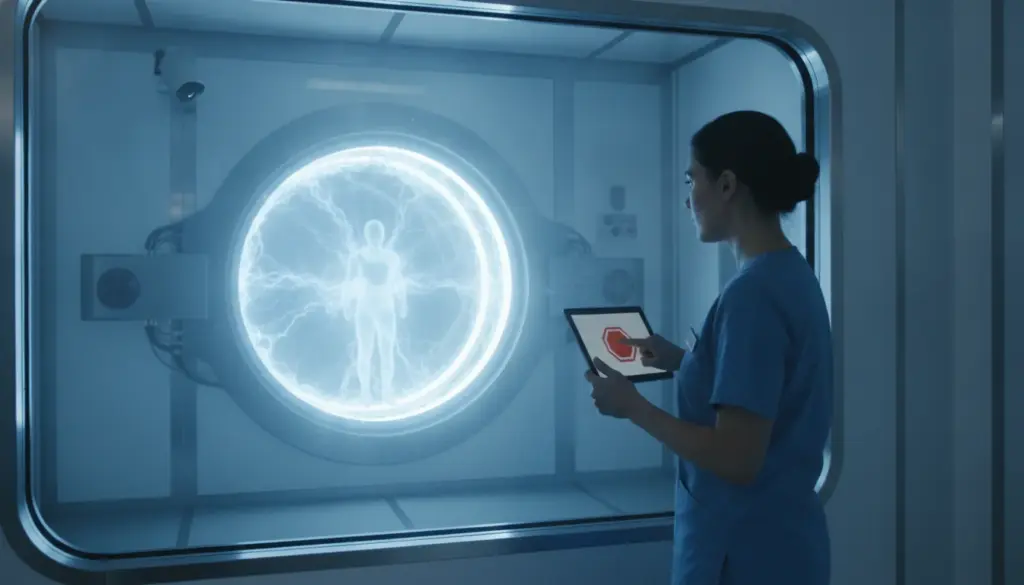
Behind the reinforced glass, a woman in blue medical scrubs holds her breath. She grips a tablet tightly, her index finger hovering instinctively over the emergency stop button. The sterile room smells sharply of ozone and harsh disinfectants, while a low, rhythmic hum builds up—sounding remarkably like a heavy freight train pulling out of a distant station.
“Experiment 42A, plasma tunnel, human subject test, commencing,” a clinical voice echoes over the intercom system. Up in the corner, a compact camera meticulously records every second. The participant’s eyes dart around, desperately seeking a reassuring human face rather than staring blindly at a digital monitor. Suddenly, the tunnel’s lighting shifts to a blinding, piercing white. For a split second, absolute silence dominates the space.
Then, something fundamentally incomprehensible begins to shift. And resting right in the middle of it all is a living, breathing human being, acting as the ultimate test subject.
Filtered Lightning: A Lifeline or a Boundary Crossed?
Inside the high-tech laboratory in Petten, researchers discuss this groundbreaking machinery as if they were casually chatting about a standard MRI scanner. Their tone remains remarkably calm, technical, and perfectly controlled. The so-called experimental plasma tunnel is designed to shield spacecraft, store massive amounts of energy, and even strip toxic particulates straight out of the atmosphere.
On an official level, this technology is simply controlled plasma. Think of it as captured, filtered lightning confined within a transparent tube and manipulated by intense magnetic fields. During corporate presentations, it looks like sleek, stylized science fiction, complete with polished visuals and flawlessly tidy charts. Yet, behind every single data point lies a fragile human body that had to endure the trial first.
This is exactly where the friction ignites: society desperately wants to be saved by advanced technology we barely comprehend. Simultaneously, we are actively asking living individuals to lay down and act as biological fuses within these high-voltage circuits.
The Quiet Launch of a Controversial European Program
Consider the European testing initiative that kicked off on a dreary, rain-soaked Monday without any fanfare. There were no flashy live streams and absolutely no press conferences. The only indicators were a routine heat warning buried in internal safety protocols and a fresh stack of ice packs stuffed into the laboratory’s breakroom fridge.
During the initial phase, researchers played it incredibly safely. Eager volunteers experienced brief exposures to remarkably low plasma densities while undergoing continuous medical monitoring. Doctors tracked heart rates, mapped brain activity, and searched for microscopic skin burns. On paper, the resulting data deemed the risks statistically insignificant. But that only tells the story for those reading the final reports.
Later that week in the cafeteria, a junior technician vividly recalled watching a test subject spend ten solid minutes just staring at his own hands after a session, seemingly convinced they no longer belonged to him. While he suffered zero physical damage, that hollow, disconnected gaze left a lasting impression. The official medical log coldly dismissed this profound experience as “mild disorientation, expected upon initial exposure.”
The Harsh Logic of Scientific Progress
Theoretically, the scientific justification is rock solid. Without these extreme human trials, we will never achieve plasma-field propulsion, robust radiation shielding, or revolutionary medical therapies. Someone ultimately has to be the first to walk through the invisible fire. The brutal, straightforward logic of innovation dictates that you simply cannot simulate authentic human biological reactions on a computer with perfect accuracy.
However, leading ethicists strictly warn that once we cross a profound moral boundary, we rarely ever step back. What initially starts as a desperate, exceptional measure inevitably transforms into a daily routine. Treatments originally pitched as an absolute last resort for terminal patients slowly morph into fast-tracked options for far less severe conditions.
Somewhere during the journey from that very first hesitant trial to the fortieth routine optimization session, the human being seamlessly turns from a vulnerable patient into a raw data point. The most terrifying part is that nobody can pinpoint the exact moment our humanity slipped away.
How We Shift Moral Limits Without Even Noticing
Every research facility utilizes an unspoken psychological trick to make ethically challenging work more digestible: they simply change the vocabulary. You refer to the person as a “subject” rather than “Leo, 38, father of two.” You document “thermal load” instead of explicitly writing down “pain.” This coping mechanism works flawlessly—at least until you drive home late at night and the overwhelming silence in your car suddenly feels unbearably heavy.
A remarkably simple tactic researchers use to soothe their lingering doubts is the incremental step strategy. You never push things to the extreme all at once. Each subsequent trial is just a tiny fraction more intense than the last one. It remains carefully balanced right on the edge of what is permissible, providing just enough justification to keep pushing forward.
Before anyone realizes what has happened, the definition of “low risk” drastically mutates from what it meant just twelve months prior. This doesn’t happen because of a sinister board decision, but rather because nobody possessed the courage to loudly say “stop” before it was too late.
The Seductive Promise of Extraordinary Gains
Standing safely on the sidelines, it is incredibly easy to preach that ethical boundaries must remain sacred. But out in the field, you meet passionate scientists who earnestly explain how a scaled-up plasma tunnel could eventually shield thousands of astronauts from lethal cosmic radiation during deep space exploration. You listen to seasoned oncologists whisper that this exact same technology could flawlessly burn away tumors that are currently a guaranteed death sentence.
These inspiring stories are completely genuine, and the hope driving them is intensely real. We’ve all experienced that precarious moment when we take a massive gamble simply because the potential reward looks too incredible to ignore. For a dedicated team that has poured years into developing this tunnel, halting a trial feels like a brutal betrayal of their life’s work and collective dreams.
Then, the icy reality of the modern world sets in: massive grant funding, intense political pressure, and fierce international technological races. The prevailing mindset insists that if rival nations aren’t playing by the ethical rules, we must naturally become a bit more flexible ourselves. This is exactly how the globe slowly drifts into a grim reality that no reasonable person would ever agree to under normal circumstances.
Anchoring Humanity in a Room Full of Machines
Project managers constantly reassure the public by stating they work under incredibly strict protocols, which is technically true. The problem is that these meticulously crafted documents are filled with pacifying jargon designed to comfort rather than confront. Absolutely no one writes down on an official form what a traumatized test subject actually witnesses during their darkest nightmares.
For those watching from the outside—concerned citizens, curious readers, and worried family members—there is only one effective strategy: relentlessly asking the most basic, fundamental questions. Who physically presses the start button? Who actively looks the volunteer in the eye right before the machine powers up? Who actually picks up the phone the next morning to ask how they are genuinely feeling?
Asking these questions is not an attack on the scientific method. Rather, these inquiries act as crucial anchors, desperately holding onto human empathy in spaces dominated by cold machinery. If we abandon this practice, we shouldn’t act shocked if, a decade from now, society considers it totally normal for financially desperate people to sacrifice their bodies to a glowing, superheated tube simply because a bureaucratic form labeled it an “acceptable risk.”
“We officially call it a tunnel,” one soft-spoken lab doctor confessed, “but for a lot of our participants, it feels much more like a hard border. Once you cross it, there are absolutely no guarantees you will come back entirely intact.”
Three Critical Questions to Ask Yourself
If you want to maintain a strong internal ethical compass, even without a background in advanced physics, keep these three brilliantly simple questions in mind. They might sound a bit childish, but that stripped-down clarity is entirely the point:
- Who stands to gain the most financial or professional reward if this experiment succeeds?
- Who is silently carrying the absolute heaviest personal and physical risk?
- Is there a designated person in that room fully empowered to declare, “Not right now, this is going too far”?
If researchers cannot provide a crystal-clear, highly convincing answer to even one of these points, the situation has already gone off the rails. Let’s be brutally honest: practically no one runs through this checklist every single day.
Living With Tech That Simultaneously Saves and Scars
This highly experimental plasma tunnel is far more than just a fleeting gadget we will inevitably forget about next year. It serves as a profound societal litmus test, revealing exactly how we view the inherent value of our own physical bodies. Are we truly vessels of untouchable human dignity, or have we simply become disposable cogs in a massive ecosystem fueled by risk, raw data, and endless optimization?
When you sit down and speak with the actual test subjects, their driving motivations are shockingly pragmatic. Some genuinely want to push the boundaries of science, while others are just desperately chasing a modest financial stipend to cover their basic rent at the end of the month. A rare few sincerely hope that enduring this bizarre ordeal today means their future grandchildren might safely travel between the stars tomorrow.
Woven tightly between these personal accounts lies an incredibly difficult dilemma: how much of humanity’s glittering future are we comfortably willing to build on the acute pain, stress, and quiet terror of those trapped inside an experimental tunnel today? Ultimately, we must all decide which role we are willing to play in this unfolding drama: the passive spectator, the vocal critic, the financial donor, or the vulnerable test subject.
Frequently Asked Questions
What exactly is an experimental plasma tunnel?
It is a highly specialized installation designed to generate a strictly controlled plasma field—essentially ionized gas acting like a continuous, sustained lightning bolt—around or along a physical object or human body. Top-tier researchers are meticulously testing how human physiology handles the intense combination of raw heat, radiation, and shifting magnetic fields. Their ultimate goal is to safely harness this extreme environment for advanced shielding, next-generation propulsion, or breakthrough medical therapies.
Why are human test subjects absolutely necessary?
Sophisticated computer models and comprehensive animal trials can only push the science so far. Human blood vessels, complex nervous systems, skin sensitivity, and deep psychological stress all react together in highly unpredictable ways that software simply cannot fully replicate. When you want to bring this theoretical technology into the real world, human testing becomes an unavoidable step. The real debate centers around the specific conditions, transparency, and hard limits placed on these trials.
Are the participants in these tunnels truly volunteering?
On official medical documents, they absolutely give their informed, legally binding consent. In stark reality, however, powerful factors like financial desperation, blind hope, subtle societal pressure, and deep-seated trust in medical authority play massive roles. True volunteering is almost never one hundred percent pure, especially when the subject is struggling financially or feels they have zero other options. This is precisely why having aggressive ethical oversight isn’t just a bureaucratic luxury; it is a vital layer of human protection.
What can everyday citizens do with this unsettling information?
You absolutely do not need an advanced degree to ask tough questions, back ethical petitions, or make your voice loudly heard during open public consultations. You have the power to challenge media outlets and ambitious politicians whenever radical experiments are heavily marketed using glossy, exaggerated promises without any concrete, plain-language explanations. Most importantly, you can start genuine conversations within your own social circles about just how much human risk we are truly willing to accept under the guise of inevitable progress.
Will this specific technology ultimately save us or destroy us?
Honestly, nobody can say with absolute certainty. The technological potential is undeniably staggering: we could see flawless radiation shielding in deep space, hyper-targeted cancer eradication, and limitless clean energy solutions. However, the true damage doesn’t just lie in the immediate physical risks. The real danger lies in how quickly society might become comfortable with the dark idea that certain human bodies are perfectly “usable” as disposable testing materials. How we manage these boundaries today will definitively decide which way the scales of history tip.