A $13 Billion Warship Plagued by Plumbing Issues
Stepping onto the USS Gerald R. Ford feels like entering a science fiction universe. It features a sleek metallic deck, invisible radar technology, and cutting-edge catapults launching without traditional steam. Add the roar of fighter jets, boots clanking on steel, and the heavy scent of aviation fuel mixing with ocean air. Costing well over $13 billion, this floating metropolis represents the pinnacle of American maritime dominance.
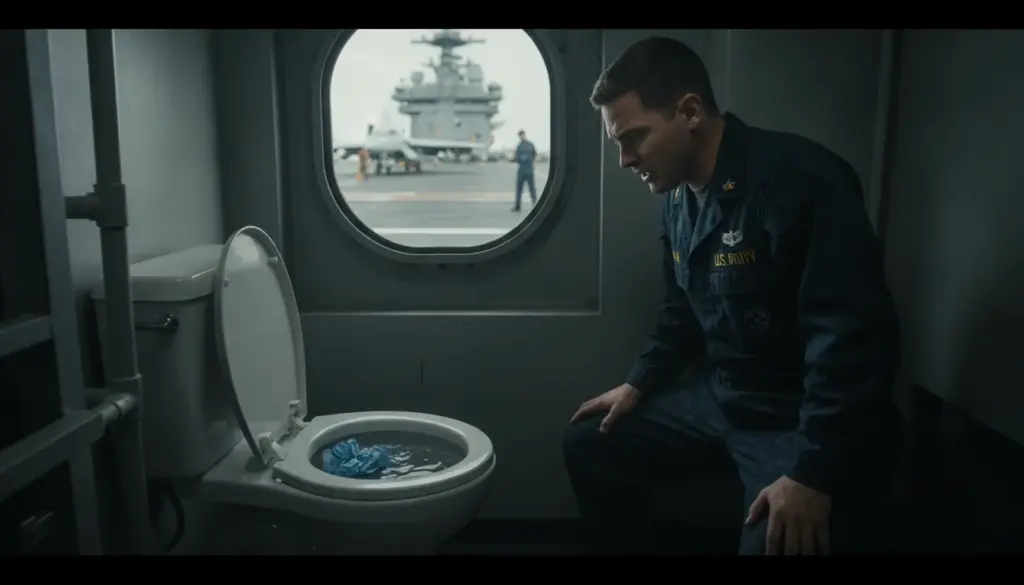
And yet, a toilet keeps running. Or refuses to flush at all.
Sailors frequently find themselves staring at out-of-order bathroom doors while maintenance crews puzzle over diagnostic screens showing false positives. On this multi-billion-dollar vessel, an incredibly basic human necessity simply refuses to cooperate.
The Danger of Unlimited Budgets and Uncharted Waters
Marketed as the ultimate flagship for a modern era, the USS Gerald R. Ford promised smaller crews, heavier firepower, and smarter technology. Engineers optimized everything from the flight deck down to the galleys. At least, that was the theory.
Out on the open ocean, sailors and repair teams are slowly discovering the painful limits of this futuristic vision. The most frustrating reality hits in a place rarely discussed during official briefings: the bathrooms. When 4,500 people live, eat, and sleep on the exact same vessel, plumbing failures escalate from minor annoyances to daily morale killers.
Instead of relying on the rugged, traditional plumbing used in older carriers, designers opted for an ultra-modern vacuum system. Modeled after the technology found in commercial airliners and luxury cruise ships, this digitally controlled network relies on intricate valves, pumps, and sensors. In blueprints, it looked brilliantly efficient and space-saving.
However, reality proved this setup to be exceptionally fragile. A minor clog, a slightly sharp pipe bend, or incorrect usage can knock out entire bathroom blocks across the ship. Official maintenance logs revealed that fixing these blockages sometimes required specialized industrial flushing procedures. The price tag for clearing out these pipes? Millions of dollars per deep clean. Naturally, taxpayers and oversight committees find this pill incredibly hard to swallow.
What This Plumbing Saga Reveals About Megaprojects
How exactly does a project with endless funding and years of development end up with faulty plumbing? The root cause lies in the “first-in-class” development mentality. Because the Ford-class was a blank-slate design, naval architects wanted everything to be smarter and fully digitized. They aimed for massive technological leaps rather than safe, incremental steps. This brings immense prestige, but guarantees massive growing pains.
Software developers understand that version 1.0 is always buggy. But this isn’t a smartphone application; it’s a nuclear-powered military installation. By choosing a largely untested, ship-wide sanitation network, every bathroom break essentially became part of a massive beta test. And out in the middle of the ocean, you can’t just run to a local hardware store for replacement pipes.
This bathroom debacle offers more than just a humorous talking point. It perfectly illustrates how mundane, everyday features frequently become the Achilles’ heel of highly complex engineering feats. While politicians focus heavily on next-generation missiles and radar, nobody wins awards for designing reliable sewage pumps or easily accessible pipes.
Fixing the Flaws Behind the Scenes
Yet, these unglamorous details dictate the daily reality for the crew. A glitch in advanced radar software is rare and largely invisible to most personnel. Conversely, a toilet that backs up multiple times a week destroys morale. It fundamentally shifts the mood on board, eroding pride and trust in the vessel.
During early deployments, prolonged plumbing outages forced sailors to wait in massive lines for the few functioning stalls. Makeshift bathroom schedules and cynical jokes quickly spread through the ranks. Observers naturally began asking a very valid question: how can a military launch precision weapons across continents, yet fail to maintain working bathrooms on its crown jewel?
Behind closed doors, engineering task forces are working overtime to rectify these design flaws. Teams are actively remapping pipe networks and pushing out software patches to improve sensor accuracy. The military is acutely aware that every sanitation breakdown hands free ammunition to critics of inflated defense budgets.
Congressional oversight reports have specifically highlighted the shocking maintenance costs tied to this vacuum infrastructure. Spending millions on chemical flushes over the ship’s lifespan adds up to a staggering financial burden. Paying 13 billion dollars for a carrier, only to spend millions just to flush the toilets—that is a soundbite guaranteed to dominate headlines.
Valuable Lessons from a Military Misstep
Surprisingly, this naval blunder mirrors challenges faced in almost every modern workplace. Massive corporations frequently fall in love with the newest, most integrated digital systems. But the frontline workers tasked with using these tools usually want something entirely different: unbreakable reliability and straightforward simplicity.
This situation highlights a crucial design principle: build for everyday reality, not just the presentation room. This means rigorously testing hardware with actual users in chaotic environments. Designers must move beyond asking if something is technically possible and start asking if a night-shift mechanic can easily fix it at 3:00 AM.
Let’s be realistic: nobody wants to study a thick technical manual before using the restroom. On a vessel packed with thousands of young recruits, demanding flawless user behavior is a terrible design strategy. If a system only functions perfectly when humans make zero mistakes, the system itself is inherently flawed.
Today, defense officials are noticeably more cautious when discussing groundbreaking innovations. There is a renewed focus on incremental upgrades and applying the hard-learned lessons from the Ford. One official perfectly summarized the situation during a congressional hearing:
“You cannot introduce a brand-new hull, a new flight deck, new catapults, new power grids, and a completely new plumbing system all at once and expect perfection. We simply crammed too many first-time technologies into a single ship.”
While painful to admit, that realization provides healthy guidelines for future development:
- Concentrate on one or two major technological leaps per project, rather than overhauling everything simultaneously.
- Stick to proven, reliable mechanisms for basic human needs like water, air, and sanitation.
- Involve end-users early in the design phase to anticipate maintenance hurdles.
- Set aside substantial budgets for inevitable early-stage glitches, particularly in hidden infrastructure.
- Run tests in messy, real-world scenarios rather than sterile laboratory conditions.
A Floating City Reflecting Our Own World
An aircraft carrier might seem entirely disconnected from civilian life, but the underlying dynamics are universally familiar. It starts with a massive budget, sky-high expectations, and a dazzling presentation full of promises. Then reality sets in, bringing friction, blockages, and minor oversights that trigger massive headaches. An invincible fortress of steel and atomic energy ultimately proves only as resilient as its weakest pipe.
If the world’s most advanced military can misjudge something as basic as a bathroom, we must question how we approach building our schools, hospitals, and smart cities. Perhaps our obsession with “new and improved” blinds us to the practical realities of daily life.
The Ford will sail the oceans for decades to come. Its onboard tech will evolve, structural bugs will be squashed, and new hurdles will inevitably arise. Yet, it serves as a permanent reminder that no amount of funding or technological wizardry can eliminate the basic requirements of human existence. Eating, sleeping, working… and yes, going to the bathroom. Every grand ambition ultimately begins and ends right there.
Frequently Asked Questions
Why did the USS Gerald R. Ford require such a complex bathroom system?
Naval architects designed the Ford-class to operate with a smaller crew inside a highly optimized footprint. A vacuum-based sanitation network saves space, reduces water consumption, and was theorized to be incredibly efficient for thousands of onboard sailors. While it made logical sense on paper, real-world execution proved far more delicate and complex than anticipated.
How much does it actually cost to fix these plumbing failures?
Government oversight reports indicated that extensive deep-cleaning operations for the vacuum pipes cost millions of dollars per flush out. While not a daily expense, these specialized maintenance routines add up to a massive financial burden over the ship’s planned lifespan. It stands as a prime example of how hidden design flaws lead to astronomical long-term costs.
Have the bathroom problems been completely resolved?
Military representatives state that many early-stage glitches have been successfully addressed. Reliability is slowly improving as engineers tweak the hardware and the crew learns how to live with the sensitive setup. However, it remains a heavily monitored issue in ongoing evaluations, proving that early design flaws on first-in-class vessels can linger for years.
Why did this specific story gain so much media attention?
The sheer contrast is captivating: a multi-billion-dollar symbol of military might struggling with a mundane household task. This vast disconnect between an intimidating, high-tech warship and a simple clogged pipe captures the public’s imagination. It perfectly symbolizes how incredibly complex megaprojects often trip over the most basic hurdles.
What can ordinary businesses learn from this naval oversight?
Always prioritize basic functionality. Avoid the temptation to over-engineer areas where simple durability gets the job done better. Bring actual users into the design process early on, test everything under chaotic real-world conditions, and pay just as much attention to unglamorous infrastructure as you do to flashy new features. Massive failures routinely start with ignored, everyday details.