
The Return of Velocity: Breaking Records Without the Sonic Boom
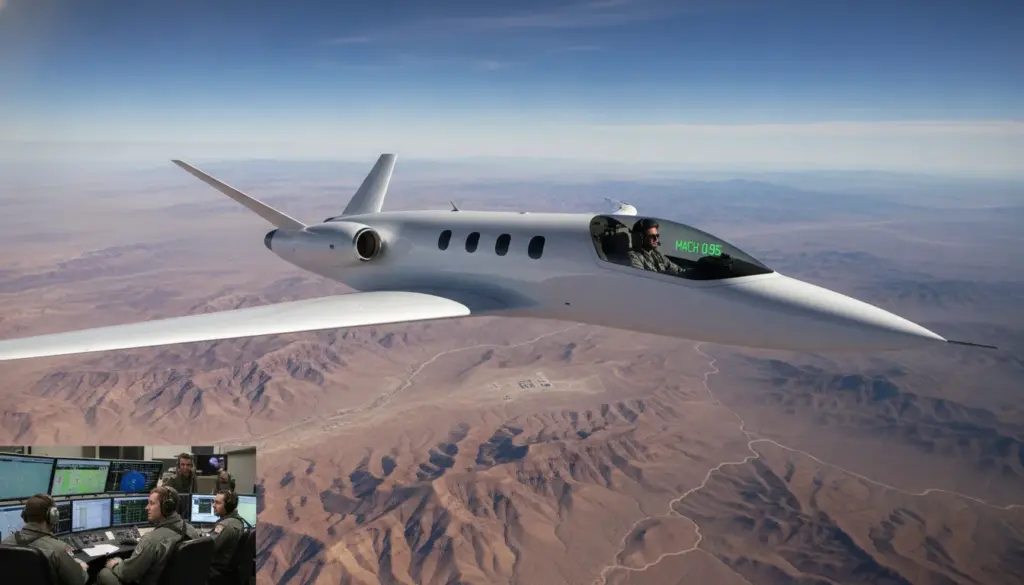
High above the arid American desert on a muted Tuesday morning, a sleek white aircraft pierced the thin atmosphere at an altitude of 12,000 meters. Inside the flight deck, a seasoned test pilot sat perfectly still, his focus locked on the digital display as the numbers steadily climbed: Mach 0.93… 0.94… 0.95. Down on the ground, mission control fell into a tense silence that felt like an eternity. Suddenly, the radio cracked with a cool, collected update: “We’ve just hit point nine five. Stable. All green.”
A collective wave of applause erupted from the small engineering team below, momentarily stunned by their monumental achievement. In a delicate balance between the golden era of the Concorde and today’s climate-aware landscape, a completely different type of aviation milestone was just established.
A quiet revolution is currently sweeping through the aerospace industry, led by a visionary aircraft builder setting their sights on creating the fastest subsonic jet in the world. While the iconic Concorde belongs to the history books, achieving Mach 0.95 today feels incredibly fast. Resting just below the sound barrier, this velocity represents a massive leap forward for commercial flight.
Instead of choosing between sluggish commercial airliners and impossible sci-fi concepts, this breakthrough carves out a practical middle ground. It delivers high-speed travel that remains financially viable and grounded in aerodynamic reality.
During a rigorous recent testing phase, this streamlined business jet—featuring incredibly slender wings and a razor-sharp nose profile—sustained Mach 0.95 multiple times. This allowed engineers to gather crucial flight data without relying on sheer brute force or generating disruptive sonic booms. The result is an aircraft that operates with profound, quiet efficiency.
Preliminary calculations suggest that a cross-country flight within the United States could be slashed by 45 minutes. For lengthier intercontinental journeys, travelers could save nearly an hour and a half. This isn’t theoretical conjecture; it is actionable flight planning.
So, why is Mach 0.95 such a critical threshold? In the realm of aerodynamics, approaching Mach 0.9 creates a massive wall of drag. Pushing slightly faster typically requires an astronomical amount of additional fuel. The Concorde bypassed this by using raw power to break through into supersonic territory. This modern generation employs a far more calculated strategy: flying as close to that invisible aerodynamic wall as physically possible without smashing through it.
The secret lies in obsessive engineering optimizations. Endless wind tunnel sessions refined the wing architecture, while the engines feature exquisitely tuned air intakes. Advanced flight software actively smooths out minor airflow disruptions in real-time, proving that this milestone is the result of countless hard-working hours rather than engineering magic.
Designing a Record-Breaker Without Repeating Past Mistakes
The engineering team behind this marvel didn’t simply ask how to outpace the competition. Their foundational question was highly practical: how can a modern business jet fly as fast as physically possible without adopting the crippling costs and operational hazards of a supersonic plane? That singular focus guided the redesign of every single component.
They opted for a fuselage that is notably longer and narrower than traditional jets in the same class, paired with highly swept wings. The futuristic tail section isn’t just for aesthetics; its design was birthed directly from complex computational fluid dynamics simulations. Every inch of this machine is built to push just a little harder and fly just a bit further.
Anyone who flies frequently knows the frustration of landing early, only to sit on the tarmac for twenty minutes waiting for an open gate. Recognizing that wasted ground time plagues the aviation sector, the manufacturer incorporated comprehensive “door-to-door” travel scenarios into their strategic pitches for diplomats, performers, and executives.
Imagine a route from New York to London taking just over five hours, factoring in the time spent on the ground. A Dubai to Paris connection now effortlessly fits into a hectic CEO’s single-day itinerary. This isn’t achieved through supersonic flight, but rather by maximizing current airspace regulations and flight corridors at a blistering Mach 0.95.
The underlying logic is brilliantly straightforward. Supersonic civilian aircraft inevitably crash into three massive hurdles: extreme noise pollution, excessive fuel burn, and regulatory nightmares. By gliding just underneath that very first barrier, this record-breaking jet sidesteps the headache entirely. There are no shattered windows from sonic booms, no need for sweeping new aviation laws, and no requirement for massive airport overhauls.
It is the ultimate strategy of a tactical sprinter: holding back just enough to avoid penalties, while accelerating at the perfect moment. By hugging the edge of the sound barrier without crossing it, the manufacturer can boast a world record while simultaneously assuring private operators that this technology is ready for immediate deployment.
What This High-Speed Shift Means for Everyday Travelers
For the average passenger stepping aboard, flying at Mach 0.95 won’t feel like a radical thrill ride. You won’t experience intense cabin pressure changes or dramatic takeoff forces. Instead, the true magic reveals itself when you check your watch upon arrival. While the manufacturer is initially targeting the premium business jet sector, these cutting-edge advancements historically trickle down to larger commercial fleets. Industry insiders suggest keeping a close eye on the cruise speeds of upcoming commercial models.
Where technical specifications once proudly displayed Mach 0.82 or 0.84, several manufacturers are quietly creeping past the 0.9 mark. While not every plane will hit 0.95 immediately, the industry-wide shift has undoubtedly begun. Raw speed is officially returning as a major selling point.
Marketing teams might be tempted to label this aircraft as the “next Concorde,” but that comparison is inherently flawed. You won’t be jetting from Paris to New York in three and a half hours. Overpromising supersonic travel times will only lead to disappointment when passengers “only” shave an hour off their journey.
The smartest approach is embracing the aircraft for exactly what it is: a revolutionary machine pushing the top tier of business aviation into an entirely new normal, completely free from the operational blunders of the past. Naturally, we can expect flashy promotional materials featuring cabin champagne and cruising at flight level 45,000. But realistically, nobody expects to commute like that every single day.
Beneath the glossy marketing campaigns lies a deeply genuine ambition. As the company’s CEO noted during the official record announcement: “We cannot resurrect the Concorde. However, we can reclaim the valuable time lost over the last two decades. Speed represents true progress, as long as it isn’t pursued blindly.”
Internal company documents neatly outline the core advantages of this new design:
- Faster cruising capabilities without triggering new noise pollution regulations
- Highly proven engine tech, specially modified for peak efficiency above Mach 0.9
- Superior cabin pressurization and passenger comfort that rivals or beats current luxury jets
- Foundational stepping-stone technology paving the way for quieter, more fuel-efficient airliners
This strategic list reveals the broader picture: breaking records generates great press, but the ultimate prize is establishing the foundational standards for tomorrow’s aviation landscape.
Transitioning from Nostalgia to High-Speed Reality
It is quite fascinating that while the public continues to fantasize about silver darts crossing the Atlantic in three hours, this specific flight record feels remarkably mature. There are no outlandish promises of supersonic commercial routes for the masses, nor any wild techno-utopian dreams. Instead, we see an aviation builder confidently stating they have achieved Mach 0.95, and are now meticulously evaluating its practical applications for daily operations.
For the dedicated frequent flyer, clawing back an hour per trip can mean the difference between agonizing burnout and a manageable work-life balance. Aviation enthusiasts can celebrate a rare instance where raw speed captures the headlines without simultaneously igniting fierce environmental backlash. For aerospace engineers, it serves as quiet validation that immense potential still exists within conventional designs, provided you are willing to analyze and refine a wing structure a hundred times over.
Several major questions do remain unanswered. Will this impressive technology eventually scale up to accommodate massive commercial airliners? Will tightening sustainability regulations stifle the pursuit of faster travel, or will they actually force the industry to develop hyper-efficient, high-speed alternatives? And on a purely human level, how fast do we truly need to travel when the hours spent inside an aircraft cabin are often our last remaining moments of digital disconnection?
The Concorde thrived on pure, unadulterated spectacle. This modern record, however, thrives on calculated nuance. It delivers a gentle recalibration of what we consider a “normal” cruising speed, devoid of any explosive sonic booms. Somewhere between the slow commercial liners of today and the supersonic dreams of yesterday, the next era of global aviation is being forged—right around the Mach 0.95 mark.
Frequently Asked Questions (FAQ)
Is this new aircraft supersonic like the Concorde?
No, it intentionally remains just below the sound barrier. The aircraft cruises up to Mach 0.95, whereas true supersonic flight begins right around Mach 1. This strategic choice makes it significantly faster than standard civilian jets while completely avoiding the disruptive sonic boom.
How much actual travel time will passengers save?
On extensive long-haul journeys, travelers can expect to shave off roughly an hour or slightly more. For shorter regional routes, the time saved drops to a few dozen minutes. The most substantial benefit lies in the ability to tightly schedule back-to-back corporate trips.
Will this high-speed technology eventually reach standard commercial flights?
It will likely happen at a gradual pace. The business jet sector frequently acts as an advanced testing ground for the broader industry. Once this technology proves to be fully reliable and economically viable, various aerodynamic elements will inevitably be integrated into future passenger airliners.
Doesn’t flying faster inherently harm the environment?
Cruising at higher velocities typically demands more fuel per mile traveled, though these penalties are partially mitigated by cutting-edge aerodynamic enhancements. The aerospace sector is currently locked in a complex debate regarding the delicate balance between saving passenger time and managing carbon emissions.
When will ordinary travelers be able to board a Mach 0.95 jet?
The initial production models are strictly tailored for the luxury business jet market and private charter operators. Consequently, early access to these remarkable speeds will be limited to private ownership or shared corporate travel, rather than standard commercial airline routes.