
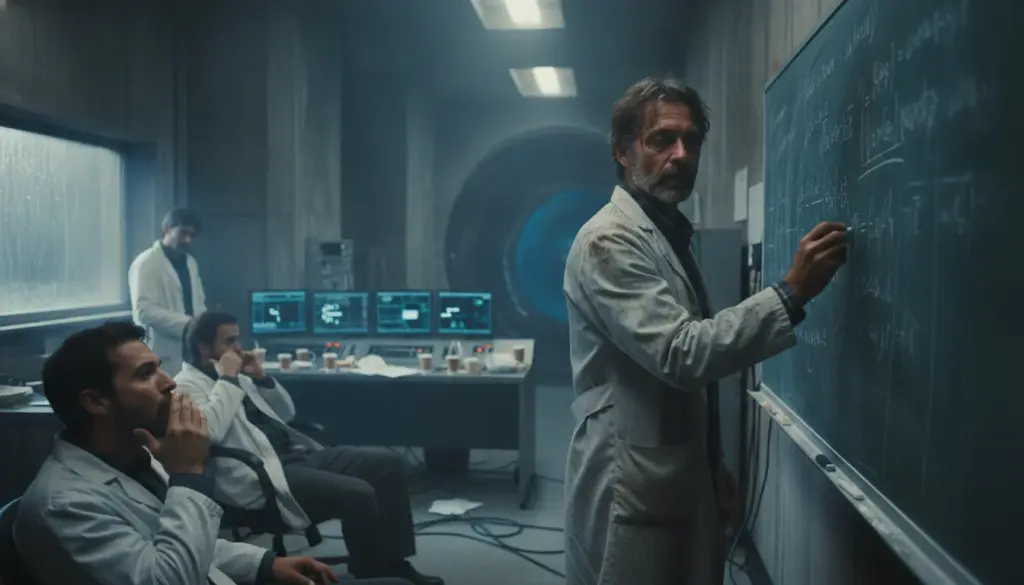
Picture a massive detector buried deep underground in Italy. The price tag hits the hundreds of millions, yet the results yield “no definitive proof.” You can hear someone whistling through their teeth—a mix of awe and pure disbelief. Up at the front of the room, a tired researcher scratches a simple equation onto a chalkboard. He carries that specific exhaustion that only comes from pulling all-nighters for months on end just to capture a single measurement. While rain hammers against the windows, the conversation inside revolves around dark matter, quantum foam, and so-called “impossible” setups that get greenlit anyway.
Then, he drops the ultimate truth bomb: we are mostly testing our own limits, and yes, your tax dollars are footing the bill. A heavy silence falls over the crowd.
Why We Pour Millions Into Experiments That Yield ‘Nothing’
The harsh truth about physics in 2025 is that many spectacular mega-projects seemingly fail. They produce no novel particles and no sudden breakthroughs, just increasingly strict boundaries on what is scientifically impossible. On paper, that reads as frustratingly dull. If you are casually scrolling through your news feed, you naturally want to see the word “breakthrough” rather than “no signal detected.”
Yet, the scientific field is thriving like never before. Inside ultra-cold freezers chilling at nearly -273 degrees Celsius, superconducting qubits vibrate softly. Complex laser systems carve intricate patterns into freezing atoms, while satellites hunt for gravitational waves we might never actually detect. It occasionally feels like a massive gamble with public funds. However, behind every disappointing null result lies a universe that slowly comes into sharper focus.
Look at the relentless hunt for dark matter. For years, dedicated teams have been constructing hyper-sensitive detectors deep inside abandoned mines or beneath mountains just to block out interfering cosmic rays. Every single upgrade costs tens of millions. Still, we have zero hard evidence. There is no magical eureka moment or sudden particle discovery to validate our reigning theories. The logical reaction might be to pull the plug, but this is exactly where the science gets truly fascinating.
These apparent failures act as crucial markers on a map, telling us exactly where the answers aren’t hiding. Theoretical physicists are essentially forced to tear down their elegant models and start from scratch. Meanwhile, experimental teams push their sensor technology to borderline insane levels of precision. Back in 2000, certain mass ranges were entirely beyond our measurement capabilities, but today we can rule them out with surgical accuracy. It might not look like a dazzling fireworks display, but it is the foundational heavy lifting required to build our understanding of reality.
How ‘Failed’ Experiments Actually Reshape Our World
One of the most concrete examples lies in the hardware surrounding colossal particle accelerators. Throughout the 2010s and 2020s, engineers built detectors and electronics for CERN’s Large Hadron Collider that had to meet completely absurd specifications. These intricate circuits needed to survive extreme heat, intense radiation, and mind-boggling speeds without dropping a single bit of data. This was never strictly just “for science.”
Out of sheer necessity, those demanding requirements birthed advanced medical imaging techniques, lightning-fast industrial sensors, and the upgraded security scanners you walk through at airports. Nobody puts that on the front page when a particle search is officially deemed a dud. Yet, that advanced technology quietly infiltrates our daily routines through the back door. Suddenly, a doctor can spot a tumor much earlier, all thanks to a microscopic chip originally engineered for a “disappointing” physics run.
We are seeing the exact same pattern unfold in 2025. Research groups tackling complex quantum setups—systems that constantly threaten to collapse from minor vibrations, thermal leaks, or background noise—are currently engineering the most delicate measurement tools humanity has ever possessed. Take gravity sensors that monitor microscopic fluctuations in the gravitational field. Today, scientists test them to detect dark energy; tomorrow, those exact same devices could warn us of impending volcanic eruptions or locate hidden underground water reserves. The leap from esoteric, niche research to practical daily application often takes just a few years. The catch is that you only ever see the connection in hindsight.
Where Your Money Truly Goes – And What You Get Out of It
If you want to understand where the physics budget actually vanishes, you have to look past the headline-grabbing megaprojects. Behind every astronomical installation, there are hundreds of smaller, uncelebrated side quests. It is a dedicated team fabricating a cutting-edge cryopump. It is a brilliant doctoral student coding an algorithm to scrub background noise from messy datasets. It is a technician who fine-tunes a laser until it literally stops vibrating.
Those tiny details are where the real magic happens. Anyone who has physically stepped foot inside a laboratory knows it looks absolutely nothing like the pristine, glowing 3D renders you see in media reports. You will find tangled cables everywhere, MacGyver-style fixes held together with duct tape, and half-empty coffee mugs resting dangerously close to million-dollar hardware. In that beautifully chaotic environment, researchers forge the exact tools that eventually dominate the telecom, industrial, and medical sectors. One optimized error-correction algorithm meant for a quantum computer could easily end up powering the hyper-efficient encryption on your smartphone a decade down the line.
The biggest trap for casual observers—and, frankly, for politicians holding the purse strings—is fixating solely on the final scientific goal. Did they find the particle, yes or no? Is it a historic breakthrough, or just another “insignificant signal”? That binary perspective completely ignores how scientific inquiry actually sustains itself. A failed test run mandates unbridled creativity, fresh engineering designs, and the rigorous testing of novel materials. That isn’t some romanticized fairy tale; it is simply the gritty reality of how technical progress happens when the cameras are turned off.
We have all experienced that fleeting thought: why do “they” dump so much cash into this when we face so many immediate, earthly crises? That frustration is completely valid. However, the history of physics is unapologetically clear. Massive leaps forward rarely emerge from projects boasting a neatly polished corporate business plan. Decades ago, lasers were openly mocked as “solutions desperately seeking a problem.” From Wi-Fi and GPS to MRI machines, almost every modern convenience we take for granted sprouted from pure curiosity about things nobody explicitly asked for. In 2025, we are merely repeating that historical cycle with dark matter, gravitational waves, and quantum networking serving as our modern testing grounds.
“A failed experiment is only truly a failure if you pretend the only acceptable outcome is a standing ovation,” a veteran theoretical physicist recently shared with me. “In reality, the entire playing field shifts—you just see the scoreboard, while we watch the actual board change.”
That sounds poetic, but there is genuine tension lingering behind those words. Today’s scientists feel immense pressure to pitch their work as immediately “useful.” Grant applications are practically overflowing with bold promises regarding climate change, health, and national security. And yes, sometimes those claims are significantly overblown. Yet, that intense pressure yields one surprisingly positive side effect: modern laboratories think far more proactively about commercial spin-offs and corporate partnerships. Ideas that used to sit dormant on whiteboards for years are now rapidly transformed into working prototypes.
- Massive experimental failures act as rapid filters for terrible ideas.
- Innovative measurement techniques almost always find a practical, real-world application.
- The rigorous data analysis demanded by physics drastically improves modeling in economics and climatology.
- International mega-projects serve as unparalleled training grounds for future generations of engineers.
- You only really notice the technology once it “just works” flawlessly in your everyday life.
Let’s be brutally honest: nobody actually sits down daily to trace every single euro of foundational research back to a tangible discount on their energy bill or a specific hospital visit. Even so, it happens continuously over the span of years. The ultimate payoff is beautifully diffuse, yet undeniably real. That is exactly why funding science often feels like jumping into the deep end without a life vest—you don’t see the resulting ripples until they finally wash ashore much later.
What These ‘Costly Failures’ Reveal About Society
When you scroll through the staggering budgets assigned to major physics endeavors, you are essentially reading a societal moral statement. We remain willing to invest tens of thousands of human hours into decoding mysteries that offer absolutely no immediate financial return. What is the true nature of gravity? How did time itself begin? Why does the universe appear wildly out of balance, yet continue to function flawlessly? Those aren’t questions for venture capitalists; they are deeply existential human inquiries.
Even so, the specific focus areas of 2025 heavily reflect our modern anxieties. We are seeing a massive surge in projects dedicated to climate modeling, next-generation energy storage, and revolutionary battery materials. Physics is slowly pivoting away from merely asking “how does reality work?” to urgently asking “how do we keep this planet habitable?” The dividing line between foundational theory and applied mechanics is blurring fast. Investigating room-temperature superconductors is simultaneously a philosophical puzzle and a hyper-practical necessity. If we finally crack it, our entire global energy grid transforms overnight. If it fails ten times in a row, at least we know exactly which blind alleys to avoid.
The core question regarding what we are actually paying for in 2025 isn’t really “what specific discovery will we get?” It is much broader: “how much room are we leaving for human curiosity?” To what extent are we gifting future generations the luxury of a robust knowledge base that wasn’t built exclusively out of sheer panic or corporate greed? That might sound incredibly lofty, but every single budget hearing, every heated debate over a new telescope, and every national quantum agenda serves as a localized referendum on that very concept.
Perhaps the most profound discovery of our modern era is simply learning to navigate uncertainty as our default state. There is no singular, explosive eureka moment waiting for us—just a relentless, exhausting series of microscopic shifts. We get newly defined limits, vastly improved sensors, discarded theories, and highly unexpected applications hidden inside mundane tech. Because of this, physics in 2025 often acts more like a mirror than a high-powered telescope. It forces us to ask: how much of the unknown can we tolerate, and what are we truly willing to spend on answers that might never be fully resolved?
Somewhere right now, buried deep inside a subterranean lab, an incredibly expensive machine is running a test that will probably find absolutely “nothing.” Yet, thousands of brilliant minds will meticulously scrutinize that resulting data graph. They aren’t looking for flashy fireworks. They know that every pocket of silence in the data whispers something vital about how the gears of reality actually interlock. That is the ultimate gamble we fund as a society—one whose true jackpot we might not fully comprehend for another twenty years.
Frequently Asked Questions
- Why do we keep funding expensive experiments that find “nothing”? Because every absence of a signal sharpens our scientific boundaries, corrects flawed theories, and routinely sparks revolutionary new technologies, even if the benefits aren’t visible for decades.
- Are we wasting money on physics when there are urgent global crises? Only a microscopic fraction of global budgets actually goes toward fundamental research. The deep knowledge and advanced tech born from these projects frequently underpin the very solutions we need for energy, health, and climate issues.
- How do I actually experience the results of this research in my daily life? You see it constantly through sharper medical scanners, blazing-fast electronics, highly secure communications, pinpoint GPS accuracy, and advanced materials that originally spawned from so-called “useless” experiments.
- Are scientists genuinely honest about their failures? Inside peer-reviewed academic journals, absolutely. Negative results and newly established boundaries are highly prized. However, those nuanced stories often vanish in mainstream media because the word “breakthrough” simply generates more clicks.
- Is it still worth studying physics in 2025? Without a doubt. You don’t just learn the fundamental laws of nature; you master complex data analysis, advanced programming, predictive modeling, and razor-sharp critical thinking. These are highly coveted skills that translate seamlessly into almost any industry, far beyond the confines of a traditional laboratory.